阿摩線上測驗
登入
首頁
>
轉學考-質能均衡
> 103年 - 103 淡江大學 轉學考 質能均衡#53167
103年 - 103 淡江大學 轉學考 質能均衡#53167
科目:
轉學考-質能均衡 |
年份:
103年 |
選擇題數:
0 |
申論題數:
9
試卷資訊
所屬科目:
轉學考-質能均衡
選擇題 (0)
申論題 (9)
(a) 3 weeks to milliseconds. (5%)
(b) 38.1 ft/s to miles/h. (5%)
(c) 554 m
4
/(day.kg) to cm
4
/(min.g). (5%)
(d) 32 lbftoN. (5%)
(a) Calculate the ratio (lb-mole O
2
react/lb-mole NO formed). (5%)
(b) If ammonia is fed to a continuous reactor at a rate of 100.0 kmol NH3/I1, what oxygen feed rate (kmol/h) would correspond to 40.0% excess O
2
? (5%)
(c) If 50.0 kg of ammonia and 100.0 kg of oxygen are fed to a batch reactor, determine the limiting reactant (5%), the percentage by which the other reactant is in excess (5%), and the extent of reaction (mol) (5%) and mass of NO produced (kg) if the reaction proceeds to completion (5%).
3. The Reynolds number is a dimensionless group defined for a fluid flowing in a pipe as Re = Duplfi where D is pipe diameter, u is fluid velocity, p is fluid density, and fj, is fluid viscosity. When the value of the Reynolds number is less than about 2100, the flow is laminarthat is, the fluid flows in smooth streamlines. For Reynolds numbers above 2100, the flow is turbulent, characterized by a great deal of agitation. Liquid methyl ethyl ketone (MEK) flows through a pipe with an inner diameter of 2.067 inches at an average velocity of 0.48 ft/s. At the fluid temperature of 20°C the density of liquid MEK is 0.805 g/cm and the viscosity is 0.43 centipoise [ 1 centipoise = 1 cP = 1.00✖ 10
-3
kg/(m-s)]. Determine whether the flow is laminar or turbulent. Show your calculations. (25%)
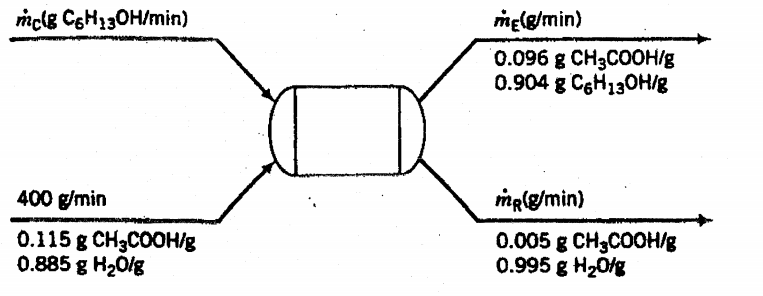
【已刪除】4. Liquid extraction is an operation used to separate the components of a liquid mixture of two or more species. In the simplest case, the mixture contains two components: a solute (A) and a liquid solvent (B). The mixture is contacted in an agitated vessel with a second liquid solvent (C) that has two key properties: A dissolves in it, and B is immiscible or nearly immiscible with it. (For example, B may be water, C a hydrocarbon oil, and A a species that dissolves in both water and oil.) Some of the A transfers from B to C, and then the B-rich phase (the raffinate) and the C-rich phase (the extract) separate from each other in a settling tank. If the raffinate is then contacted with fresh C in another stage, more A will be transferred from it. This process can be repeated until essentially all of the A has been extracted from the B. Shown below is flowchart of a process in which acetic acid (A) is extracted from a mixture of acetic acid and water (B) into 1 -hexanol (C), a liquid immiscible with water.
Calculate
E, and
R, using the given mixture feed rate as a basis and writing balances in an order such that you never have an equation that involves more than one unknown variable. (25%)
相關試卷
101年 - 101 淡江大學 轉學考 質能均衡#53232
101年 · #53232
99年 - 99 淡江大學 轉學考 質能均衡#55757
99年 · #55757
97年 - 97 淡江大學 轉學考 質能均衡#55763
97年 · #55763
95年 - 95 淡江大學 轉學考 質能均衡#55930
95年 · #55930
93年 - 93 淡江大學 轉學考 質能均衡#55981
93年 · #55981
91年 - 91 淡江大學 轉學考 質能均衡#56118
91年 · #56118
 阿摩線上測驗
登入
阿摩線上測驗
登入
 Calculate
 E, and
  R, using the given mixture feed rate as a basis and writing balances in an order such that you never have an equation that involves more than one unknown variable. (25%)