阿摩線上測驗
登入
首頁
>
國中會考基測◆英語科
> 104年 - 104年國中基測英文科閱讀試題#21292
104年 - 104年國中基測英文科閱讀試題#21292
科目:
國中會考基測◆英語科 |
年份:
104年 |
選擇題數:
40 |
申論題數:
0
試卷資訊
所屬科目:
國中會考基測◆英語科
選擇題 (40)
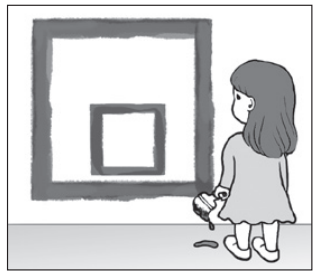
1. Look at the picture. The girl drew two ______ on the wall.
(A) circles (B) lines (C) points (D) squares
2. This dress is pretty, ______it does not look good on me. (A) so (B) but (C) or (D) if
3. Getting up early on a cold morning is not easy, ______? (A) are you (B) do you (C) does it (D) is it
4. Tonight I’ll stay at the office until I ______ the work. (A) finish (B) am finishing (C) finished (D) will finish
5. Charles ______ a day in the department store looking for a hat for his wife. (A) cost (B) spent (C) saw (D) made
6. Tom ______ ten pounds over the past two months. He looks much thinner now. (A) loses (B) has lost (C) will lose (D) was losing
7. I don’t like any one of these three watches. Can you show me ______ one? (A) the others (B) other (C) either (D) another
8. The waiters are asked to be ______ ; they should always smile and remember to say “Welcome” and “Please.” (A) honest (B) polite (C) special (D) strong
沒有 【段考】國二英文 權限,請先開通.
10. No one thought James would appear at Katie’s party. So when he ______ , everyone was surprised and could not believe their eyes. (A) would (B) was (C) had (D) did
11. B&J Café ______ known as the tallest building in town. However, O&G Restaurant became the tallest building in 2010. (A) has been (B) had been (C) is (D) would be
12. Actor David Piper became tired of talking about the movie ______ after he was interviewed about it many times. (A) he is famous (B) that he is famous (C) that is famous for (D) he is famous for
13. (A) got better (B) been warm (C) changed a lot (D) become wet and cold
14. (A) made two plans for you (B) worried about your trip to here (C) decided to take you to a nice place (D) prepared everything you’ve asked for
15. (A) we’ll agree with each other (B) don’t worry if it rains (C) we all love animals very much (D) don’t forget to check the weather
16. (A) we cannot really call it a neighbor (B) we do not know anything about it yet (C) we might not be able to stay there for long (D) we are not sure how long it takes to get there
17. (A) What’s more, it is not water that makes HD189773b look blue (B) With its blue color, HD189773b could be a second Earth for us (C) Except for its blue color, HD189773b is nothing like our home planet (D) Because of its blue color, people guess there might be life on HD189773b
18. (A) gives us hope (B) took hard work (C) has changed our life (D) helps us know more about Earth
19. On the order list, Ginny ordered a sandwich with cheese, a fruit milk shake, and a fruit drink without ice. How much did she have to pay for her food? (A) $300.(B)320. (C) $385. (D) $410.
20. Ginny wants to go to Howell’s Bowl again during Joy Time. When will she possibly go there? (A) 11:00 a.m. on Wednesday. (B) 2:30 p.m. on Monday. (C) 8:00 p.m. on Friday. (D) 10:00 p.m. on Thursday.
21. What question did the teacher most likely ask in class? (A) “What do you want to do in the future?” (B) “What’s your plan for the coming vacation?” (C) “What do you like to talk about with your friends?” (D) “What’s your favorite thing to do with your family?”
22. What do we know from the reading? (A) Lily is good at making clothes. (B) One of Bill’s parents is an animal doctor. (C) Ryan enjoys meeting people on the Internet. (D) Anna was once very sick and stayed in the hospital for a long time.
23. What does them mean? (A) Pets. (B) Books. (C) Stories. (D) Parents.
24. What does it mean when someone is lousy at something? (A) They are famous for it. (B) They cannot do it well. (C) They think it is important. (D) They are not interested in it.
25. What can we learn from the preface? (A) How Foster started his own restaurant. (B) When Foster’s father married Foster’s mother. (C) What Foster’s mother taught him about cooking. (D) How Foster learned the art of cooking from his father.
26. Below are the cards which four kids have taken since they began the game. Who has won the game? (A) Anna:
→
→
. (B) Kate:
→
→
. (C) Billy:
→
→
. (D) Ivan:
→
→
.
27. What can we learn about the game? (A) One can never begin his turn from Lion King. (B) The cards can be used to decide who goes first. (C) One can never get to Light Church at the first turn. (D) The cards can be used to decide where to start the game.
28. What does The idea mean in the reading? (A) Water is important in one’s everyday life. (B) Water is not just about one’s everyday needs. (C) It is nice to have a cool bath on a hot summer day. (D) We should not take a bath when there is little water.
29. What is the reading mostly about? (A) Why it is important to save water. (B) How water may give a country power. (C) How water may play a part in one’s future. (D) Why it is hard to get water in poor countries.
30. What do we know from the reading? (A) Children in poor countries die from drinking dirty water every day. (B) Girls who spend little time at school have a harder life when they grow up. (C) Girls in countries like Tanzania are often paid less for the same job than the boys are. (D) Children from poor families are often kept from school to take care of younger children.
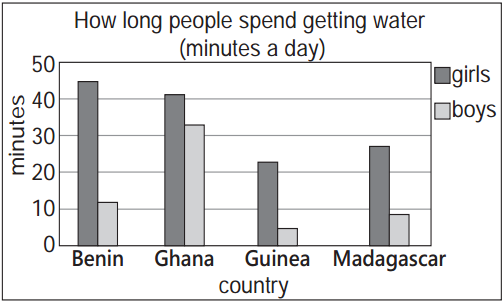
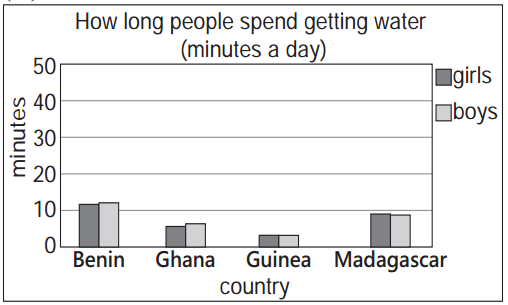
31. Families in the countries of Benin, Ghana, Guinea and Madagascar deal with the job of water-collecting the same way Tanzanian families do. From the reading, which chart best shows the fact? chart 圖表(A)
(B)
(C)
(D)
32. What is Garden House? (A) A bakery. (B) A gift shop. (C) A flower shop. (D) An apartment.
33. What can we learn about Keith? (A) He forgot to meet Amber and Matt for lunch. (B) He did not know how to get to Amber’s apartment. (C) He called Amber without knowing her phone was not working. (D) He did not know Amber left him a voice message this morning.
34. Which sentence was most likely part of the message that Amber left Keith this morning? (A) “Matt and I will go to the party after lunch.” (B) “Don’t forget to buy a birthday gift for Liz.” (C) “You can go straight to the party from your office.” (D) “I need to talk to you about the party this weekend.”
35. What lesson can we learn from Froggie’s story? (A) Life is too short; one should live it to the fullest. (B) Those who use their time well will win in the end. (C) People are blind to problems that slowly get worse over time. (D) It is difficult to give up old habits, but easy to pick up new ones.
36. What do we know about Froggie? (A) He learned to share what he liked with others. (B) He thought what he had hoped for became real. (C) He once almost lost a dear friend to a water snake. (D) He wanted to go back to the same pot for a hot bath.
37. What does it mean when someone is in a calamitous state? (A) They have serious trouble. (B) They try to change themselves. (C) They are looking for a second chance. (D) They lost interest in the outside world.
38. What can we learn about the church-goers from the report? (A) Between 1980 and 2005, few church-goers were younger than 50. (B) In 2010, only 6% of church-goers were younger than 50 years old. (C) In 2020, the percentage (%) of church-goers drops to lower than half that in 1980. (D) Between 1980 and 2020, the rising number of old church-goers has led to an old church.
39. What is talked about in the report? (A) Where the church’s money goes. (B) How people decide to join a church. (C) What happens to churches that are closed. (D) Why people have stopped going to church.
40. Below are four findings from other reports. Which does NOT agree with the idea of the report? (A) “Reports show over 90% of church-goers go to church because their fathers do. In the last 20 years, 49% of men under 30 have left the church. That means there’s a 90% chance that their children won’t go to church. This is hard for the church to take in.” (B) “Between 2003 and 2010, over 1,000 new churches were built in the country. This may sound like good news. During the same years, however, more than 2,000 were closed.” (C) “In the report, 33% of the people that were interviewed say they never go to church and another 33% say they used to. Only 15% go to church at least once a month.” (D) “Of the 15 countries in the report, the percentage (%) of church-goers in some countries, like Denmark, is lower than 10%; in others, like Poland, the percentage is higher than 70%.”
申論題 (0)
相關試卷
115年 - 115 國中教育會考:英語(閱讀)#139897
115年 · #139897
114年 - 114 國中教育會考:英語#127080
114年 · #127080
113年 - 113 國中教育會考:英文#119932
113年 · #119932
112年 - 112 國中教育會考(大陸考場):英語#116363
112年 · #116363
112年 - 112 國中教育會考:英語科閱讀#114327
112年 · #114327
111年 - 111 國中教育會考(補考):英文科閱讀試題#120729
111年 · #120729
111年 - 111 國中教育會考:英語#108035
111年 · #108035
110年 - 110年會考補考英文科#99216
110年 · #99216
110年 - 110年會考英語#98873
110年 · #98873
109年 - 109 國中教育會考(補考):英文科#86423
109年 · #86423
 阿摩線上測驗
登入
阿摩線上測驗
登入
 (A) circles
(B) lines
(C) points
(D) squares
(A) circles
(B) lines
(C) points
(D) squares
 →
→  →
→ . (B) Kate:
  →
→  (B)
(B) 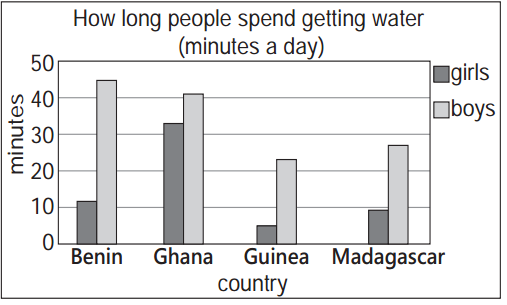 (C)
(C)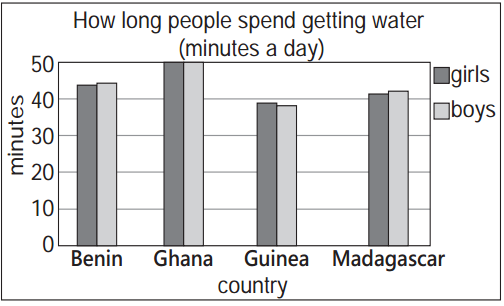 (D)
(D)