所屬科目:研究所、轉學考(插大)◆化工動力學
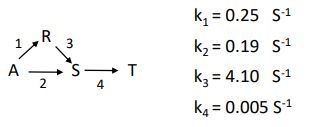
1. Consider the following elementary reactions: What temperature progression and reactor types would you recommended if the desired product is: (a) R, (b) S, (c) T, and (d) U. (20%)
2. Monobutylphthalate and butanol react in the presence of H2SO4 forming dibutylphthalate and water. Reaction can be carried out in the continuous stirred tank reactor (CSTR). The reactants are placed in two separate tanks containing 0.4 mol/liter of monobutylphthalate and 2 mol/liter of butanol and fed to the reactor under 10 liter/h and 30 liter/h, respectively. The reactants are mixed before entering the reactor. The reaction rate constant is k = liter/(mol.min). Calculate the CSTR volume when conversion is 60%. (Reaction rate expression: (20%)
3. Enzyme E catalyze the fermentation of substrate A to product R. Find the size of the continuous stirred tank reactor (CSTR) needed for 90% conversion of A in a feed stream (20 liter/min) of A (1 mol/liter) and enzyme. The kinetics of the fermentation at this enzyme concentration are given by (20%)
4. A liquid phase reaction A → R + S takes place in a system consisting of a CSTR and a plug flow reactor (PFR) with recycle. One introduces 2 kmol/m3 of reagent A into the first reactor (CSTR). Both CSTR and PFR operate isothermally at 400oC and atmospheric pressure. The volume of the first reactor is 0.086 m3 and the inlet flow is 3.2 m3/ks. The conversion at the outlet of the PFR is 90%. It is a first-order reaction and the reaction rate is (-rA) = 8 CA kmol/(m3.h). Calculate the PFR volume considering a recycle ratio of R = 1. (20%)
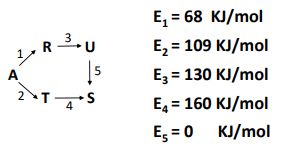
5. Consider the following elementary reactions: What reactor type gives the maximum yield of S? Roughly estimates this yield and the fractional conversion of A which will give this yield. (20%)
 阿摩線上測驗
登入
阿摩線上測驗
登入
 liter/(mol.min). Calculate the CSTR volume when conversion is 60%. (Reaction rate expression:
  (20%)
(20%)