所屬科目:研究所、轉學考(插大)◆普通化學
1. Which of the following is a non-metal?(A) K(B) Mg(C) Hg(D) I(E) Bi
2. Which of the following ions occurs commonly?(A) Br²⁺(B) S⁶⁺(C) Ca²⁻(D) O²⁻(E) K⁻
3. What are the approximate mass ratios of carbon to hydrogen in ethene?(A) 1:1(B) 1:2(C) 2:1(D) 1:4(E) 6:1
4. What is the mass in grams of NaCl in 500 mM of NaCl solution in 100 mL?(A) 2.925 g(B) 29.25 g(C) 1.170 g(D) 1170 g(E) 0.005 g
5. When 5.22 g of solid Na₂CO₃ is dissolved in water to make 250 mL of solution, what is the concentration of Na₂CO₃?(A) 0.197 M(B) 0.049 M(C) 20.8 M(D) 0.41 M(E) 0.282 M
6. What is the oxidation number of chlorine in Cl2?(A) -1(B) 0(C) +1(D) +7(E) -7
7. What is the oxidation number of Cl in KClO4?(A) -1(B) 0(C) +1(D) +7(E) -7
8. Identify the reducing agent in the following redox reaction.MnO4- + NO2¯ ⇌ Mn2+ + NO3¯(A) MnO4-(B) NO2-(C) H2O(D) O2(E) None of above
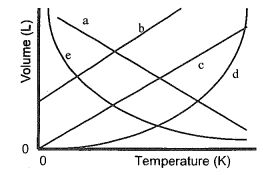
9. Which of the lines on the figure below is the best representation of the relationship between the volume of a gas and its absolute temperature, other factors remaining constant?
(A) a(B) b(C) c(D) d(E) e
10. A helium-filled balloon has a volume of 15.8 L at a pressure of 0.980 atm and 22°C. What is its volume at the mountain, where the atmospheric pressure is 0.700 atm and the temperature is 1°C?(A) 50.2 L(B) 1.0 L(C) 20.5 L(D) 0.075 L(E) 75 L
11. The shape of an atomic orbital is associated with(A) the principal quantum number (n).(B) the angular momentum quantum number (l).(C) the magnetic quantum number (ml).(D) the spin quantum number (ms).(E) the magnetic and spin quantum number, together.
12. Which of the following is a correct set of quantum numbers for an electron in a 3d orbital?(A) n=3, l=0, ml=-1(B) n=3, l=1, ml=+3(C) n=3, l=2, ml=3(D) n=3, l=3, ml=+2(E) n=3, l=2, ml=-2
13. Select the correct electron configuration for Cu (Z=29).(A)[Ar]4s²3d⁹(B) [Ar]4s¹3d¹⁰(C) [Ar]4s²4p⁶3d3(D) [Ar]4s²4d9(E) [Ar]5s²4d9
14. Which of the following is a covalent compound?(A) Cl₂O(B) Na₂O(C) CaCl₂(D) CsCl(E) Al₂O₃
15. In the electron configuration [Ar] 4s²3d¹º4p⁴, which are valence electrons?(A) All of the electrons after the [Ar](B) Only the 4s² electrons(C) Only the 3d¹º electrons(D) Only the 4p⁴ electrons(E) Both the 4s² and the 4p⁴ electrons
16. Which of the following period 3 chlorides would be expected to have the highest melting point?(A) MgCl₂(B) AlCl₃(C) SiCl₄(D) PCl₃(E) SCl₂
17. How many electron pairs are shared between the carbon atoms in C₂H₄?(A) 5(B) 4(C) 3(D) 2(E) 1
18. What is the molecular shape of CO₃²⁻?(A) Trigonal planar(B) Trigonal pyramidal(C) T-shaped(D) Bent(E) Square pyramidal
19. Predict the smallest actual bond angle in BrF₃ using the VSEPR theory.(A) Less than 90°(B) Exactly 120°(C) Between 109° and 120°(D) Between 90° and 109°(E) More than 120°
20. According to valence bond theory, which orbitals on N and H overlap in the NH3?(A) 2p on N overlaps with 2s on H(B) 2p on N overlaps with 1s on H(C) 2s on N overlaps with 1s on H(D) sp³ on N overlaps with sp on H(E) sp³ on N overlaps with Is on H
21. Name the period 3 element with the following ionization energies (kJ/mol).(A) Mg(B) Al(C) Si(D) P(E) S
22. Rank the ions in each set in order of decreasing size(A) K+>S²¯ >Cl(B) S²¯ >Cl>K+(C) Cl >K+> S²-(D) K+>Cl>S2-(E) Cl¯ > S²¯ >K+
23. Rank the bonds in order of decreasing bond strength: S-F, S-Br, S-Cl(A) S-F>S-Br>S-Cl(B) S-CI>S-Br>S-F(C) S-Br>S-CI>S-F(D) S-F>S-Cl>S-Br(E) S-Br>S-F>S-Cl
24. Excluding cyclic compounds, how many isomers exist for C4H6?(A) 2(B) 3(C) 4(D) 5(E) 6
25. Use bond energies to find the enthalpy of reaction:C=C = 614 kJ/mol; C-H = 413 kJ/mol; H-Br = 363 kJ/mol; C-C = 347 kJ/mol; C-Br = 276 kJ/mol(A) 767 kJ/mol(B) 354 kJ/mol(C) -59 kJ/mol(D) -354 kJ/mol(E) 0 kJ/mol
26. What is the correct name for the following compound?(A) 1,1,3-triethyl-2-methylbutane(B) 3-ethyl-4,5-dimethylheptane(C) 1,1-diethyl-2,3-dimethylpentane(D) 2,4-diethyl-3-methylhexane(E) None of the above
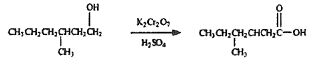
27. Select the correct reaction type for the following process.(A) Addition(B) Elimination(C) Carbonylation(D) Dehydration(E) Oxidation
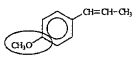
28. Identify the functional group circled:(A) Aldehyde(B) Ketone(C) Alcohol(D) Ether(E) Ester
29. Each amino acid has two functional groups in common and one of 20 other groups attached to the α-carbon. The two functional groups are:(A) Carboxyl and amine(B) Carbonyl and amine(C) Carboxyl and amide(D) Carbonyl and amide(E) Amine and amide
30. The secondary structure, helical and sheet-like segments, in proteins arise from(A) Hydrogen bonding(B) Disulfide bridges(C) Salt bridges(D) Crosslinking via covalent bonds(E) Dispersion forces within the protein's interior
31. What types of forces exist between molecules of CO2?(A) Hydrogen bonding only(B) Dispersion forces only(C) Hydrogen bonding and dispersion forces(D) Dipole-dipole forces only(E) Dipole-dipole and dispersion forces
32. The strongest intermolecular interactions between CH3CH2OH molecules arise from:(A) Dipole-dipole forces(B) London dispersion forces(C) Hydrogen bonding(D) Ion-dipole interactions(E) Carbon-oxygen bonds
33. What volusm of concentrated (14.7 M) phosphoric acid is needed to prepare 25 L of 3 M H3PO4?(A) 0.2 L(B) 0.57 L(C) 1.8 L(D) 3.6 L(E) 5.1 L
34. Which of the following oxides will give the most basic solution when dissolved in water?(A) SO2(B) CO2(C) K2O(D) P4O10(E) SO3
35. Which of the following oxides will give the most acidic solution when dissolved in water?(A) MgO(B) Al2O3(C) Cl2O(D) SrO(E) H2O2
36. A chemical reaction has an equilibrium constant of 6x10°. If this reaction is at equilibrium, select the one correct conclusion that can be made about the reaction.(A) The forward and back reactions have stopped(B) The limiting reactant has been used up(C) The forward and reverse rate constants are equal(D) The forward and reverse reaction rates are equal(E) None of the above conclusions is correct
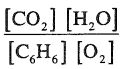
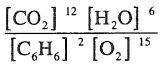
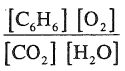
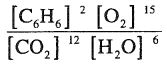
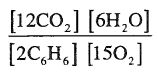
37. Write the mass-action expression, QC, for the following chemical reaction equation: 2C6H6(g) + 15O2(g) ⇌ 12CO2(g) + 6H2O(g)(A)(B)(C)(D) (E)
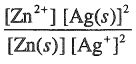
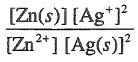
38. Write the mass-action expression, Qe, for the following chemical reaction.Zn(s) + 2Ag+(aq) ⇌ Zn2+(aq) + 2Ag(s)(A) (B)(C)(D)(E)
39. When the following redox equation is balanced with smallest whole number coefficients, the coefficient for zinc will be___________.Zn(s) + ReO4- (aq) → Re(s) + Zn2+(aq) (acidic solution)(A) 1(B) 2(C) 4(D) 7(E) 8
40. What is the E°cell for the cell represented by the combination of the following half-reactions?(A) -0.18 V(B) 0.18 V(C) 1.28 V(D) 1.66 V(E) 2.12 V
 阿摩線上測驗
登入
阿摩線上測驗
登入
 (A) Mg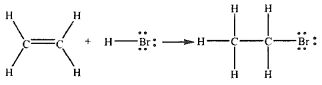
 (A) Addition
 (A) Aldehyde