阿摩線上測驗
登入
首頁
>
OJCP(SCJP)
>
104年 - SCJP 151-200#99330
> 申論題
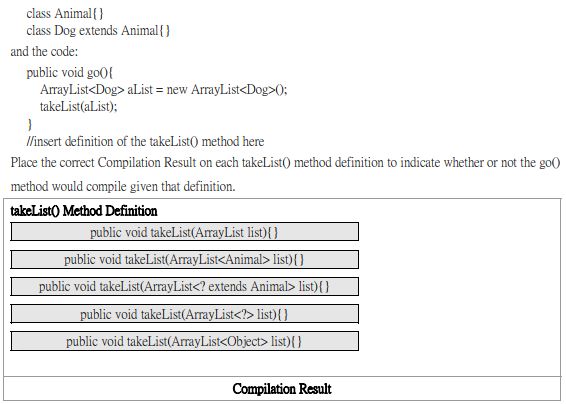
182. Given the class definitions:
相關申論題
183. Place the code in the appropriate places such that this program will always output [1, 2].
#415286
184. Place each Collection Type on the statement to which it applies.
#415287
188. Given a pre-generics implementation of a method: 11. public static int sum(List list){ 12. int sum = 0; 13. for(Iterator iter = list.iterator(); iter.hasNext();){ 14. int i = ((Integer)iter.next()).intValue(); 15. sum += i; 16. } 17. return sum; 18. } What three changes allow the class to be used with generics and avoid an unchecked warning? (Choose three.) (A) Remove line 14. (B) Replace line 14 with "int i = iter.next();". (C) Replace line 13 with "for(int i : intList){". (D) Replace line 13 with "for(Iterator iter : intList){". (E) Replace the method declaration with "sum(List<int> intList)". (F) Replace the method declaration with "sum(List<Integer> intList)".
#415288
191. Given: 11. //insert code here 12. private N min, max; 13. public N getMin() { return min; } 14. public N getMax() { return max; } 15. public void add(N added) { 16. if(min == null || added.doubleValue() < min.doubleValue()) 17. min = added; 18. if(max == null || added.doubleValue() > max.doubleValue()) 19. max = added; 20. } 21. } Which two, inserted at line 11, will allow the code to compile? (Choose two.) (A) public class MinMax<?>{ (B) public class MinMax<? extends Number>{ (C) public class MinMax<N extends Object>{ (D) public class MinMax<N extends Number>{ (E) public class MinMax<? extends Object>{ (F) public class MinMax<N extends Integer>{
#415289
199. Given: 10. interface A{void x();} 11. class B implements A{public void x(){} public void y(){}} 12. class C extends B{public void x(){}} And: 20. java.util.List<A> list = new java.util.ArrayList<A>(); 21. list.add(new B()); 22. list.add(new C()); 23. for(A a : list){ 24. a.x(); 25. a.y(); 26. } What is the result? (A) The code runs with no output. (B) An exception is thrown at runtime. (C) Compilation fails because of an error in line 20. (D) Compilation fails because of an error in line 21. (E) Compilation fails because of an error in line 23. (F) Compilation fails because of an error in line 25.
#415290
(1)
#415291
(2)
#415292
(3)
#415293
(4)
#415294
(5)
#415295
相關試卷
104年 - SCJP 201-244#99410
104年 · #99410
104年 - SCJP 51-100#99391
104年 · #99391
104年 - SCJP 151-200#99330
104年 · #99330
104年 - SCJP 1-50#41416
104年 · #41416
無年度 - SCJP 6.0 認證教戰手冊第二版 SCJP 6.0 認證教戰手冊第二版 認證教戰手冊第二版_題庫 201-244#83084
#83084
無年度 - SCJP 6.0 認證教戰手冊第二版 SCJP 6.0 認證教戰手冊第二版 認證教戰手冊第二版_題庫 151-200#83081
#83081
無年度 - SCJP 6.0 認證教戰手冊第二版 SCJP 6.0 認證教戰手冊第二版 認證教戰手冊第二版_題庫 101-150#83070
#83070
無年度 - SCJP 6.0 認證教戰手冊第二版 SCJP 6.0 認證教戰手冊第二版 認證教戰手冊第二版_題庫 51-100#83056
#83056

 阿摩線上測驗
登入
阿摩線上測驗
登入
阿摩線上測驗
登入
阿摩線上測驗
登入