所屬科目:研究所、轉學考(插大)-經濟學
1. Suppose a tax of $2 per unit is imposed on this market. What will be the new equilibrium quantity in this market? (A)less than 50 units (B) 50 units (C) between 50 units and 100 units (D)greater than 100 units
2. Suppose a tax of $2 per unit is imposed on this market. How much will sellers receive per unit after the tax is imposed? (A) $3 (B) between $3 and $5 (C) between $5 and $7 (D) $7
3. Suppose a tax of $2 per unit is imposed on this market. How much will buyers pay per unit after the tax is imposed? (A) $3 (B) between $3 and $5 (C) between $5 and $7 (D) $7
4. Suppose a tax of $2 per unit is imposed on this market. Which of the following is most close to the true answer? (A) One-fourth of the burden of the tax will fall on buyers, and three-fourths of the burden of the tax will fall on sellers. (B) One-third of the burden of the tax will fall on buyers, and two-thirds of the burden of the tax will fall on sellers. (C) One-half of the burden of the tax will fall on buyers, and one-half of the burden of the tax will fall on sellers. (D) Three-fourths of the burden of the tax will fall on buyers, and one-fourth of the burden of the tax will fall on sellers.
5. A binding price floor will reduce a firm's total revenue (A) always. (B) when demand is elastic. (C) when demand is inelastic. (D) never.
6. Suppose a tax of $0.50 per unit on a good creates a deadweight loss of $100. If the tax is increased to $2.50 per unit, the deadweight loss from the new tax would be (A) $500. (B) $1,000. (C) $2,000. (D) $2,500.
7. If the tax on a good is increased from $1 per unit to $4 per unit, the deadweight loss from the tax increases by a factor of (A) 5. (B) 9. (C) 16. (D) 24.
8. A 10 percent increase in gasoline prices reduces gasoline consumption by about (A) 6 percent after one year and 2.5 percent after five years. (B) 2.5 percent after one year and 6 percent after five years. (C) 10 percent after one year and 20 percent after five years. (D) 0 percent after one year and 1 percent after five years.
9. The federal government is concerned about the negative effects of cigarette smoking in the United States. Suppose Congress is considering two plans. One plan would limit the production of cigarettes. The other would require manufacturers to include graphic photos on cigarette packages of people suffering cancer's effects. Which of the following statements is true? (A) Both programs would increase the price of cigarettes. (B) Both programs would reduce the quantity of cigarettes sold. (C) Both programs would decrease revenues for cigarette manufacturers. (D) All of the above are correct.
10. Assume for the United States that the opportunity cost of each airplane is 50 cars. Which of these pairs of points could be on the United States' production possibilities frontier? (A) (200 airplanes, 5,000 cars) and (150 airplanes, 4,000 cars) (B) (200 airplanes, 12,500 cars) and (150 airplanes, 15,000 cars) (C) (300 airplanes, 15,000 cars) and (200 airplanes, 25,000 cars) (D) (300 airplanes, 25,000 cars) and (200 airplanes, 40,000 cars)
11. Consider Frank's decision to go to college. If he goes to college, he will spend $21,000 on tuition, $11,000 on room and board, and $1,800 on books. If he does not go to college, he will earn $16,000 working in a store and spend $7,200 on room and board. Frank's total cost of going to college is (A) $33,800. (B) $42,600. (C) $49,800. (D) $57,000
12. Regarding Harry and Darby, for whom have sandwiches a normal good? (A) only for Harry (B) only for Darby (C) for both Harry and Darby (D) This cannot be determined from the given information
13. Suppose x = 1. Then it must be true that (A) Harry and Jake have the same income, which is lower than Darby's income. (B) if sandwiches and potato chips are complements for Harry, then those two goods are also complements for Jake. (C) Harry's demand curve is identical to Jake's demand curve. (D) All of the above are correct.
14. Suppose x = 1. Then the slope of the inverse market demand curve is (A) -3. (B) -1/3. (C) 1/3. (D) 3.
15. Suppose Harry, Darby, and Jake are the only demanders of sandwiches and that the market demand violates the law of demand.Then, in the table, the value of x must be (A) less than or equal to 5. (B) greater than or equal to 5. (C) greater than or equal to 7. (D) greater than or equal to 10.
16. For a monopolist, marginal revenue is (A) positive when the demand effect is greater than the supply effect. (B) positive when the monopoly effect is greater than the competitive effect. (C) negative when the price effect is greater than the output effect. (D) negative when the output effect is greater than the price effect.
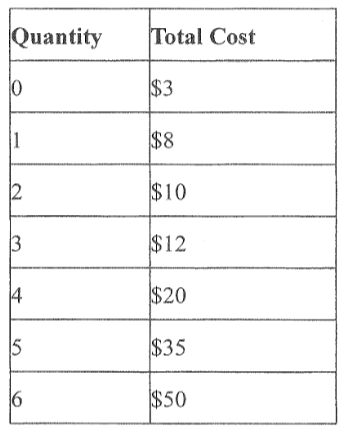
17. Consider the following table for a competitive firm. What is the lowest price at which this firm would operate in the short run? (A) $3. (B) $4. (C) $5. (D) $6.
18. A study sponsored by the Food Consumer Safety Board found that consumption of irradiated tomatoes increased the health of laboratory rats. As a result of national press coverage of the report, the demand for irradiated tomatoes increased dramatically. Organic farmers were able to switch from organic production of tomatoes to irradiated production with no additional cost. Assume that the tomato market satisfies all of the assumptions of perfect competition. As a result of the increase in the demand for tomatoes, we would predict that in the short run that the (A) production of tomatoes would be at efficient scale. (B) price of tomatoes would rise. (C) total cost for existing irradiated tomato producers must rise. (D) number of firms in the market would fall as prices fall and firms exit the market.
19. As in question 18, if the increased production of irradiated tomatoes caused a rise in the marginal transportation costs of moving irradiated tomatoes to market, the (A) short-run market supply curve for irradiated tomatoes would be affected but not the long-run market supply. (B) long-run market supply curve for irradiated tomatoes would be perfectly elastic. (C) long-run market supply of irradiated tomatoes would be downward sloping. (D) long-run market supply of irradiated tomatoes would be upward sloping.
20. Abe owns a dog; the dog's barking annoys Abe's neighbor, Jenny. Suppose that the benefit of owning the dog is worth $200 to Abe and that Jenny bears a cost of $400 from the barking. Assuming Abe has the legal right to keep the dog, a possible private solution to this problem is that (A) Jenny pays Abe $150 to give the dog to his parents who live on an isolated farm. (B) Abe pays Jenny $350 for her inconvenience. (C) Jenny pays Abe $300 to give the dog to his parents who live on an isolated farm. (D) There is no private transaction that would improve this situation.
21. An internet radio broadcast is (A) excludable and rival in consumption. (B) excludable and not rival in consumption. (C) not excludable and rival in consumption. (D) not excludable and not rival in consumption.
22. Contractionary monetary policy (A) leads to disinflation and makes the short-run Phillips curve shift right. (B) leads to disinflation but leave the short-run Phillips curve unchanged. (C) leads to disinflation and makes the short-run Phillips curve shift left. (D) does not lead to disinflation but makes the short-run Phillips curve shift left.
23. If there is a temporary adverse supply shock, then the short-run Phillips curve shifts to the (A) right. It remains to the right regardless of monetary policy. (B) right. It remains to the right if the central bank pursues expansionary monetary policy. (C) left. It remains to the left regardless of monetary policy. (D) left. It remains to the left if the central bank pursues expansionary monetary policy.
24. Other things the same, if Taiwan residents chose to travel overseas less due to concerns about the safety of foreign travel, then in the open-economy macroeconomic model (A) the domestic equilibrium real interest rate will increase, and the equilibrium real exchange rate will increase. (B) the domestic equilibrium real interest rate will decrease, and the equilibrium real exchange rate will decrease. (C) the domestic equilibrium real interest rate will increase, and the equilibrium real exchange rate may increase, decrease, or remain unchanged. (D) the domestic equilibrium real interest rate will decrease, and the equilibrium real exchange rate may increase, decrease, or remain unchanged.
25. Other things the same, if foreign residents desired to purchase more Taiwan rice and Taiwan residents buy more US bonds, then in the open-economy macroeconomic model (A) the domestic equilibrium real interest rate will increase, and the equilibrium net export amount will increase. (B) the domestic equilibrium real interest rate will increase, and the equilibrium net export amount will decrease. (C) the domestic equilibrium real interest rate will decrease, the equilibrium net export amount will increase. (D) the domestic equilibrium real interest rate will decrease, and the equilibrium net export amount will decrease.
26. You eat either apples or oranges every day, and have negatively-sloped demand functions of apples and oranges. If apples are on sales, your demand for (A) apples will increase. (B) apples will decrease. (C) oranges will increase. (D) oranges will decrease.
27. In past decade, Taiwanese have chosen to cook less at home and eat more at restaurants. This change in behavior, by itself, has (A) reduced measured GDP. (B) not affected measured GDP. (C) increased measured GDP by the value of the restaurant meals. (D) increased measured GDP by the value added by the restaurant's preparation and serving of the meals.
28. Suppose the government increases her expenditures which are totally financed by the increase of taxes. In the short run, what happens to the real interest rate, the price level, and real GDP? (A) the real interest rate increases, the price level increases, and real GDP rises. (B) the real interest rate falls, the price level increases, and real GDP rises. (C) the real interest rate increases, the price level falls, and real GDP rises. (D) the real interest rate increases, the price level increases, and real GDP falls.
29. As in question 28, what happens to the real interest rate, the price level, and real GDP in the long run? (A) the real interest rate increases, the price level increases, and real GDP rises. (B) the real interest rate falls, the price level increases, and real GDP unchanged. (C) the real interest rate increases, the price level falls, and real GDP rises. (D) the real interest rate increases, the price level increases, and real GDP unchanged.
30. In the short run, the change in price expectations created by the stock market boom will make (A) the price level increase and real GDP rise. (B) the price level increase and real GDP fall. (C) the price level fall and real GDP rise. (D) the price level fall and real GDP fall.
31. In the long run, the change in price expectations created by the stock market boom will make (A) the price level increase and real GDP rise. (B) the price level remain unchanged and real GDP fall. (C) the price level fall and real GDP remain unchanged. (D) the price level and real GDP remain unchanged.
32. Which of the following would raise the price level in both the short and long run? (A) an increase in taxes. (B) an increase in government expenditures. (C) a decrease in the minimum wage. (D) an increase in the capital stock.
 阿摩線上測驗
登入