所屬科目:研究所、轉學考(插大)◆普通化學
1. Which of the following names is a correct one? (A) 2,2,3,5-tetramethylheptane (B) trans-1,2-dimethylethane (C) t-butylethane (D) 2-ethyl-4-tertiary-butylpentane (E) 3-methyl-4-isopropylpentane
2. What will happen if a small amount of hydrochloric acid is added to a 0.1 M solution of HF? (A) Ka for HF will increase. (B) Ka for HF will decrease. (C) The percent ionization of HF will increase. (D) The percent ionization of HF will decrease. (E) The percent ionization of HF will remain unchanged.
3. For the following reaction, \( \text{CO}_{2(g)} + 2\text{H}_2\text{O}_{(g)} \rightleftharpoons \text{CH}_{4(g)} + 2\text{O}_{2(g)} \), \( H^\circ = 803 \text{ kJ} \) which of the following will increase \( K \)? (A) increase volume of system (B) increase the temperature of system (C) decrease number of moles of methane (D) none of the above (E) all of the above
4. In titrating 0.20 M hydrochloric acid, HCl, with 0.20 M NaOH at 25°C, the solution at the equivalence point is (A) very acidic (B) slightly acidic (C) 0.10 M NaCl (D) 0.20 M NaCl (E) 0.10 M HCl and 0.20 M NaOH
5. The following reaction occurs in basic solution: \( \text{Ag}^+ + \text{Cu} \leftrightarrow \text{Ag} + \text{Cu}^{2+} \) When the equation is balanced, the sum of the coefficients is: (A) 3 (B) 4 (C) 5 (D) 6 (E) 7
6. Why does octane have a higher boiling point than ethane, 126°C versus –89°C? (A) Octane contains more double bonds than ethane. (B) Octane has a higher vapor pressure than ethane. (C) Octane exhibits hydrogen bonding and ethane does not. (D) Octane has stronger London dispersion forces than ethane. (E) At least two of the above are correct.
7. Ammonium metavandate reacts with sulfur dioxide in acidic solution as follows (hydrogen ions and H2O omitted): \( x\text{VO}_3^- + y\text{SO}_2 \leftrightarrow x\text{VO}^{2+} + y\text{SO}_4^{2-} \) The ratio \( x : y \) is(A) 1 : 1 (B) 1 : 2 (C) 2 : 1 (D) 2 : 3 (E) 3 : 1
8. Which of the following is a conjugate acid/base pair? (A) \( \text{NH}_4^+/\text{NH}_3 \) (B) \( \text{H}_3\text{O}^+/\text{OH}^- \) (C) \( \text{H}_2\text{SO}_4/\text{SO}_4^{2-} \) (D) \( \text{HCl}/\text{OCl}^- \) (E) more than one of these
9. Consider the molecule: \[ \begin{array}{c} \text{H} \quad \text{H} \quad \text{OH} \\ \text{H} \underset{1}{\text{C}} = \underset{2}{\text{C}} - \underset{3}{\text{C}} - \underset{4}{\text{C}} \equiv \underset{5}{\text{C}} - \text{NH}_2 \\ \text{H} \quad \quad \quad \quad \text{O} \quad \quad \quad \quad 6 \end{array} \] Specify the hybridization of each carbon atom (C-1, C-2, C-3, C-4, C-5 and C-6). (A) \( sp^2 \), \( sp^3 \), \( sp^2 \), \( sp^3 \), \( sp \) and \( sp \) (B) \( sp^2 \), \( sp^3 \), \( sp^2 \), \( sp^3 \), \( sp^2 \) and \( sp^2 \) (C) \( sp^3 \), \( sp^3 \), \( sp^2 \), \( sp^3 \), \( sp^2 \) and \( sp^2 \) (D) \( sp^3 \), \( sp^3 \), \( sp^2 \), \( sp^3 \), \( sp \) and \( sp \) (E) \( sp^2 \), \( sp^2 \), \( sp^3 \), \( sp^2 \), \( sp \) and \( sp \)
10. Which of the following solutions contains the strongest acid? (A) 5.00 M HCN (\( K_a = 6.2 \times 10^{-10} \)) (B) 3.50 M H2C6H6O6 (\( K_{a1} = 7.9 \times 10^{-5} \), \( K_{a2} = 1.6 \times 10^{-12} \)) (C) 2.50 M HC2H3O2 (\( K_a = 1.8 \times 10^{-5} \)) (D) 4.00 M HOCl (\( K_a = 3.5 \times 10^{-8} \)) (E) 1.00 M HF (\( K_a = 7.2 \times 10^{-4} \))
11. The concentration of \( \text{OH}^- \) in a saturated solution of \( \text{Mg(OH)}_2 \) is \( 4.0 \times 10^{-4} \text{ M} \). The \( K_{\text{sp}} \) of \( \text{Mg(OH)}_2 \) is (A) \( 1.3 \times 10^{-10} \) (B) \( 1.6 \times 10^{-11} \) (C) \( 3.2 \times 10^{-11} \) (D) \( 4.8 \times 10^{-12} \) (E) \( 9.6 \times 10^{-12} \)
12. How many milliliters of 15.7 M H2SO4 are needed to prepare 600.0 mL of 0.10 M H2SO4? (A) 0.26 mL (B) 1.9 mL (C) 3.8 mL (D) 4.8 mL (E) 9.4 mL
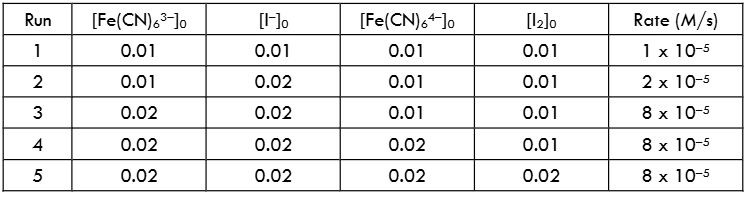
13. Tabulated below are initial rate data for the reaction: \( 2\text{Fe(CN)}_6^{3-} + 2\text{I}^- \leftrightarrow 2\text{Fe(CN)}_6^{4-} + \text{I}_2 \)What is the value of \( k \)?(A) \( 10 \ M^{-2} \ s^{-1} \)(B) \( 10^3 \ M^{-3} \ s^{-1} \)(C) \( 10^7 \ M^{-5} \ s^{-1} \)(D) \( 50 \ M^{-2} \ s^{-1} \)(E) \( 5 \text{ M}^{-3} \text{ s}^{-1} \)
14. The hybridization of the carbon atom in the cation \( \text{CH}_3^+ \) is: (A) \( sp \) hybridized (B) \( sp^2 \) hybridized (C) \( sp^3 \) hybridized (D) \( dsp \) hybridized (E) \( dsp^3 \) hybridized
15. Which of the following groups contains no ionic compounds? (A) HCN, NO2, Ca(NO3)2 (B) PCl5, LiBr, Zn(OH)2 (C) KOH, CCl4, SF4 (D) CH2O, H2S, NH3 (E) NaH, CaF2, NaNH2
16. Which of the following is an incorrect designation for an atomic orbital? (A) 5s (B) 4f (C) 3d (D) 2p (E) 1p
17. You are holding two balloons, an orange balloon and a blue balloon. The orange balloon is filled with neon (Ne) gas and the blue balloon is filled with argon (Ar) gas. The orange balloon has twice the volume of the blue balloon. Which of the following best represents the mass ratio of Ne:Ar in the balloons? (A) 1:1 (B) 2:1 (C) 1:2 (D) 3:2 (E) 2:3
18. What is the simplest formula of a solid containing A, B, and C atoms in a cubic lattice in which the A atoms occupy the corners, the B atoms the body-center position, and the C atoms the faces of the unit cell? (A) ABC (B) ABC3 (C) ABC6 (D) A4BC3 (E) A8BC6
19. In which of the following compounds does N have its maximum oxidation state? (A) NaNO3 (B) NH3 (C) N2O (D) NO2 (E) NO
20. The Cs-131 nuclide has a half-life of 30 years. After 144 years, about 3.0 grams remain. The original mass of the Cs-131 sample is closest to(A) 21 g (B) 42 g (C) 84 g (D) 168 g (E) 336 g
21. Choose the element with the largest electronegativity. (A) P (B) N (C) Bi (D) As (E) Sb
22. Which of the following is the best explanation for how a water softener works? (A) When hard water passes through the softener, the Ca2+ and Mg2+ ions precipitate out as Mg(OH)2 and Ca(OH)2. (B) The softener releases K+ ions to counteract the Ca2+ and Mg2+ ions in the hard water. (C) When hard water passes through the softener, the Ca2+ and Mg2+ ions are removed through electrolysis. (D) The softener releases an acid to interact with the Ca2+ and Mg2+ ions in the hard water to neutralize them. (E) When hard water passes over a resin in the softener, the Ca2+ and Mg2+ ions in the water bind to the resin in place of Na+ ions.
23. You have two salts, AgX and AgY, with very similar \( K_{sp} \) values. You know that \( K_a \) for HX is much greater than \( K_a \) for HY. Which salt is more soluble in acidic solution? (A) AgX(B) AgY (C) Cannot be determined by the information given. (D) They are equally soluble in acidic solution. (E) None of these (A–D).
24. What are the oxidation numbers of each central metal atom in the following coordination compounds of \( \text{K}_3[\text{Fe}(\text{CN})_6] \), \( [\text{Cr}(\text{NH}_3)_4\text{Br}_2]\text{Br} \), \( \text{Na}_2[\text{TaF}_7] \) and \( [\text{Ni}(\text{H}_2\text{O})_6]\text{Cl}_2 \)? (A) 3, −1, 5 and 2 (B) −3, 3, 5 and 2 (C) 3, 3, 5 and 2 (D) −3, 1, 5 and 2 (E) −3, 3, 7 and 2
25. If the equilibrium constant for \( \text{A} + \text{B} \rightleftharpoons \text{C} \) is 0.20, then the equilibrium constant for \( 2\text{C} \rightleftharpoons 2\text{A} + 2\text{B} \) is (A) 25.0 (B) 5.00 (C) 0.20 (D) 0.04 (E) 0.02
 阿摩線上測驗
登入