所屬科目:研究所、轉學考(插大)◆普通化學
1. Which of the following figure(s) represent a result having high precision? (A) Figure I only (B) Figure II only (C) Figure III only (D) Figure I and Figure II (E) Figure I and Figure III
2. You have 100.0 mL of 0.100 M aqueous solutions of each of the following acids: HCN, HF, HCl, and HC2H3O2. You titrate each with 0.100 M NaOH(aq). Rank the pHs of each of the solutions when each are titrated to the equivalence point, from highest to lowest pH. (\( K_a \) for HCN is \( 6.2 \times 10^{-10} \), \( K_a \) for HF is \( 7.2 \times 10^{-4} \), \( K_a \) for HC2H3O2 is \( 1.80 \times 10^{-5} \)). (A) HCN, HC2H3O2, HF, HCl (B) HCN, HC2H3O2, HCl, HF (C) HC2H3O2, HCN, HCl, HF (D) HC2H3O2, HF, HCN, HCl (E) HC2H3O2, HF, HCl, HCN
3. You have two salts, AgX and AgY, with very similar Ksp values. You know that Ka for HX is much greater than Ka for HY. Which salt is more soluble in acidic solution? (A) AgX (B) AgY (C) They are equally soluble in acidic solution. (D) Cannot be determined by the information given. (E) More information is needed to answer this.
4. A hypothetical element consists of two isotopes of masses 70.00 and 72.00 amu with abundances of 25% and 75%, respectively. What is the average atomic mass of this element? (A) 70.50 amu (B) 71.00 amu (C) 71.25 amu (D) 71.50 amu (E) 71.75 amu
5. A scientist obtains the number 0.035006701258 on a calculator. If this number actually has four (4) significant figures, how should it be written? (A) 0.035 (B) 0.0350 (C) 0.03501 (D) 0.035007 (E) 0.0350067
6. Which of the following should have the lowest boiling point? (A) HF (B) N2 (C) NH3 (D) H2O (E) Na2S
7. For the redox reaction \( 2Fe^{2+} + Cl_2 \leftrightarrow 2Fe^{3+} + 2Cl^- \) which of the following observations are the correct half-reactions? I: \( Cl_2 + 2e^- \leftrightarrow 2Cl^- \) II: \( Cl \leftrightarrow Cl^- + e^- \)III: \( Cl_2 \leftrightarrow 2Cl^- + 2e^- \)IV: \( \text{Fe}^{2+} \leftrightarrow \text{Fe}^{3+} + \text{e}^- \) V: \( \text{Fe}^{2+} + \text{e}^- \leftrightarrow \text{Fe}^{3+} \) (A) I and IV (B) I and V (C) II and IV (D) II and V (E) III and IV
8. When a strontium salt is ignited, it burns with a red flame. The frequency of the light given off by this flame is greater than (A) X-rays (B) ultraviolet light (C) infrared light (D) green light (E) yellow light
9. Consider the molecule: \[ \begin{array}{c} \text{H} \quad \text{H} \quad \text{OH} \\ \text{H} \underset{1}{\text{C}} = \underset{2}{\text{C}} - \underset{3}{\text{C}} - \underset{4}{\text{C}} \equiv \underset{5}{\text{N}} \\ \text{H} \quad \quad \quad \quad \text{O} \end{array} \] Specify the hybridization of each carbon atom (C-1, C-2, C-3, C-4 and C-5). (A) \( sp^2 \), \( sp^3 \), \( sp^2 \), \( sp^3 \) and \( sp \) (B) \( sp^2 \), \( sp^3 \), \( sp^2 \), \( sp^3 \) and \( sp^2 \) (C) \( sp^3 \), \( sp^3 \), \( sp^2 \), \( sp^3 \) and \( sp^2 \) (D) \( sp^3 \), \( sp^3 \), \( sp^2 \), \( sp^3 \) and \( sp \) (E) \( sp^2 \), \( sp^2 \), \( sp^3 \), \( sp^2 \) and \( sp \)
10. Bromine exists naturally as a mixture of Br-79 and Br-81 isotopes. An atom of Br-79 contains (A) 34 protons and 35 electrons, only (B) 35 protons, 79 neutrons, and 35 electrons (C) 44 protons, 44 electrons, and 35 neutrons (D) 35 protons, 44 neutrons, 35 electrons (E) 79 protons, 79 electrons, and 35 neutrons
11. Which of the following is not a strong base? (A) KOH (B) LiOH (C) NH3 (D) NaOH (E) Sr(OH)2
12. \( \text{Cu}_2\text{O}_{(s)} + 1/2 \text{O}_{2(g)} \rightarrow 2 \text{CuO}_{(s)} \quad \Delta H^\circ = -144 \text{ kJ} \)\( \text{Cu}_2\text{O}_{(s)} \rightarrow \text{Cu}_{(s)} + \text{CuO}_{(s)} \quad \Delta H^\circ = +11 \text{ kJ} \) Calculate the standard enthalpy of formation of \( \text{CuO}_{(s)} \). (A) \( +155 \text{ kJ} \) (B) \( -155 \text{ kJ} \) (C) \( -166 \text{ kJ} \) (D) \( +299 \text{ kJ} \) (E) \( -299 \text{ kJ} \)
13. How many electrons are involved in pi bonding in benzene? (A) 2 (B) 3 (C) 4 (D) 6 (E) 12
14. Which among the following represent a set of isotopes? Atomic nuclei containing: I: 20 protons and 20 neutrons, II: 21 protons and 19 neutrons, III: 22 neutrons and 18 protons, IV: 20 protons and 22 neutrons, V: 21 protons and 20 neutrons (A) I, V (B) III, IV (C) I, IV and II, V (D) I, II, III (E) No isotopes are indicated.
15. If the equilibrium constant for X + Y↔Z is 0.20, then the equilibrium constant for 2Z↔2X + 2Y is (A) 0.04 (B) 0.40 (C) 2.50 (D) 6.25 (E) 25.0
16. For the reaction 5W + 5X → 2Y + 2Z, at a particular instant in time, the rate of the reaction is 0.0223 M/s. What is the rate of change of W? (A) –0.112 M/s (B) –0.0223 M/s (C) –0.00446 M/s (D) 0.112 M/s (E) 0.00446 M/s
17. An ideal solution is formed from a mixture of the nonvolatile solute urea, CO(NH2)2, and methanol, CH3OH. The vapor pressure of pure methanol at 20°C is 89 mmHg. If 4.5 g of urea is mixed with 40.0 g of methanol, calculate the vapor pressure of the methanol solution. (A) 4.9 mmHg (B) 15 mmHg (C) 74 mmHg (D) 80 mmHg (E) 84 mmHg
18. For the elements Cs, F, and P, the order of increasing electronegativity is: (A) Cs < P < F (B) Cs < F < P (C) P < F < Cs (D) F < Cs < P (E) P < Cs < F
19. Of the following, which molecule has the largest bond angle? (A) H2S (B) HCN (C) OF2 (D) H2O (E) More than one of the above have equally large bond angles.
20. How many moles of hydrogen sulfide are contained in a 49.7 g sample of this gas? (A) 0.69 mol (B) 1.46 mol (C) 2.92 mol (D) 24.7 mol (E) 83.8 mol
21. Which of the following groups contains no ionic compounds (A) PCl5, LiBr, Zn(OH)2 (B) CH2O, H2O, NH3 (C) KOH, CCl4, SF4 (D) NaH, CaF2, NaNH2 (E) HCN, NO2, Ca(NO3)2
22. You have equal masses of different solutes dissolved in equal volumes of solution. Which of the solutes would make the solution having the highest molar concentration? (A) LiOH (B) NaOH (C) KOH (D) KCl (E) KBr
23. Consider three 1-L flasks at STP. Flask A contains NH3 gas, flask B contains NO2 gas, and flask C contains N2 gas. In which flask are the molecules least polar and therefore most ideal in behavior? (A) Flask A (B) Flask B (C) Flask C (D) All are the same. (E) More information is needed to answer this.
24. Which of the following exhibits resonance? (A) NH3 (B) H2O (C) PCl5 (D) O3 (E) H2S
25. The equilibrium constant for the reaction \( \text{NH}_4^+ + \text{OH}^- \leftrightarrow \text{NH}_3 + \text{H}_2\text{O} \) is: (A) \( 1/[\text{K}_b (\text{NH}_3)] \) (B) \( 1/[\text{K}_a (\text{NH}_4^+)] \) (C) \( \text{K}_w/[\text{K}_a (\text{NH}_4^+)] \) (D) \( \text{K}_w/[\text{K}_b (\text{NH}_3)] \) (E) \( [\text{K}_b (\text{NH}_3)]/\text{K}_w \)
 阿摩線上測驗
登入
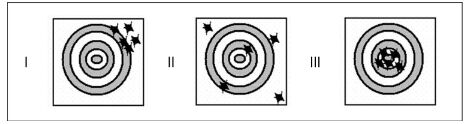 (A) Figure I only (B) Figure II only (C) Figure III only (D) Figure I and Figure II (E) Figure I and Figure III