所屬科目:台大◆化工◆化工熱力學與反應工程
12. Consider a binary mixture in an isolated system at equilibrium. The tempcrature is fixed at 300 K, the equilibrium compositions at different pressures are shown below. At 300K, the saturated pressure of species 1 is 2 bar, and that of species 2 is 1 bar. Please calculate the molar Gibbs energy change on mixing, of this mixture in liquid phase at the equilibrium state at 300 K and 1.72 bar. [15 points]
13. A gas-phase reaction (A →B + C) is found to be irreversible and follows an clementary law. The reaction is performed in a plug-flow reactor isothcrmally at 1000 K and isobarically at 10 atm. The rate constant and activation energy are determined to be 0.1 at 800 K and 40 kJ, respectively. The molar flowrate of A at inlet is 60 mol. Calculate the volume of reactor required to achieve a conversion of 90% for species A. [10 points].
14. A liquid-phase reaction is found to be irrcversible and elementary following the sequence: . The reaction is catalyzed by a solid catalyst in a packed-bed reactor isothermally. The concentration of species A at inlet is 0.005 mol . The volumetric flow rate is 2 L . The rate constants k1 and k2 are 0.1 and 0.001 L , respectively. What is the mass of catalyst to maximizc the concentration of species B? [15 points].
15. For an enzyme-catalyzed reaction, the mechanism can be expressed as follows: and [E]. [S]. [E.S]. ISㆍEㆍS]. and [P] represent the concentrations of enzyme, substrate, enzyme-substrate complex, substrate-enzyme-substrate complex, and product, respectively. The total concentration of enzyme is [Et]. Derive the rate law for generation of product. [10 points].
 阿摩線上測驗
登入
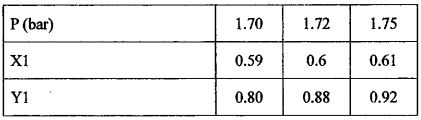
 of this mixture in liquid phase at the equilibrium state at 300 K and 1.72 bar. [15 points]
 at 800 K and 40 kJ
 , respectively. The molar flowrate of A at inlet is 60 mol
 . Calculate the volume of reactor required to achieve a conversion of 90% for species A. [10 points].
 . The reaction is catalyzed by a solid catalyst in a packed-bed reactor isothermally. The concentration of species A at inlet is 0.005 mol
 . The volumetric flow rate is 2 L
 . The rate constants k1 and k2 are 0.1 and 0.001 L
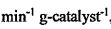 , respectively. What is the mass of catalyst to maximizc the concentration of species B? [15 points].
