所屬科目:研究所、轉學考(插大)◆普通化學
1. Quartz (SiO2) is a solid with a melting point of 1550°C. The bonding in quartz is best describedas(A) covalent bonding. (B) network attractions. (C) ionic bonding. (D) lattice energy.(E) None of these choices is correct.
2. What is the highest oxidation state of chlorine in any of its compounds?(A)+3 (B) +7 (C) +1 (D) -1(E) 0
3. Liquid ammonia (boiling point = -33.4°C) can be used as a refrigerant and heat transfer fluid.How much energy is needed to heat 25.0 g of NH3(l) from -65.0°C to -12.0°C?Specific heat capacity, NH3(l) : 4.7 J/(g · K)Specific heat capacity, NH3(g): 2.2 J/(g · K)Heat of vaporization: 23.5 kJ/molMolar mass, м: 17.0 g/mol(A)5.5 kJ (B) 6.3 kJ (C) 39 kJ (D) 340 kJ(E) None of these choices is correct.
4. Examine the phase diagram for the substance Bogusium (Bo) and select the correct statement.(A)Bo(s) has a lower density than Bo(l).(B) The triple point for Bo is at a higher temperature than the melting point for Bo.(C) Bo changes from a solid to a liquid as one follows the line from C to D.(D) Bo changes from a liquid to a gas as one follows the line from C to D.(E.) None of these choices is correct.
5. A molecule with the formula AX3E uses _________ to form its bonds.(A)s and p atomic orbitals (B) sp hybrid orbitals. (C) sp2 hybrid orbitals(D) sp3 hybrid orbitals(E) None of these choices is correct.
6. According to molecular orbital (MO) theory, the 12 outermost electrons in the O2 molecule aredistributed as follows:(A)8 in bonding MOs, 4 in antibonding MOs.(B) 10 in bonding MOs, 2 in antibonding MOs.(C) 9 in bonding MOs, 3 in antibonding MOs.(D) 12 in bonding MOs, 0 in antibonding MOs.(E.) None of these choices is correct.
7. Calculate the lattice energy of magnesium sulfide from the data given below.Mg(s) → Mg(g) ∆H° = 148 kJ/molMg(g) → Mg2+(g) + 2e ̄ ∆H° = 2186 kJ/molS8(s) → 8S(g) ∆H° = 2232 kJ/molS(g) + 2e ̄ → S2 ̄(g) ∆H° = 450 kJ/mol8Mg(s) + S8(s) → 8MgS(s) ∆H° = -2744 kJ/molMg2+(g) + S2 ̄(g) → MgS(s) ∆H°lattice = ?(A)-3406 kJ/mol (B) -2720. kJ/mol (C) 2720. kJ/mol(D) 3406 kJ/mol(E) None of these choices is correct
8. Which of the following sets of conditions could exist when two liquids which are completelymiscible in one another are mixed?(A)∆Hsoln > 0, entropy of system decreases (B) ∆Hsoln ≈ 0, entropy of system decreases(C) ∆Hsoln ≈ 0, entropy change of system ≈ 0 (D) ∆Hsoln ≈ 0, entropy of system increases(E) None of these choices is correct.
9. A saturated solution of carbon dioxide in water contains 3.00 g of CO2 when the CO2 partialpressure is 8.0 atm. What mass of CO2 will escape if the partial pressure is lowered to 3.2atm?(A)0.90 g (B) 1.20 g (C) 1.40 g (D) 1.80 g(E) None of these choices iscorrect.
10. Including cyclic compounds, how many possible isomers exist for C4H8?(A)2 (B) 4 (C) 5 (D) 6(E) 7
11. Select the correct name for this compound.(A)ortho-butylethylbenzene (B) meta-butylethylbenzene (C) para-butylethylbenzene(D) 1-butyl-2-ethylcycloh exene(E) None of these choices is correct.
12. Which compound, if any, will be optically active?(A)(B)(C)(D)(E.) None of these choices is optically active.,
13. Given this equilibrium constant data at 25°C,\( \text{N}_2(g) + \text{O}_2(g) \rightleftharpoons 2\text{NO}(g) \quad K_c = 4.8 \times 10^{-31} \)\( 2\text{NOBr}(g) \rightleftharpoons 2\text{NO}(g) + \text{Br}_2(g) \quad K_c = 0.50 \)what is the value of Kc at this temperature for the reaction\( 2\text{NOBr}(g) \rightleftharpoons \text{N}_2(g) + \text{O}_2(g) + \text{Br}_2(g)? \)(A)2.4 × 10 ̄31 (B) 9.6 × 10 ̄31 (C) 1.0 × 1030 (D) 4.2 × 1030(E) None of these choices is correct.
14. A reaction is first-order with respect to the reactant R. Which of the following plots willproduce a straight line?(A)[R] vs. 1/time (B) 1/[R] vs. time (C) [R]2 vs. time(D) ln[R] vs. time (E) None of these choices is correct.
15. Consider the equilibrium reaction: H2(g) + Br2(g) ⇌2HBr(g)Which of the following correctly describes the relationship between Kc and Kp for thereaction?(A)\( K_{\text{p}} = K_{\text{c}} / (RT)^2 \) (B)\( K_{\text{p}} = (RT)K_{\text{c}} \) (C) \( K_{\text{p}} = (RT)^2 K_{\text{c}} \) (D)\( K_{\text{p}} = K_{\text{c}} / RT \)(E) \( K_{\text{p}} = K_{\text{c}} \)
16. Calculate the number of oxygen atoms in 29.34 g of sodium sulfate, Na2SO4. (Mw(Na) = 23g/mol, Mw(S) = 32 g/mol, Mw(O) = 16 g/mol)(A)4.976 × 1023 O atoms (B) 1.244 × 10²³ O atoms (C) 2.409 × 1024 O atoms(D) 2.915 × 1024 O atoms(E) None of these choices is correct .
17. Balance the following redox equation using the smallest integers possible and select thecorrect coefficient for the hydrogen sulfite ion, HSO3 ̄.MnO4 ̄(aq) + HSO3 ̄(aq) + H+(aq) → Mn2+(aq) + SO42 ̄(aq) + H2O(l)(A)10 (B) 5 (C) 3 (D) 2(E) 1
18. The line notation, Pt | H2(g) | H+(aq) || Cu2+(aq) | Cu(s), indicates that(A)Cu is the anode. (B) hydrogen gas (H2) is a product of the cell reaction.(C) copper metal is a product of the cell reaction. (D) Pt is the cathode.(E.) None of these choices is correct.
19. The redox reaction of peroxydisulfate with iodide has been used for many years as part of theiodine clock reaction which introduces students to kinetics. If E°cell = 1.587 V and E° of thecathode half-cell is 0.536 V, what is E° of the anode half-cell?S2O82 ̄(aq) + 2H+ + 2I ̄(aq) → 2HSO4 ̄(aq) + I2(aq)(A)2.123 V (B) -2.123 V (C) 1.051 V (D) -1.051 V(E.) None of these choices is correct.
20. Which of the following is necessary for a process to be spontaneous?(A)ΔHsys < 0 (B) ΔSsys > 0 (C) ΔSsurr< 0 (D) ΔGsys = 0(E.) None of these choices is correct.
21. Examine the following half-reactions and select the strongest oxidizing agent among thespecies listed.(A)Sr2+(aq) (B) Co2+(aq) (C) Fe2+(aq) (D) Fe(s)(E) Cr2+(aq)
22. Which relationship or statement best describes ΔS° for the following reaction?CaO(s) + CO2(g) → CaCO3(s)(A)ΔS° ≈ 0 (B) ΔS° < 0 (C) ΔS° > 0 (D) ΔS° = ΔH°/T(E.) More information is needed to make a reasonable prediction.
23. Calculate ΔS° for the reactionSiCl4(g) + 2Mg(s) → 2MgCl2(s) + Si(s)(A)-254.96 J/K (B) 198.02 J/K (C) -198.02 J/K (D) 254.96 J/K(E.) None of these choices is correct.
24. According to VSEPR theory, a molecule with the general formula AX3E will have a _____molecular shape.(A)bent (B) tetrahedral (C) trigonal pyramidal (D) trigonal planar(E.) None of these choices is correct.
25. A system initially has an internal energy E of 501 J. It undergoes a process during which itreleases 111 J of heat energy to the surroundings, and does work of 222 J. What is the finalenergy of the system, in J?(A)0 J (B) 390 J (C) 612 J (D) 168 J(E) 834 J
 阿摩線上測驗
登入
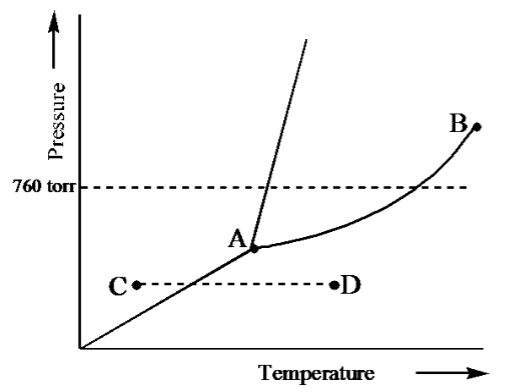 (A)Bo(s) has a lower density than Bo(l).(B) The triple point for Bo is at a higher temperature than the melting point for Bo.(C) Bo changes from a solid to a liquid as one follows the line from C to D.(D) Bo changes from a liquid to a gas as one follows the line from C to D.(E.) None of these choices is correct.
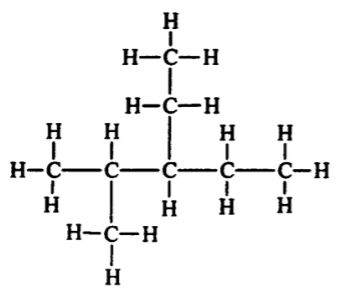 (B)
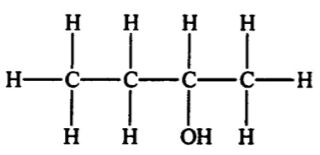 (C)
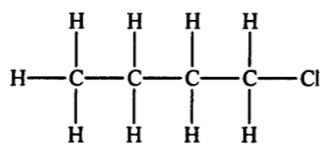 (D)
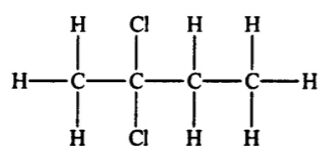 (E.) None of these choices is optically active.,