所屬科目:研究所、轉學考(插大)-經濟學
1. 簡答題:(每小題 4%,共 16%) (1) What is the main conceptual difference between GDP and GNP? How different are GDP and GNP for countries with many migrant workers from abroad? (4%)
(2) Suppose that there are 10 million people not in the labor force. How many people are UNEMPLOYED if the labor force participation rate is 95% and the unemployment rate is 2%? (4%)
(3) Please describe the main idea of the Ricardian equivalence proposition. (4%)
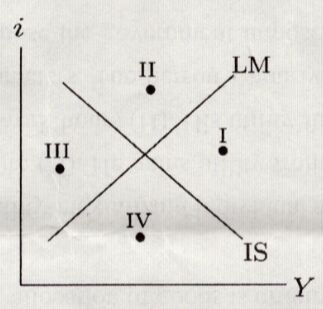
(4) 下圖為 IS-LM 圖形分析,其中縱軸為利率(i)而橫軸為產出(Y),請問圖中(I, II, III, IV)哪一點表示商品市場與貨幣市場同時供不應求?為什麼?(4%)
2. 根據 Laffer 曲線的邏輯,所得稅稅率達 100%時,沒有勞動者願意提供勞動,稅基將被完全侵蝕。從供給面經濟學來看,試繪圖說明是否所得稅率一定要高達 100%,稅基才會等於零?(10%)
3. 試以 Solow 的新古典成長模型推演,人均政府預算赤字增加將會導致每人平均產出水準下跌,但整體產出的成長率不變。(12%)
4. 請用 IS-LM-BP 模型說明當資本可以在國際間自由移動時,一國無法同時維持獨立的貨幣政策及固定匯率制度。(12%)
(1) A firm will shut down if its profit is negative.
(2) If the government imposes a specific tax per unit of output on a monopoly, the tax incidence will fall entirely on consumers.
(3) For a cost-minimizing firm, when the prices of the inputs double, the optimal input combination remains the same.
(4) A person with a concave utility function of wealth always chooses the least risky investment.
(5) Consider a pure exchange economy with two goods and two traders. At the competitive equilibrium, there is a unique set of absolute prices for the goods, and the allocation of goods is efficient.
(1) Derive the individual's leisure demand and labor supply functions. (7%)
(2) Based on your answer in part (1), can you tell whether leisure is a normal or inferior good to this individual? (4%)
(3) Suppose the government does not impose a tax on labor income but a lump-sum tax of T dollars. What will be the individual's leisure demand and labor supply functions? (7%)
(4) Assume the government could collect the same amount of tax either by the tax rate t on labor income or the lump-sum tax $T. Which policy do you think the individual would prefer? The tax on labor income or the lump-sum tax? Why? (7%)
 阿摩線上測驗
登入