所屬科目:研究所、轉學考(插大)◆普通化學
1. What is the molecular geometry of \(\text{BrF}_4^-\)?(A)tetrahedral(B)square pyramidal(C)square planar(D)seesaw
2. Which of the following elements has the highest electronegativity?(A)Br(B)Al(C)Cl(D)F
3. Express the number 0.03300 in scientific notation:(A)\(3.300 \times 10^{-2}\)(B)\(3.30 \times 10^{-2}\)(C)\(3.3 \times 10^{-2}\)(D)\(33 \times 10^{-3}\)
4. An exothermic reaction causes the surroundings to(A)warm up.(B)become acidic.(C)expand.(D)decrease its temperature.
5. The orbital hybridization on the carbon atom in \(\text{CO}_2\) is(A)\(dsp^3\)(B)\(sp^3\)(C)\(sp\)(D)\(sp^2\)
6. Which statement is false for \(\text{O}_2\), \(\text{O}_2^{2-}\), and \(\text{O}_2^{2+}\)?(A)There are bond orders of 2 for \(\text{O}_2\), 1 for \(\text{O}_2^{2-}\), and 3 for \(\text{O}_2^{2+}\).(B)The highest occupied molecular orbital of \(\text{O}_2^{2+}\) is bonding.(C)The highest occupied molecular orbital of \(\text{O}_2\) is antibonding.(D)All of them are diamagnetic.
7. How many of the \(\sigma\) bonds are there in \(\text{H}_2\text{SO}_4\) molecule?(A)1(B)3(C)5(D)6
8. Which of the following is diamagnetic?(A)\(\text{B}_2\)(B)\(\text{C}_2\)(C)\(\text{O}_2\)(D)\(\text{O}_2^+\)
9. Which of the following atoms has the largest number of unpaired electrons in p orbitals in their ground-state electron configurations?(A)Br(B)Xe(C)S(D)P
10. Which of the following statements is false?(A)For monoelectron atom, the 4s orbital lies lower in energy than the 5s orbital.(B)For a potassium atom, a 4s orbital, a 4p orbital, and a 4d orbital all have the same energy.(C)For a hydrogen atom, a 4s orbital, a 4p orbital, and a 4d orbital all have the same energy.(D)The 4s orbital lies lower in energy than the 3d orbital for atoms K, Ca, Sc, and Ti.
11. Which of the following statements about the node for an orbital is true?(A)Node is a surface where there is no chance of finding the electron.(B)Node is a surface where there is a 50% chance of finding the electron.(C)Node is a surface where there is a maximum probability of finding the electron.(D)Node is the midpoint of the orbital.
12. What volume of 18.0 M sulfuric acid must be used to prepare 12.0 L of 0.195 M \(\text{H}_2\text{SO}_4\)?(A)90 mL(B)45 mL(C)130 mL(D)65 mL
13. Iron is produced from its ore by the reactions:\(2\text{C(s)} + \text{O}_2\text{(g)} \to 2\text{CO(g)}\)\(\text{Fe}_2\text{O}_3\text{(s)} + 3\text{CO(g)} \to 2\text{Fe(s)} + 3\text{CO}_2\text{(g)}\)How many moles of \(\text{O}_2\)(g) are needed to produce 1 mole of Fe(s)?(A)0.5 mole \(\text{O}_2\)(B)0.75 mole \(\text{O}_2\)(C)1 mole \(\text{O}_2\)(D)1.5 mole \(\text{O}_2\)
14. Vitamin C (ascorbic acid) contains 40.92% C, 4.58% H, and 54.50% O by mass. What is the empirical formula of ascorbic acid?(A)\(\text{C}_3\text{H}_5\text{O}_2\)(B)\(\text{C}_2\text{H}_4\text{O}\)(C)\(\text{C}_3\text{H}_6\text{O}_2\)(D)\(\text{C}_3\text{H}_4\text{O}_3\)
15. What is the volume of the solution that would result by diluting 70.00 mL of 0.0913 M NaOH to a concentration of 0.0150 M?(A)466 mL(B)489 mL(C)426 mL(D)504 mL
16. What is the electron configuration of \(\text{Ca}^{2+}\)?(A)\(1s^2 2s^2 2p^6 3s^2 3p^6 4s^2\)(B)\(1s^2 2s^2 2p^6 3s^2 3p^6\)(C)\(1s^2 2s^2 2p^6 3s^2 3p^6 4s^1\)(D)\(1s^2 2s^2 2p^6\)
17. What kind of information will be provided by the infrared spectrum?(A)Nuclear Vibration(B)Nuclear spin(C)Electron spin(D)Electronic transition
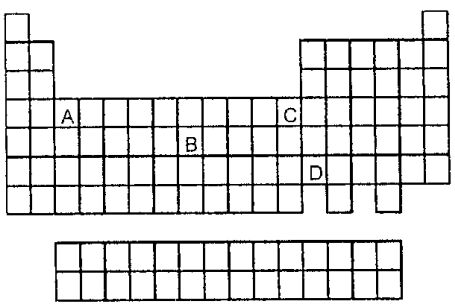
18. Which element, indicated by letter on the periodic table shown below, has a 2+ ion with the electron configuration \([\text{Ar}]3d^{10}\)?(A)A(B)B(C)C(D)D
19. In a recent accident, some drums of uranium hexafluoride were lost in the English Channel. The melting point of uranium hexafluoride is 64.5°C. What is the melting point of uranium hexafluoride on the Fahrenheit scale?(A)148 °F(B)83.3 °F(C)116 °F(D)122 °F
20. In which of the following is electromagnetic radiation listed correctly in increasing order of wavelength (lowest wavelength first)?(A)X-rays < infrared < ultraviolet(B)Microwave < visible < infrared(C)Visible < microwave < infrared(D)Ultraviolet < visible < infrared
21. Which of the following statements about buffer solution is NOT true?(A)It resists changes in pH by dilution(B)It resists changes in pH by small addition of acids or bases(C)The most effective buffer solution contains approximately equal concentration of conjugate acid-base pair(D)A concentrate sulfuric acid is a good buffer solution
22. Which atom has the lowest ionization energy?(A)N(B)O(C)F(D)Ne
23. Which wavelength listed below is in the visible light region?(A)60000 nm(B)6000 nm(C)600 nm(D)60 nm
24. Which of the following compounds has the highest melting point?(A)1,4-dichlorobenzene (1,4 二氯苯)(B)1,3-dichlorobenzene (1,3 二氯苯)(C)1,2-dichlorobenzene (1,2 二氯苯)(D)Toluene (甲苯)
25. Absorption of what type of electromagnetic radiation results in transitions among allowed nuclear spin states?(A)Microwave(B)Radio wave(C)Ultraviolet light(D)Infrared light
26. What is the important precaution observed in the storage of metallic sodium?(A)Leave the container uncoverd(B)Store the sodium in kerosene(C)Store the sodium in water(D)Use an opaque container
27. Solutions which distill without change in composition or temperature are called(A)Saturated solution(B)Ideal solution(C)aqueous solution(D)Azeotropic mixtures
28. Which of the following reactions would have a negative \(\Delta S^\circ\)?(A)\(\text{H}_2\text{(g)} \to 2\text{H(g)}\)(B)\(\text{H}_2\text{(l)} \to \text{H}_2\text{(g)}\)(C)\(\text{H}_2\text{(g)} + \text{Cl}_2\text{(g)} \to 2\text{HCl(g)}\)(D)\(2\text{H}_2\text{(g)} + \text{CO(g)} \to \text{CH}_3\text{OH(g)}\)
29. Which of the following species could be a Lewis base?(A)A negative ion(B)A positive ion(C)Organic molecules with sigma bonds(D)A molecule with an empty orbital
30. A solution with pH = 2 is more acidic than one with a pH = 6 by a factor of(A)4(B)16(C)10000(D)1000
31. Cathode-ray tubes experiments conducted by J. J. Thomson evidenced the presence of(A)Protons(B)Electrons(C)X-ray(D)Photons
32. Which halogen molecule has a yellow color at room temperature?(A)\(\text{F}_2\)(B)\(\text{Cl}_2\)(C)\(\text{Br}_2\)(D)\(\text{I}_2\)
33. For Cr, which of the following oxidation numbers does NOT exist?(A)4(B)3(C)2(D)6
34. Which of the following species is the strongest reducing agent?(A)Cu(B)Al(C)\(\text{H}_2\)(D)Zn
35. Which of the following ions would be useful in the removal of \(\text{Fe}^{3+}\) from water?(A)\(\text{OH}^-\)(B)\(\text{Cl}^-\)(C)\([\text{SO}_4]^{2-}\)(D)\([\text{NO}_3]^-\)
36. Which of the following electron configurations is inconsistent with Hund's rule of maximum multiplicity?(A)\(1s^2 2s^2 2p_x^1 2p_y^1 2p_z^1\)(B)\(1s^2 2s^2 2p_x^2 2p_y^2 2p_z^2\)(C)\(1s^2 2s^2 2p_x^2 2p_y^1 2p_z^1\)(D)\(1s^2 2s^2 2p_x^2 2p_y^1 2p_z^0\)
37. The \(\text{NO}_2^-\) ion forms linkage isomers in which either the nitrogen or the oxygen is bound to a transition metal. Which of the following ligands can also form linkage isomers?(A)\(\text{CO}_2\)(B)\(\text{SCN}^-\)(C)\(\text{OH}^-\)(D)\(\text{CO}_3^{2-}\)
38. Which one is NOT colligative property (which depends on concentration rather than the identity of the molecules)?(A)Freezing point depression(B)Boiling point elevation(C)Osmotic pressure(D)Capillary rise
39. Chlorine exists naturally as a mixture of chlorine-35 and chlorine-37 isotopes. An atom of chlorine-35 contains(A)17 protons, 18 neutrons, 17 electrons.(B)16 protons and 17 electrons, only.(C)18 protons, 18 electrons, and 17 neutrons.(D)17 protons, 35 neutrons, and 17 electrons.
40. Which of the following combinations of quantum numbers is NOT allowed?(A)\((n,l,m_l,m_s) = (4,3,-2,\frac{1}{2})\)(B)\((n,l,m_l,m_s) = (3,1,0,-\frac{1}{2})\)(C)\((n,l,m_l,m_s) = (1,1,0,\frac{1}{2})\)(D)\((n,l,m_l,m_s) = (5,2,0,-\frac{1}{2})\)
 阿摩線上測驗
登入
阿摩線上測驗
登入