所屬科目:中山◆資工◆計算機結構
1. You are going to enbance a machine, and there are two possible improvements:either make multiply instructions run four times faster than before, or make memory access instructions run two times faster than before. You repeatedly run a program that takes 200 seconds to execute. Of this time, 50% is used for multiplication, 20% for memory access instructions, and 30% for other tasks. Determine the speedup for the corresponding cases. Copy Table I to your answer sheet and fill your answers.Enhancement cases:C1: Improve only multiplicationC2: Improve only memory accessC3: Improve both multiplication and memory accessTable 1.
2. The dynamic power of a processor is related to the capacitive load (C), operation frequency (F) and voltage (V) with this equation Power=CFV2. Suppose we developed a new, simpler processor that has 80% of the capacitive load of the more complex older processor. Further, we can reduce the voltage of the new processor by 20% and let the new processor run at 20% faster frequency. What's the dynamic power of the new processor with respect to the dynamic power of the old processor ?
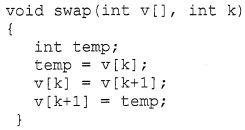
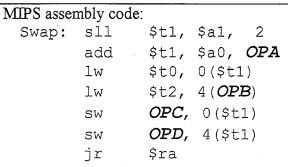
3. The following C procedure swap is compiled into the corresponding MIPSassembly code. Assume that the parameters v and k, and variable temp are in registers $a0, sal and $to, respectively. Other registers that can be used are St1 and St2. C procedure:
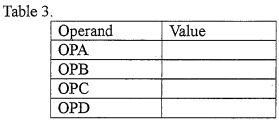
Please determine proper values for the operands (OPA, OPB, OPC, OPD). Copy thefollowing table (Table 3) to your answer sheet and fill in the operand values.
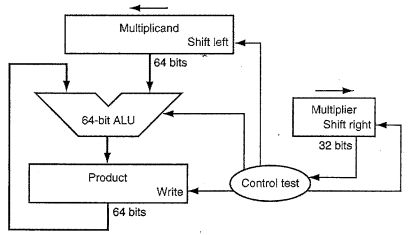
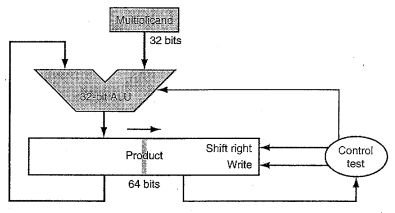
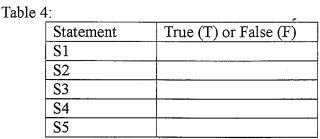
4. Figure 4.1 is a basic multiplication hardware and Figure 4.2 is an improvedversion of the basic one.Figure 4.1: Basic multiplication hardwareFigure 4.2: Improved multiplication hardwareThe following statements are possible observations for the improvement:S1: The multiplicand register, ALU, Multiplier register and the Product register are all 32 bits wide;S2: The Product register always shifts right two bits in each iteration;S3: The original Multiplier register disappears and is now placed in the right half of the Product register initially;S4: The left side of the Product register is initially set to zero.S5: The Multiplicand register is initially set to zero.Please copy the following table (Table 4) to your answer sheet and determine if these statements are true or false.
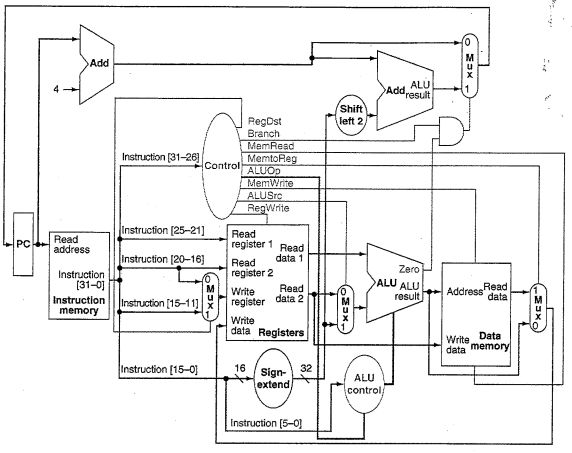
5.The following figure is a simple implementation of a MIPS subset (R-type, 1w, sw, beg). Copy Table 5 to your answer sheet and fill in the corresponding control signal values (0, 1 or X) for instructions 1w (load word) and beg (branch on equal).
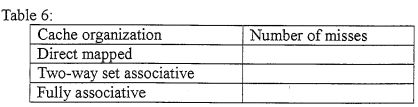
6. There are three small caches, each consisting of four one-word blocks. The first cache is direct mapped, the second cache is two-way set associative, and the third cache is fully associative. Find the numbers of misses for each organization given the following sequence of block addresses: 8. 0. 8. 6, 0. Copy Table 6 to your answer sheet and fill in the answers. Assume that the least recently used replacement policy is used for the fully associative cache and the set-associative cache.
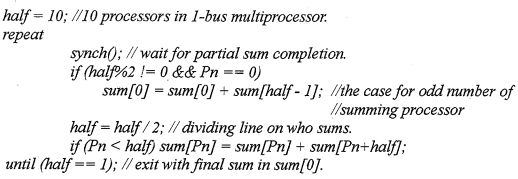
7. Suppose we want to sum 100,000 numbers on a single-bus multiprocessorcomputer. Let's assume we have 10 processors. The first step would be to split the set ofnumbers into subsets of the same size. All processors start the program by running thefollowing loop that sums their subset of numbers, where Pn is its processor index (0~9):sum/Pn] = 0;for (I = 10000 * Pn;I <10000*(Pn+1);I=I+1) sum(Pn] = sum[Pn] + Al]; / sum the assigned areasThe next step is to add these many partial sums, so we divide to conquer. Half ofprocessors add pairs of partial sums, then a quarter add pairs of the new partial sums,and so on until we have the single, final sum. We want each processor to have its ownversion of loop counter variable I, so we must indicate that it is a "private" variable.In this problem, the two processors must synchronize before the "consumer" processortries to read the result from the memory location written by the "producer" processor,otherwise, the consumer may read the old value of the data. Here is the code (halfis alsoa private variable):Question: according to the algorithm, find out what operations are executed by thedesignated processor during the designated repeat-loop iteration. (Ex: NOP or sum[0] =sum[0] + sum [4]). Copy Table 7 to your answer sheet and fill in the answers.
8.1 Derive the Boolean equation for the carry-out bit C2 using only (where i=0,1) and C0.
8.2 In a carry-lookahead adder, there are two additional signals defined, , (generate), (propagate). Derive the Boolean equation for the carry-out bit Co using only G, Pi(where i=0, 1) and C0.
 阿摩線上測驗
登入
阿摩線上測驗
登入

 with respect to the dynamic power of the old processor
  ?
?


 (where i=0,1) and C0.
 , (generate),
  (propagate). Derive the Boolean equation for the carry-out bit Co using only G, Pi(where i=0, 1) and C0.