所屬科目:研究所、轉學考(插大)◆基礎分子生物學
1. Which of the following are DNA sequences? (A) Promoter (B) Repressor (C) Operator (D) Enhancer (E) Activator
2. When bacteria produce mammalian proteins, cDNA is used rather than genomic DNA. Which of the following is the best explanation? (A) It is easier to clone RNA than DNA. (B) It is not possible to clone the entire coding region of the gene. (C) It is easier to clone cDNA than genomic DNA of comparable size. (D) Most eukaryotic genes have introns that cannot be removed in bacteria. (E) Most eukaryotic gene promoters do not function in bacteria
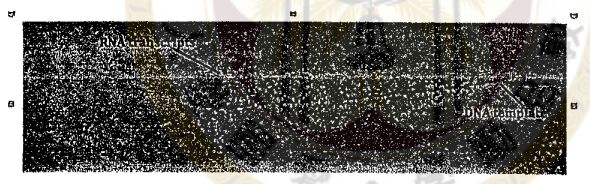
3. Below is an electron micrograph of a gene that is being transcribed. The DNA strand runs horizontally with RNA transcripts extending vertically outward.
What is the direction of movement of RNA polymerases along the length of DNA strand? (A) Upward (B) Downward (C) Rightward (D) Leftward (E) Can't be determined
4. Which of the following statements are true? (A) Bacterial mRNA normally occurs as a double-stranded structure, with one strand containing codons, the other containing anticodons. (B) Bacterial mRNA is broken down within a few minutes of its formation in E. coli. (C) Bacterial mRNA consists only of the bases that code for amino acids. (D) The three ribosomal RNAs in a bacterial ribosome are distributed in three separate, large ribosomal subunits. (E) Bacterial mRNA can be translated while it is still being synthesized.
5. A microarray is a large collection of specific DNA oligonucleotides spotted in a defined pattern on a microscope slide. What is the most useful experiment that can be done with such a tool? (A) Evaluating the linkage relationships of genes (B) Comparing newly synthesized nuclear RNA with cytoplasmic RNA to locate introns (C) Comparing RNA produced under two different physiological conditions to understand patterns of gene expression (D) Comparing proteins produced under two different physiological conditions to understand their function (E) Predicting the presence of specific metabolites in a cell
6. Which of the following statements are true for the enzyme reverse transcriptase? (A) It is sensitive to high temperatures and so can be readily "killed" by heat treatment when the reaction is completed. (B) It does not require a primer to initiate polymerization as do most DNA polymerases. (C) It is insensitive to high temperatures and so can survive the many cycles of heating required to perform the polymerase chain reaction. (D) It is an RNA-dependent DNA polymerase. (E) It lacks the proofreading function of most DNA polymerases and so is able to utilize mRNA from mutated genes as a template.
7. Possesses genes that may be integrated into the genome of an infected eukaryotic cell(A) E. coli (B) Yeast (C) Retrovirus (D) Bacteriophage lambda (E) Adenovirus
8. Can lysogenize bacteria(A) E. coli (B) Yeast (C) Retrovirus (D) Bacteriophage lambda (E) Adenovirus
9. The reason it takes approximately one hour before the first radioactively labeled mitotic cells are observed is that (A) cells must repair thymidine-induced DNA damage before entering G2 (B) the cells get out of synchrony as they proceed through the cell cycle (C) the period of thymidine labeling is 5 minutes (D) G2 lasts 1 hr (E) M phase lasts 1 hr
10. What percent of labeled cells are in M phase at 4 hours after exposure to labeled thymidine? (A) 100 (B) 33 (C) 20 (D) 6 (E) 0
11. If the length of G2 were increased by one hour, which of the following statements would be true regarding the slope of the line from the point of the first appearance of labeled mitotic cells to the first point at which all the mitotic cells were labeled? (A) It would stay the same. (B) It would decrease. (C) It would increase. (D) It would switch from a positive to a negative slope. (E) No conclusion regarding the slope of the line can be drawn.
12. The expected frequency of the triple CCC in the A: C=1:5 copolymer should be (A) 1/8 (B) 5/6 (C) 7/8 (D) 15/216 (E) 125/216
13. Which of the following amino acid(s) appear to be coded by triplets containing 2 A's and 1 C? (A) Asparagine (B) Glutamine (C) Proline (D) Threonine (E) Lysine
14. Which mutant would have a mutation in the "strong" promoter? (A) 1 (B) 2 (C) 3 (D) 4 (E) 5
15. Which mutant(s) would have a mutation in the repressor? (A) 1 (B) 2 (C) 3 (D) 4 (E) 5
16. Which mutant(s) would have a mutation in the operator? (A) 1 (B) 2 (C) 3 (D) 4 (E) 5
17. Which mutant(s) would have a mutation in the protein coding region? (A) 1 (B) 2 (C) 3 (D) 4 (E) 5
18. Which element(s) are cis-acting? (A) 1 (B) 2 (C) 3 (D) 4 (E) 5
19. Which element(s) are trans-acting? (A) 1 (B) 2 (C) 3 (D) 4 (E) 5
20. Which element is the repressor? (A) 1 (B) 2 (C) 3 (D) 4 (E) 5
21. Which of the following statements about "Transcription" is/are TRUE? (A) Transcription factors function to help move ribosomes along the mRNA. (B) The release of pyrophosphate from a nucleoside triphosphate drives the reaction. (C) RNA is synthesized from the 5' end to the 3' end. (D) Transcription requires the use of a primer. (E) DNA to RNA base pairing includes A to U and G to C.
22. In prokaryotic RNA synthesis (A) the rate of incorporation of nucleotides is constant throughout the elongation process (B) the p (rho) protein is always required for termination (C) a unique series of three bases leads to termination (D) inverted-repeat sequences in the DNA being transcribed can lead to termination (E) the sigma (6) subunit stays with the RNA Polmerase throughout synthesis.
23. Which of the following statements about "the genetic code" is/are TRUE? (A) Some codons do not specify an amino acid. (B) Some amino acids share the same codon. (C) The first two nucleotides of a codon are often enough to specify a given amino acid. (D) Nearly all organisms use the same genetic code. (E) The initiation codon specifies methionine.
24. Which of the following elements can function as "eukaryotic promoters"? (A) a TATA box. (B) an initiator element. (C) CpG islands. (D) an enhancer. (E) silencers.
25. Which of the following is/are category for the gene product for an Oncogene? (A) Glycolytic enzyme. (B) Transcription factor. (C) Housekeeping gene. (D) Nonreceptor protein kinase. (E) Growth factor receptor.
26. A mutant bacterium is isolated. This bacterial strain has the characteristic of very slow, "sickly" growth. You isolate mRNA from this bacteria to use in an in vitro translation system and note that even in vitro it is difficult to use this message and obtain protein. Of the following, which is/are likely explanation for these results? (A) There may be a mutation in the ribosomal rRNA recognizing the Shine-Delgarno sequence of the message. (B) In this mutant, the ribosomal subunits may not associate well enough for effective translation. (C) This mutant may have altered tRNA molecules, such that the codon-anticodon interaction during translation is affected. (D) These bacteria may not manufacture enough translation factors for effective translation. (E) There may be a mutation in the Shine-Delgarno sequence of the DNA, resulting in a RNA that poorly binds the ribosome.
27. You are working with a gene associated with an essential pathway that is necessary at two time points in an organism's lifetime. With regard to gene regulation, you would expect the gene to be (A) associated with response to distinct events. (B) not constitutive. (C) "activated" by particular signals (induced). (D) "turned off" by particular signals (repressed). (E) None of the above.
28. In a histone protein, what modification(s) to lysine mark the nucleosome as a transcription target? (A) alkylation (B) acetylation (C) phosphorylation (D) methylation (E) ubiquitylation
29. microRNAs play a key role in which of the following? (A) repressed translation of the mRNA. (B) degradation of viral RNA (C) rapid translation of the mRNA. (D) degradation of the mRNA (E) repeated translation as the miRNA prevents destruction of the mRNA
30. Which of the following statements is/are TRUE? (A) Restriction endonucleases can cut DNA and RNA. (B) It is common to use ddNTPs (dideoxyribonucleoside triphosphates) in DNA sequencing. (C) Enzymes that seal nicks in DNA are called ligases. (D) In recombinant DNA technology, a YAC is an enzyme isolated from a large South American four-legged mammal. (E) The "c" in cDNA stands for Circular.
31. Which property of DNA is crucial for the conservation of genetic information? (A) antiparallelism (B) semiconservative replication (C) the ability to form a circular DNA (D) base-pair complementarity (E) The amount of A is the same as the amount of C
32. The ability of DNA to denature is important for which process? (A) DNA synthesis (B) nucleic acid hybridization experiments (C) RNA synthesis (D) PCR reaction (E) DNA separation by agarose gel electrophoresis
33. Which of the following is required for both DNA replication and RNA transcription? (A) DNA (B) primers (C) RNA polymerase (D) phosphodiesterase (E) topoisomerase
 阿摩線上測驗
登入