所屬科目:研究所、轉學考(插大)◆生物化學
1. Approximately what fraction of the human genome are transposable elements? (A) 1.5% (B) 5% (C) 10% (D) 45% (E) 80%
2. It is correct to say that DNA supercoiling cannot: (A) be induced by strand separation. (B) be induced by underwinding of the double helix. (C) form if there is Z-DNA structure present. (D) occur if a closed-circular, double-stranded DNA molecule has a nick. (E) result in compaction of the DNA structure.
3. Which of the following is not required for initiation of DNA replication in (E) coli? (A) DnaB (helicase) (B) DnaG (primase) (C) Dam methylase (D) DNA ligase (E) None of the above
4. In base-excision repair, the first enzyme to act is: (A) AP endonuclease. (B) Dam methylase. (C) DNA glycosylase. (D) DNA ligase. (E) DNA polymerase.
5. The ABC excinuclease is essential in: (A) base-excision repair. (B) methyl-directed repair. (C) mismatch repair. (D) SOS repair. (E) nucleotide-excision repair.
6. Which of the following statements regarding plasmid cloning vectors is correct? (A) Circular plasmids do not require an origin of replication to be propagated in (E) coli. (B) The copy number of plasmids may vary from a few to several hundred. (C) Foreign DNA fragments up to 45,000 base pairs can be cloned in a typical plasmid. (D) Plasmids do not need to contain genes that confer resistance to antibiotics. (E) Plasmid vectors must carry promoters for inserted gene fragments.
7. Which of the following information can be determined from the protein sequencer in a purified protein sample? (A) amino acid contents (B) amino acid sequence (C) amounts of amino acids (D) mean residue weight (E) protein concentration
8. The major conformation of hair protein belongs to (A) α-helix (B) β-sheet (C) random coils (D) β-turn (E) none of the above
9. The formation of a peptide bond between two amino acids is a/an _____ reaction (A) group transfer (B) isomerization (C) condensation (D) oxidation reduction (E) cleavage
10. The proteins from the tumor and normal cells can be compared using (A) RNA interference (B) In situ hybridization (C) cDNA microarrays (D) two dimensional gel electrophoresis (E) Northern blotting
11. Which of the following is an activator of lipoprotein lipase? (A) ApoB-48 (B) ApoB-100 (C) ApoC-II (D) ApoC-III (E) ApoE
12. Carnitine deficiency is often associated with (A) hypercholesterolemia (B) hypocholesterolemia (C) hyperglycemia (D) hypoglycemia (E) lipodystrophy
13. In the blood, free fatty acids are bound to (A) chylomicron (B) VLDL (C) LDL (D) HDL (E) albumin
14. Injection of C¹⁴-acetyl-CoA into a rat, the C¹⁴ cannot be found in which fatty acid? (A) palmitic acid (B) stearic acid (C) oleic acid (D) palmitoleic acid (E) linoleic acid
15. Which following enzyme catalyzes the reaction: glucose-1 phosphate + UTP → UDP-glucose + pyrophosphate? (A) UDP-glucose synthetase (B) phosphoglucose uridyltransferase (C) UDP-glucose dehydrogenase (D) UDP-glucose peroxidase (E) UDP-glucose pyrophosphorylase.
16. In glucose metabolism, what enzyme can be directly activated by calcium ion? (A) glucokinase (B) hexokinase (C) glycogen synthase (D) phosphorylase kinase (E) phosphoglucokinase
17. Hydroxylation is important for collagen function. Which factor is required for this posttranslational modification on collagen? (A) acetyl-CoA (B) α-ketoglutarate (C) oxaloacetate (D) NADPH (E) FADH2.
18. Which product is generated by bacteria in terminal ileum and the large intestine? (A) urobilinogen (B) coproporphyrinogen I (C) coproporphyrinogen III (D) uroporphyrinogen II (E) protoporphyrinogen.
19. Which of the following is true about nucleosomes? (A) Nucleosomes are composed of DNA wound around an octameric complex of histone molecules. (B) Nucleosomes contain four major types of histones: H1, H2, H3, and H4. (C) Nucleosomes are the most abundant chromatin proteins. (D) Nonhistone proteins are necessary for the reconstitution of the nucleosome core. (E) All are true.
20. Which of the following statements is correct concerning biosynthesis of purine nucleotides? (A) Glycine, aspartate and glutamate are the nitrogen sources of the purine ring. (B) The major determinant of the rate of de novo purine nucleotide biosynthesis is the concentration of5-phosphoribosyl 1-pyrophosphate. (C) von Gierke disease reflects a defect in hypoxanthine-guanine phosphoribosyl transferase, an enzyme of purine salvage. (D) AMP and GMP also inhibit hypoxanthine-guanine phosphoribosyl transferase, which converts hypoxanthine and guanine to AMP and GMP. (E) All are true.
21. Which of the following RNA species is NOT directly involved in protein synthesis? (A) mRNAs (B) tRNAs (C) snRNAs (D) rRNAs (E) None of them.
22. Which of the following nomenclature names is right for the unsaturated fatty acid below? [Image of a fatty acid molecule] (A) ω5, C20:4 (B) ω6, C20:5 (C) ω5, C19:4 (D) ω6, C19:5 (E) ω6, C20:4
23. Which one of the following molecules in Glycolysis donates a phosphate group to ADP to produce ATP? (A) glucose-6-phosphate (B) phosphoenolpyruvate (C) fructose-6-phosphate (D) fructose-1,6-bisphosphate (E) pyruvate
24. The anaerobic conversion of 1 mol of glucose to 2 mol of lactate by fermentation is accompanied by a net gain of: (A) 2 mol of ATP + 1 mol of NADH (B) 2 mol of ATP + 2 mol of NADH (C) 2 mol of ATP + 4 mol of NADH (D) 2 mol of ATP (E) 2 mol of NADH
25. One turn of the citric acid cycle produces (A) 2 NADH, 2 FADH2, 2 ATP. (B) 3 NADH, 2 FADH2, 1 ATP. (C) 1 NADH, 3 FADH2, 2 ATP. (D) 3 NADH, 3 FADH2, 1 ATP. (E) 3 NADH, 1 FADH2, 1 ATP
26. Which of following is an anomeric pair? (A) α-D-glucose and β-L-glucose (B) α-D-glucose and β-D-glucose (C) α-D-glucose and α-L-glucose (D) D-glucose and L-fructose (E) D-glucose and D-fructose
27. All are characteristics of pyrimidines EXCEPT: (A) six membered ring. (B) heterocyclic. (C) conjugated. (D) fused five membered rings. (E) two nitrogens separated by a carbonyl.
28. In a sample of double-stranded DNA containing 34% cytosine, the percentage of adenine would be: (A) 34% (B)68% (C) 16% (D) 0% (E) insufficient information to answer question
29. All are properties of nucleosomes EXCEPT: (A) protein spools neatly wrapped with DNA. (B) fundamental structural unit in chromatin. (C) protein spools made up of pairs of histones H2A, H2B, H3 and H4 octameric aggregates. (D) DNA binds histones by ionic bonds of positively charged amino acids and the negative charged phosphate groups. (E) all are true.
30. Thymidylate synthase synthesizes dTMP from _____ by _____ utilizing the coenzyme _____ (A) dCTP; carboxylation; biotin (B) dUMP; methylation; THF (C) dCMP; methylation; THF (D) dGMP; phosphorylation; ATP (E) dUMP; phosphorylation; ATP
31. Which enzyme is not localized and involved in oligosaccharides processing in the medial Golgi? (A) N-acetylglucosaminyltransferase I (B) golgi apparatus alpha-mannosidase II (C) Sialyl transferase (D) N-acetylglucosaminyltransferase II (E) fucosyl transferase
32. Which proteins can not bind sialy-Lewis X sugar (A) LFA-1 (B) L-selectin (C) E-selectin (D) P-selectin (E) all of the above
33. Which description about the major differences between collagen and elastin is not right? (A) Elastin is No triple helix (B) collagen is in tramolecular desmosine cross-link (C) collagen is presence of extension peptides during biosynthesis (D) there is no hydroxylysine (E) No (Gly-X-Y)n repeating structure
34. Which components is not existing in the normal polarized epithelial cells surface or basal membrance: (A) Laminin (B) tight junction (C) lamin (D) integrin (E) cadherin
35. Defects in which of the following enzyme will NOT cause hyperammonemia. (A) Cabomoyl phosphate synthetase I (B) Ornithine permease (C) Arginase (D) N-acetylglutamate synthase (E) Ornithine transcarbamoylase
36. Which enzyme releases the amide nitrogen of glutamine to form glutamate? (A) Glutamate dehydrogenase (B) Glutamate pyruvate transaminase (GPT) (C) Glutaminase (D) Glutamate oxaloacetate transaminase (GOT) (E) Glutamine synthetase
37. What property do biotin, tetrahydrofolate and S-adenosylmethionine have in common? (A) They bind streptavidin (B) They transfer single nitrogen (C) They transfer single carbon (D) They are amino acid derivatives (E) They are enzymes
38. Which of the amino acid is NOT glucogenic? (A) Isoleucine (B) Arginine (C) Lysine (D) Tryptophan (E) Aspartatic acid
39. Which of the following reactions is most likely catalyzed by a ligase ? (A) A+ H2O ←→P+Q (B) A + B + ATP ←→ P + ADP + (C) A ←→ P+Q (D) A + ←→P + NADH (E) A + ATP ←→ P + ADP
40. To measure the "rate" of an enzymatic reaction, you need to plot (A) "substrate concentration" vs "time" (B) "initial rate" vs "substrate concentration" (C) "initial rate" vs "time" (D) "initial rate" vs "product concentration" (E) "free enzyme concentration" vs "time"
41. When [S] increases from 2Kᴍ to 4Kᴍ, the initial velocity (Vo) of an enzyme catalyzed reaction increases by a factor of _____ (Assuming this enzyme follows the Michaelis-Menton kinetics.) (A) 0.9 (B) 1.0 (C) 1.1 (D) 1.2 (E) 1.4
42. Inhibitor "X" was found to decrease the Vmax (maximum velocity) of an enzymatic reaction. Therefore, "X" can be classified as a _____ (A) competitive inhibitor (B) uncompetitive inhibitor (C) mixed inhibitor (D) uncompetitive inhibitor or mixed inhibitor (E) competitive inhibitor or mixed inhibitor
43. The ligands for peroxysome proliferator-activator receptor (PPAR) belong to which of the following categories. (A) protein (B) vitamin (C) fatty acid (D) amino acid (E) carbohydrate
44. Cholera toxin, a protein produced by a gram-negative bacterium vibrio cholerae, is responsible for the characteristic symptoms of cholera: extensive loss of body water and Na⁺ through continuous, debilitating diarrhea. If body fluid and Na⁺ are not replaced, severe dehydration results; untreated, the disease is often fatal. What is the effect of cholera toxin in the intestinal cells? (A) Increase GTP hydrolysis. (B) Persist activation of G protein. (C) Increase the degradation of cGMP. (D) Increase the rate of phophatidylinositol turnover. (E) Open the chloride channels on the membrane of intestinal cells.
45. According to the description, which of the following compounds could illicit proliferation signaling in smooth muscle cells? (A) thrombin (B) vitamin K (C) interferon (D) cholesterol (E) retinoic acid
46. After the ligand binding to PAR, which of the following events will happen? (A) The receptors form dimer on the membrane. (B) The receptors will be tyrosine-phosphorylated. (C) The receptor will dimerize with RXR and illicit gene transcription. (D) It activates GTP binding proteins and increase calcium mobilization. (E) It contains DNA- and ligand-binding domains in distinct region of PAR.
47. Some hormones are derived from amino acids; for example, catecholamines are derived from while NO is derived from _____ (A) tyrosine; arginine (B) tryptophan; lysine (C) tyrosine; histidine (D) tryptophan; arginine (E) histidine; lysine
48. Hormone-activated phospholipase C can convert phosphatidylinositol 4,5-bisphosphate to: (A) diacylglycerol + inositol triphosphate. (B) diacylglycerol + inositol + phosphate. (C) glycerol + inositol + phosphate. (D) glycerol + phosphoserine. (E) phosphatidyl glycerol + inositol + phosphate.
49. The force that drives an ion through a membrane channel depends upon: (A) the charge on the membrane. (B) the difference in electrical potential across the membrane. (C) the size of the channel. (D) the size of the ion. (E) the size of the membrane.
50. Ubiquitin is a: (A) component of the electron transport system. (B) protease. (C) protein kinase. (D) protein phosphorylase. (E) protein that tags another protein for proteolysis.
 阿摩線上測驗
登入
阿摩線上測驗
登入
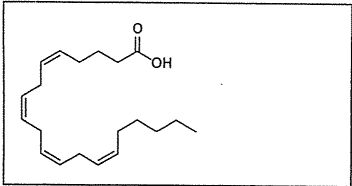 [Image of a fatty acid molecule] (A) ω5, C20:4 (B) ω6, C20:5 (C) ω5, C19:4 (D) ω6, C19:5 (E) ω6, C20:4
 (C) A ←→ P+Q (D) A +
 ←→P + NADH (E) A + ATP ←→ P + ADP