所屬科目:轉學考-物理
1. (10%) Find the magnetic field at the point P (as shown in Figure 1) contributed by the straight wire carrying a constant current I with $\theta1 = \frac{\pi}{3}$ and $\theta2 = \frac{-\pi}{6}$. Assume $\mu_0$ is the permeability of vacuum.Figure 1
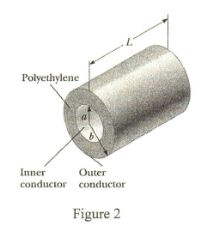
2. (10%) A coaxial cable consists of two concentric cylindrical conductors. The region between the conductors is completely filled with polyethylene plastic as shown in Figure 2. Current leakage through the plastic, in the radial direction, is unwanted. The radius of the inner conductor is \( a \), the radius of the outer conductor is \( b \), and the length is \( L \). The resistivity of the plastic is \( \rho \). Calculate the resistance of the plastic between the two conductors.
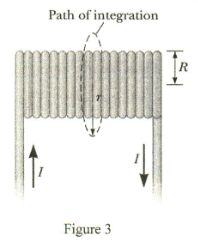
3. (10%) A long solenoid of radius \( R \) has \( n \) turns of wire per unit length and carries a time-varying current that varies sinusoidally as \( I = I{\max} \sin \omega t \), where \( I{\max} \) is the maximum current and \( \omega \) is the angular frequency of the alternating current source (Figure 3). Determine the magnitude of the induced electric fields inside the solenoid at a distance \( r \) from its long central axis.
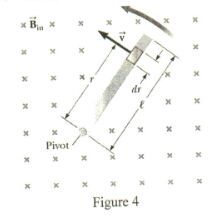
4. (10%) A conducting bar of length $\ell$ rotates with a constant angular speed $\omega$ about a pivot at one end. A uniform magnetic field $\vec{\mathbf{B}}_{\text{in}}$ is directed perpendicular to the plane of rotation as shown in Figure 4. Find the motional emf induced between the ends of the bar.
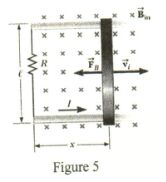
5. (10%) The conducting bar illustrated in Figure 5 moves on two frictionless, parallel rails in the presence of a uniform magnetic field directed into the page. The bar has mass \( m \), and its length is \( \ell \). The bar is given an initial velocity \( \vec{v}_i \) to the right and is released at time \( t = 0 \). find the velocity of the bar as a function of time.
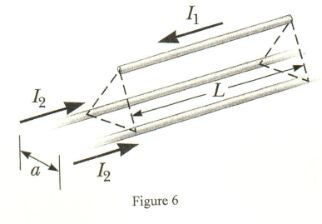
6. (10%) Two infinitely long, parallel wires are lying on the ground a distance a meter apart as shown in Figure 6. A third wire, of length L meter and mass m kg, carries a current of I₁ Ampere and is levitated above the first two wires, at a horizontal position midway between them. The infinitely long wires carry equal currents I₂ in the same direction, but in the direction opposite that in the levitated wire. What current must the infinitely long wires carry so that the three wires form an equilateral triangle?Figure 7
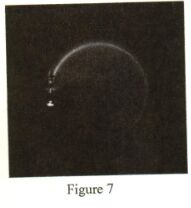
7. (10%) In an experiment designed to measure the magnitude of a uniform magnetic field, electrons are accelerated from rest through a potential difference of ΔV Voltage and then enter a uniform magnetic field that is perpendicular to the velocity vector of the electrons. The electrons travel along a curved path because of the magnetic field of B Tesla (Such a curved beam of electrons is shown in Figure 7). What is the radius of the curved beam as shown in Figure 7? Note that the mass of an electron is mₑ kg and an electron contains e Coulomb charges.
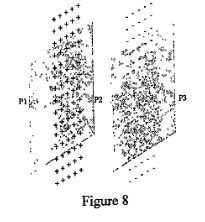
8. (10%) Suppose two infinite planes of charge are parallel to each other (Figure 8), one positively charged and the other negatively charged. The positively and negatively charged planes have charge densities of $\sigmap$ and $-\sigman$, respectively. What is the directions and magnitudes of electric field at point P1 (to the left of the positively charged plane)?Figure 8
9. (10%) The electric potential at the position of a point \( P \) in three dimensions be given by the vector \( r = (x, y, z) \) in Cartesian Coordinates is \( (x^2 + y^2 + z^2)^{-0.5} \). Please find the magnitude of the electric field at the point \( (1, 1, 1) \).
10. (10%) Assume a uniformly wound solenoid having \( N \) turns and length \( \ell \), and \( \ell \) is much greater than the radius of the solenoid, find the inductance of this solenoid. Assume \( \mu_0 \) is the permeability of vacuum.
 阿摩線上測驗
登入
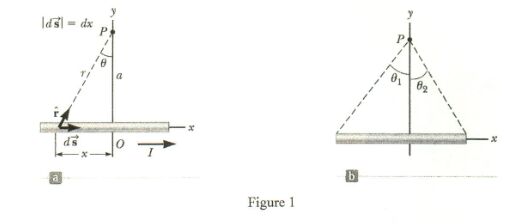 Figure 1