所屬科目:台大◆電機◆控制系統(C)(含電路系統分析)
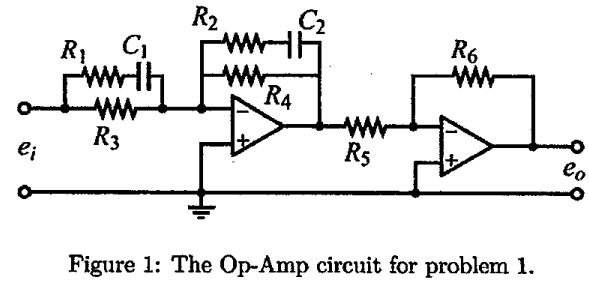
1. Consider the operational-amplifer circuit as shown in Figure 1. Which of the following parameter assign- , ments implement a lead-lag compensator ?(A) R1 = 2MΩ, R2 = 500kΩ, R3 = 8MΩ, R4 = 300kΩ,R5 = iMn, and R6 = 1MΩ. (B) R1= 2MΩ, R2 = 200kΩ, R3 = 8MΩ, R4 = 300kΩ, R5 = 1MΩ, and R6 = 1MΩ. (C) R1 = 2MΩ, R2 = 200kΩ, R3 = 8MΩ,R4 = 300kΩ,R5 = 3MΩ, and RΩ = 1MΩ. (D) C1 = 0.1μF and C2 = 0.5μF. (E) C1 = 0.5μF and C2= 0.1μF.
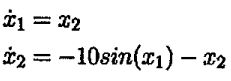
2. Consider a non-linear dynamic model Which of the following statements are true? (A) The linearized model at the equilibrium point x1 =x2 = 0 has poles at -0.5 ± j3.12 (B) The linearized model at the equilibrium point x1 =x2 = 0 has poles at 0.5± j3.12 (C) The linearized model at the equilibrium point x1 = π, x2 = 0 has poles at -3.7 and 2.7 (D) The lin arized m odel at the equilibrium point x1 = π, x2 = 0 has poles at 3.7 and -2.7 (E) The linearized model at the equilibrium point x1 = π, x2 = 0 has poles at 0.5 ± j3.12
4. Consider the system P(s) and input u(t) given byWhich of the following terms are expected to appear in the steady state output of P(s)? (A) 1 (B)(C) (D) sin(4t) (E)cos(5t)
5. Consider a second-order LTI plant P(s) Which of the following statements are true? (A) The D.C. gain of P(s) is 0.5. (B) The natural frequency of P(s) is 16 rad/s. (C) The rise time of the step response of P(s) is larger than 1 s. (D) The settling time of the step response of P(s) is less than 1 s. (E) The maximum overshoot of the step response of P(8) is less than 5%.
6. Which of the following statements are true? (A) Given the characteristic equation 3s2+ 5s+k = 0 of a linear control system, increasing the value of k will decrease the frequency of oscillation of the system.(B) can be approximated bysince the pole at -20 is much larger than the dominant poles at O and -1. (C) For a stable open-loop system with a perfect model P(s), it is always possible to have a stable and causal feedforward controller F(s) such that P(s)F(s) = 1. (D) The maximum overshoot of is possibly exceed 100 percent when and T are all positive. (E) If a unity-feedback control system type is 2, then it is certain that the steady-state error of the system to a step or a ramp input will be zero.
7. Consider the closed-loop feedback control architecture shown in Fig. 2, where P(s) is the open-loop plant, C1(s) and C2(s) are the feedback controllers, and H(s) is the transfer function from the reference r(t) to the output y(t), respectively. Assume thatand H(s) is asymptotically stable, which of the following reference signal r(t) can be tracked by Hr(s without steady-state error? (A) r(t) =sin(10t). (B) r(t) = sin(20πt). (C) r(t) = sin(0.1t). (D)r(t)=sin(0.2πt). (E) A 100 Hz triangular wave reference r(t).
9. Consider the state-space model given by where x is the system state, u is the input, and y is the output. Which of the following statements are true? (A) This state-space model is a minimal realization. (B) The poles of this model are at -2 and 4. (s+3) (C) The transfer function of this model from u to y is(D) This model has a transmission zero at -3. (E) The state feedback law u = -Kx yields the closed-loop poles at –10 and –20 when k = [32 80].
 阿摩線上測驗
登入
阿摩線上測驗
登入
 ?
 Which of the following terms are expected to appear in the steady state output of P(s)? (A) 1 (B)
 (C)
 (D) sin(4t) (E)cos(5t)
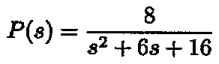 Which of the following statements are true? (A) The D.C. gain of P(s) is 0.5. (B) The natural frequency of P(s) is 16 rad/s. (C) The rise time of the step response of P(s) is larger than 1 s. (D) The settling time of the step response of P(s) is less than 1 s. (E) The maximum overshoot of the step response of P(8) is less than 5%.
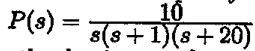 can be approximated by
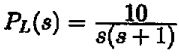 since the pole at -20 is much larger than the dominant poles at O and -1. (C) For a stable open-loop system with a perfect model P(s), it is always possible to have a stable and causal feedforward controller F(s) such that P(s)F(s) = 1. (D) The maximum overshoot of
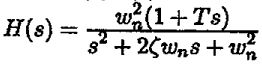 is possibly exceed 100 percent when
 and T are all positive. (E) If a unity-feedback control system type is 2, then it is certain that the steady-state error of the system to a step or a ramp input will be zero.
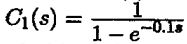 and H(s) is asymptotically stable, which of the following reference signal r(t) can be tracked by Hr(s without steady-state error?
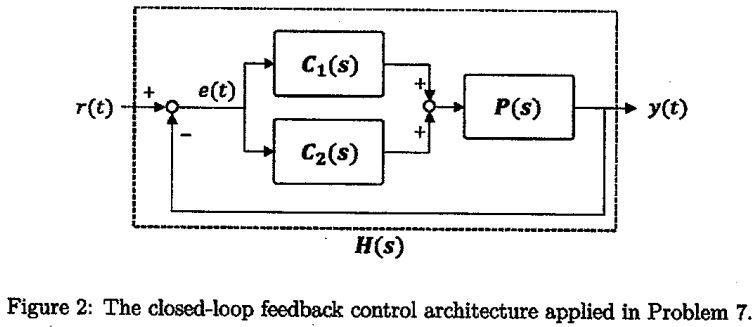 (A) r(t) =sin(10t). (B) r(t) = sin(20πt). (C) r(t) = sin(0.1t). (D)r(t)=sin(0.2πt). (E) A 100 Hz triangular wave reference r(t).
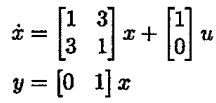
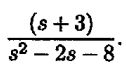 (D) This model has a transmission zero at -3. (E) The state feedback law u = -Kx yields the closed-loop poles at –10 and –20 when k = [32 80].