阿摩線上測驗
登入
首頁
>
研究所、轉學考(插大)◆審計學
> 109年 - 109東吳大學_碩士班招生考試_會計學系A 組(一般) ︰審計學#100472
109年 - 109東吳大學_碩士班招生考試_會計學系A 組(一般) ︰審計學#100472
科目:
研究所、轉學考(插大)◆審計學 |
年份:
109年 |
選擇題數:
25 |
申論題數:
16
試卷資訊
所屬科目:
研究所、轉學考(插大)◆審計學
選擇題 (25)
1. Which of the following would be least likely to be regarded as a test of a control? (A) Tests of the additions to property by physical inspection. (B) Comparisons of the signatures on cancelled checks to the authorized check signer list. (C) Tests of signatures on purchase orders. (D) Recalculation of payroll deductions.
2. Which statement is correct concerning the relevance of various types of controls to a financial statement audit? (A) An auditor may ordinarily ignore the consideration of controls when a substantive audit approach is used. (B) Controls over the reliability of financial reporting are ordinarily most directly relevant to an audit, but other controls may also be relevant. (C) Controls over safeguarding assets and liabilities are of primary importance, while controls over the reliability of financial reporting may also be relevant. (D) All controls are ordinarily relevant to an audit.
3. Which of the following is least likely to be included in an auditor's inquiry of management while obtaining information to identify the risks of material misstatement due to fraud? (A) Are all financial reporting operations at one location? (B) Does it have knowledge of fraud or suspect fraud? (C) Does it have programs to mitigate fraud risks? (D) Has it reported to the audit committee the nature of the company's internal control?
4. Which of the following topics is not normally included in an engagement letter? (A) The auditors' level of materiality in planning the audit. (B) The auditors' estimate of the fee for the engagement. (C) Limitations on the scope of the engagement. (D) A description of responsibility for the detection of fraud.
複選題
5. When a company has changed auditors, according to the Professional Standards: (A) The successor auditor has the responsibility to initiate contact with the predecessor auditor to ask about the client before the engagement is accepted; the predecessor has no responsibility to initiate this contact, even when aware of matters bearing on the integrity of management. (B) The predecessor must always respond fully to all inquiries made by the successor auditor. (C) The successor must discuss with the predecessor matters bearing on the engagement prior to accepting the engagement. (D) The successor may choose not to attempt any communication with the predecessor auditor.
6. During an audit, the working papers are primarily considered to be: (A) A client-owned record of conclusions reached by the auditors who performed the engagement. (B) Evidence supporting financial statements. (C) Support for the auditors' representations as to compliance with generally accepted auditing standards. (D) A record to be used as a basis for the following year's engagement.
7. The auditors are least likely to "audit around the computer" when: (A) Input transactions are batched and system logic is straightforward. (B) Processing primarily consists of sorting the input data and updating the master file sequentially. (C) Processing is primarily online and updating is real-time. (D) Outputs are in hard copy form.
8. Various factors influence the sample size for a substantive test of details of an account balance. All other factors being equal, which of the following would lead to a larger sample size? (A) Smaller expected frequency of misstatements. (B) Smaller measure of tolerable misstatement. (C) Greater reliance on analytical procedures. (D) Lower assessment of control risk.
9. An investor reading the financial statements of The Fairbury Corporation observes that the statements are accompanied by an unmodified auditors' report. From this, the investor may conclude that: (A) Informative disclosures in the financial statements but not necessarily in the footnotes are to be regarded as reasonably adequate. (B) Any disputes over significant accounting issues have been settled to the auditors' satisfaction. (C) The auditors have ascertained that Fairbury's financial statements are free from error. (D) The auditors are satisfied that Fairbury is operationally efficient.
10. An auditor wishes to estimate inventory shrinkage by weighing a sample of inventory items. From experience, the auditor knows that a few specific items are subject to unusually large amounts of shrinkage. In using statistical sampling, the auditor's best course of action is to: (A) Eliminate any of the items known to be subject to unusually large amounts of shrinkage. (B) Increase the sample size to lessen the effect of the items subject to unusually large amounts of shrinkage. (C) Stratify the inventory population so that items subject to unusually large amounts of shrinkage are reviewed separately. (D) Continue to draw new samples until a sample is drawn which includes none of the items known to be subject to large amounts of shrinkage.
11. The auditors have calculated the total uncorrected identified misstatements as $445,000; materiality for the audit is $450,000. The client has declined to record the related journal entries. In this situation it is most likely that the auditors will: (A) Resign from the audit. (B) Issue a disclaimer of opinion. (C) Conclude that the financial statements are not materially misstated. (D) Perform additional audit procedures to reduce audit risk to an appropriately low level.
12. Which of the following is generally true about the sufficiency of audit evidence? (A) The amount of evidence that is sufficient varies directly with the acceptable risk of material misstatement. (B) The amount of evidence that is sufficient concerning a particular account varies inversely with the materiality of the account. (C) The amount of evidence that is sufficientc oncerning a particular account varies inversely with the inherent risk of the account. (D) When evidence is appropriate with respect to an account it is also sufficient.
13. Under which circumstance is it likely that the extent of substantive procedures will be expanded beyond that anticipated in the audit plan? (A) The auditors have determined that controls have been implemented (placed in operation) but, in accordance with the audit plan, have performed no tests of controls. (B) Certain controls do not leave a trail of documentary evidence. (C) Deviation rates were greater than zero and approached anticipated levels. (D) The operating effectiveness of certain controls was found to be less than expected, although no material misstatements were identified.
14. Which of the following computer related employees should not be allowed access to program listings of application programs? (A)The librarian. (B) The operator. (C) The systems analyst. (D)The programmer.
15. After obtaining an understanding of internal control and arriving at a preliminary assessed level of control risk, an auditor decided to perform tests of controls. The auditor most likely decided that: (A)Additional evidence to support a reduction in the assessed level of control risk is not available. (B) An increase in the assessed level of control risk is justified for certain financial statement assertions. (C) It would be efficient to perform tests of controls that would result in a reduction in planned substantive procedures. (D)There were many internal control deficiencies that would allow misstatements to enter the accounting system.
16. In the course of the audit of financial statements for the purpose of expressing an opinion thereon, the auditors will normally prepare a schedule of unadjusted differences for which the auditors did not propose adjustments when they were identified. What is the primary purpose served by this schedule? (A) To point out to the responsible client officials the errors made by various company personnel. (B) To summarize the adjustments that must be made before the company can prepare and submit its federal tax return. (C) To summarize the misstatements made by the company so that corrections can be made after the audited financial statements are released. (D) To identify the potential financial statement effects of misstatement or disputed items that were considered immaterial when discovered.
17. An approach that quantifies the total of uncorrected misstatement as of the current year-end based on the effects of reflecting misstatements during the current year (and not considering any unadjusted previous year misstatements) is referred to as the: (A) Evaluation materiality approach. (B) Projected misstatement approach. (C) Iron curtain approach. (D) Rollover approach.
18. To which of the following matters would materiality limits not apply when obtaining written client representations? (A) Violations of state labor regulations. (B) Instances of fraud involving management. (C) Disclosure of line-of-credit arrangements. (D) Information about related party transactions.
19. The auditors' best course of action with respect to "other information (not including required supplemental information)" included in an annual report containing the auditors' report is to: (A) Read and consider the manner of presentation of the "other financial information." (B) Indicate in the auditors' report, that the "other financial information" is only compiled. (C) Consider whether the "other financial information" is accurate by performing a limited review. (D) Obtain written representations from managements as to the material accuracy of the "other financial information."
20. In evaluating whether there is a sufficiently low probability of material misstatement in the financial statements, the auditors accumulate: (A) Factual misstatements in the financial statements. (B) Judgmental misstatements in the financial statements. (C) Factual and judgmental misstatements in the financial statements. (D) Factual, judgmental and projected misstatements and an allowance for undetected misstatements in the financial statements.
21. 關於管理階層提供予查核人員以確認某些事項或支持其他查核證據之書面聲明,下列敘述何 者正確? (A) 書面聲明之日期即為查核報告日。 (B) 書面聲明應為書函形式,並以會計師為收受者。 (C) 提供書面聲明之管理階層通常為董事長、總經理及會計主管。 (D) 查核人員未取得管理階層對其責任之書面聲明屬範圍限制,應視其可能影響廣泛與否出 具保留意見或無法表示意見。
22. 關於查核過程中所辨認與評估之重大不實表達風險,下列敘述何者錯誤? (A) 包含固有風險與控制風險。 (B) 包含顯著風險與非顯著風險。 (C) 包含細項測試風險與證實分析性程序風險。 (D) 包含整體財務報表層級與個別項目聲明層級。
23. 關於查核過程中分析性程序之運用,下列敘述何者錯誤? (A) 必須作為風險評估程序而執行。 (B) 必須作為進一步查核程序而執行。 (C) 必須為協助作成整體查核結論而執行。 (D) 可能對同一聲明連同細項測試而執行。
24. 下列哪些段落中之事項
非屬
應於查核報告中溝通之關鍵查核事項?①查核意見之基礎段②繼續經營有關之重大不確定性段③強調事項段④其他事項段 (A) 僅①② (B) 僅①③④ (C) 僅②③④ (D) ①②③④
25. 下列何種意見之查核報告中,
一定必須
敘明其相信已取得足夠及適切之查核證據以作為表示 該項意見之基礎? ①無保留意見②保留意見③否定意見④無法表示意見 (A) 僅①② (B) 僅①③ (C) 僅①②③ (D) ①②③④
申論題 (16)
1. Voided checks are torn up and destroyed.
2. Separate sequences of prenumbered checks are used for each bank account.
3. The purchasing department manager and assistant manager are the authorized check signers.
4. All checks are written to specific payees.
5. The authorized check signers reconcile bank accounts.
6. All cash receipts (checks) received through the mail are prelisted by the two individuals who open the mail.
7. All cash receipts received through the mail are restrictively endorsed when received.
8. When a disbursement is made based on paper supporting documents, those supporting documents are canceled by the individual who signs the check. Please copy the following table on your answer sheet and organize your solution into the table.
1. The entity has legal title to inventories.
2. Recorded inventory quantities include all products on hand.
3. Inventories are reduced, when appropriate, to replacement costs or net realizable value.
4. Cost of inventories is properly calculated.
5. The major categories of inventories and their basis of valuation are adequately reported in the financial statements.
6. All products included in recorded inventory quantities are on hand.
7. The credits to perpetual inventory records are recorded in proper.
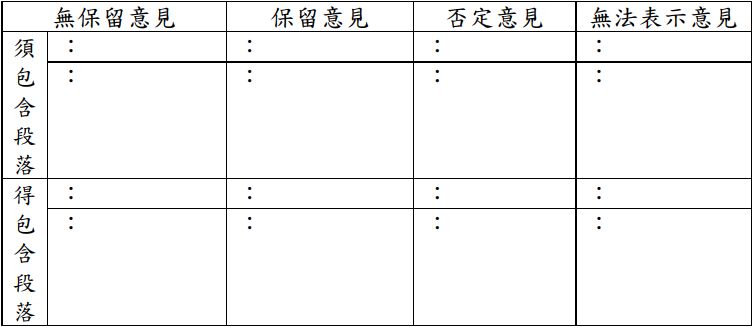
IV. 根據我國審計準則公報,比較修正式意見查核報告與無保留意見查核報告之異同。請先列
出無保留意見查核報告得包含之所有段落標題(區分為須包含者與得包含者),再就各類修正式意見查
核報告,逐一說明該類查核報告與無保留意見查核報告每一段落間之差異。差異按以下分類:
代號 差異種類
A 須包含此段落,且標題與內容均相同
B 須包含此段落,且標題相同但內容不同
C 須包含此段落,但標題與內容均不同
D 得包含此段落,且標題與內容均相同
G 得包含此段落,且標題相同但內容不同
F 得包含此段落,但標題與內容均不同
G 不得包含此段落
請將下列表格複製於答案卷上並將答案彙總其中(差異種類以代號列示)。
相關試卷
110年 - 110 國立政治大學_碩士班暨碩士在職專班招生考試_會計研究所/會計、稅務組:審計學#125294
110年 · #125294
110年 - 110 國立臺灣大學_碩士班招生考試試題_會計學研究所:審計學#123557
110年 · #123557
110年 - 110 國立台北商業大學_碩士班招生考試_會計資訊系會計財稅:審計學#110839
110年 · #110839
110年 - 110東吳大學_碩士班招生考試_會計學系︰審計學#100129
110年 · #100129
109年 - 109國立臺灣大學_碩士班招生考試_會計學研究所:審計學#111292
109年 · #111292
109年 - 109 輔仁大學_碩士班招生考試_會計學系:審計學#105744
109年 · #105744
109年 - 109中原大學_碩士班招生考試_會計學系︰審計學#101446
109年 · #101446
109年 - 109東吳大學_碩士班招生考試_會計學系B組(智能審計)︰審計學#100467
109年 · #100467
108年 - 109東吳大學_碩士班招生考試_會計學系:審計學#101268
108年 · #101268
107年 - 107 東吳大學_碩士班招生考試_會計學系:審計學#111193
107年 · #111193
 阿摩線上測驗
登入
阿摩線上測驗
登入