所屬科目:台大◆電機◆工程數學(C)(含微分方程、線性代數)
1. (5%) Which are the possible solutions of the differential equation =y2-9? (A) y=3 (B) y=-3 (C) (D)(E)
2. (5%) Which are the possible solutions of the differential equation ?(A)(B)(C) (D) (E)
4. (5%) Consider the equationwiththe boundary conditions y(0)=0.y(π)=π.Which statements are correct? (A) The particular solution is yP =-x. (B) The general solution is y=ex sinx+x. (C) There is a unique solution to this boundary-value problem. (D) This differential equation is homogencous. (E) None of the above.
5. (5%) Which are the possible solutions of the differential equation ? (A) y+Inly-1l=x (B) 2y+In|y-1|=4x (C) 2y+1n|2y-1|=4x+4 (D)y2 =2x (E) y2=-2x+1
6. (5%) Assume.Which statements are always true?(A) c0=0 (B) c1=0 (C) C2=0 (D)(E)
7. (5%) Consider the equation with the inial condition y(0)=1. Which satecmens about dt the function y(t) and its Laplace transform Y(s) are correct? (A) (B) (C)t sint (D) y(π)=0 (E) y(π)=-1
8. (5%) Which are the possible solutions of the given system?(A)(B)(C)(D)(E)
9. (5%) Consider the wave equation. Which are the possible solutions? (A) u(x,t)=f(x-at) (B) u(x,r)=f(x+at) (C) (D) (E) None of the above
10. (5%) Evaluate the Fourier transform (A) (B) (C) (D) (E)
11. (5%) Find an equation involving g, h, and k that makes this augmented matrix correspond to a consistent system: (A) 2k+g+h =0 (B)k+2g+3h =0 (C) k+2g+h =0 (D) 3k+g+2h = 0 (E) 4k+h+2h = 0
12. (5%) Let For what value(s) ofh is b in the plane spanned by al and a2? (A) 0 (B) -10 (C) 16 (D) -17 (E) 20
13. (5%) Determine the rank of the matrix in the following.(A)0 (B)1 (C)2 (E) 4 (D)3
14. (5%) Matrix A can be written in the form A=LU, where L is m x m lower triangular matrix I's on the diagonal and U is an m x n echelon form of A. Such a factorization is called an LU factorization. Please find the L matrix for LU factorization of the following matrix A.
(A)(B)(C)(D)(E)
15. (5%) Find the determinant for the following matrix (A)-5 (B) 5 (C)1 (D)-1 (E) 0
16. (5%) Find the dimension of the subspace(A) 2 (B) 3 (C) 4 (D) 1 (E) 0
17Let and consider the bases for R2 given by B={b1,b2} and C={c1,c2}. Find the change-of-coordinates matrix from C to B. (A)(B)(C)(D)(E)
19. (5%) Find the singular values of the following matrix . (A) 0 (B) 1 (D) 3 (E) 4 (C) 2
 阿摩線上測驗
登入
阿摩線上測驗
登入
阿摩線上測驗
登入
阿摩線上測驗
登入
 =y2-9? (A) y=3 (B) y=-3 (C)
  (D)
(D) (E)
(E) 
 ?(A)
?(A) (B)
(B) (C)
(C) (D)
(D) 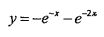 (E)
(E) 
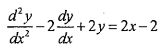 withthe boundary conditions y(0)=0.y(π)=π.Which statements are correct? (A) The particular solution is yP =-x. (B) The general solution is y=ex sinx+x. (C) There is a unique solution to this boundary-value problem. (D) This differential equation is homogencous. (E) None of the above.
 ? (A) y+Inly-1l=x (B) 2y+In|y-1|=4x (C) 2y+1n|2y-1|=4x+4 (D)y2 =2x (E) y2=-2x+1
 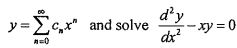 .Which statements are always true?(A) c0=0 (B) c1=0 (C) C2=0 (D)
 (E)
(E)
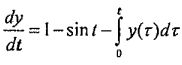 with the inial condition y(0)=1. Which satecmens about dt the function y(t) and its Laplace transform Y(s) are correct? (A)
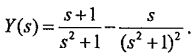 (B)
(B) 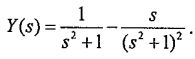 (C)
(C)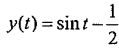 t sint (D) y(π)=0 (E) y(π)=-1
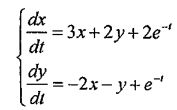 (A)
(A)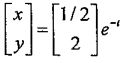 (B)
(B)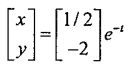 (C)
(C)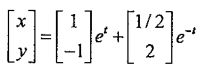 (D)
(D)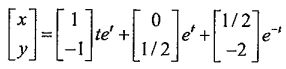 (E)
(E)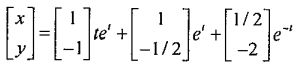
 . Which are the possible solutions? (A) u(x,t)=f(x-at) (B) u(x,r)=f(x+at) (C)
 (D)
(D)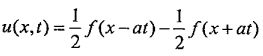 (E) None of the above
  (A)
(A)  (B)
(B) 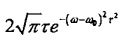 (C)
(C)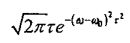 (D)
(D) 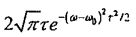 (E)
(E)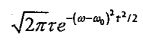
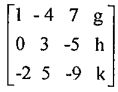 (A) 2k+g+h =0 (B)k+2g+3h =0 (C) k+2g+h =0 (D) 3k+g+2h = 0 (E) 4k+h+2h = 0
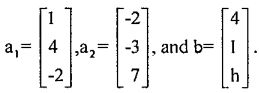 For what value(s) ofh is b in the plane spanned by al and a2? (A) 0 (B) -10 (C) 16 (D) -17 (E) 20
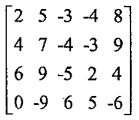 (A)0 (B)1 (C)2 (E) 4 (D)3
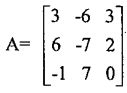 (A)
(A)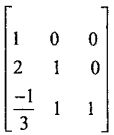 (B)
(B)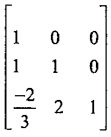 (C)
(C)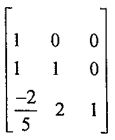 (D)
(D)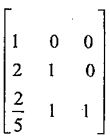 (E)
(E)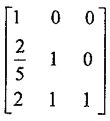
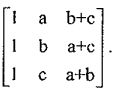 (A)-5 (B) 5 (C)1 (D)-1 (E) 0
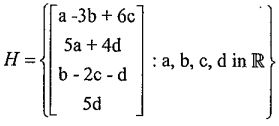 (A) 2 (B) 3 (C) 4 (D) 1 (E) 0
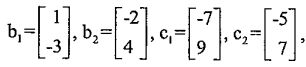 and consider the bases for R2 given by B={b1,b2} and C={c1,c2}. Find the change-of-coordinates matrix from C to B. (A)
 (B)
(B) (C)
(C) (D)
(D) (E)
(E)
 . (A) 0 (B) 1 (D) 3 (E) 4 (C) 2