所屬科目:研究所、轉學考(插大)◆流體力學及熱傳學
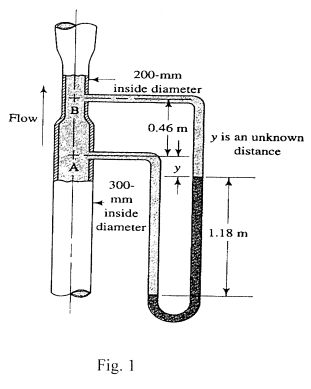
1. The venturi meter shown in Fig. I carries water at 60 ℃ (The specific weight γ = 9.65 kN/m3). The specific gravity of the gage fluid in the manometer is 1.25. Calculate the velocity of flow at scction A and the volume flow rate of wate
r.
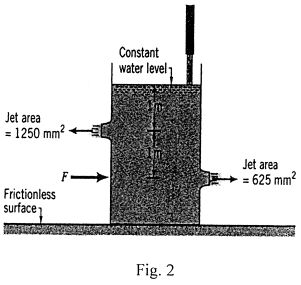
2. Water is added to the tank shown in Fig. 2 through a vertical pipe to maintain a constant (water) level. The tank is placed on a horizontal plane, which has a frictionless surface. Determine the horizontal force, F, required to hold the tank stationary. Neglcct all losses.
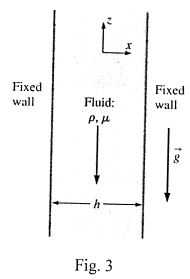
3. Consider steady, incompressible, parallel, taminar flow of a viscous fluid falling between two infinite vertical walls, as shown in Fig. 3. The distance between the walls is h, and the gravity acts in the negative z-direction. There is no applied pressure driving the flow; that is, the fluid falls by gravity alone. The pressure is constant everywhere in the flow field. Calculate the velocity field.
(b) Show that , where δ is the boundary-layer thickness and , please find C=?
(c) Show that local skin friction coefficient . Please find D=? (10%) (4%)
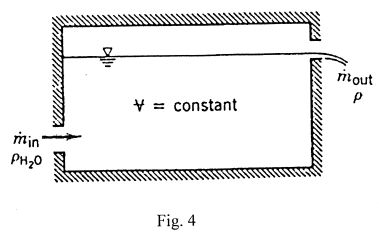
5. As shown in Fig. 4, a tank with fixed volume,contains brine with initial density, ρi, greater than water. Pure water enters the tank steadily and mixes thoroughly with the brine in the tank. The liquid level in the tank remains constant. Derive expressions for (a) the rate of change of density of the liquid mixture in the tank, and (b) the time required for the density to reach the value ρf, where, ρi > ρf > ρH2O Note: A first-order lincar differential equation:y'(x)+ p(x)y = q(x). Its solution is
 阿摩線上測驗
登入
 , where δ is the boundary-layer thickness and
 , please find C=?
 . Please find D=? (10%) (4%)
 contains brine with initial density, ρi, greater than water. Pure water enters the tank steadily and mixes thoroughly with the brine in the tank. The liquid level in the tank remains constant. Derive expressions for (a) the rate of change of density of the liquid mixture in the tank, and (b) the time required for the density to reach the value ρf, where, ρi > ρf > ρH2O Note: A first-order lincar differential equation:y'(x)+ p(x)y = q(x). Its solution is