24. After people take the medicine X, it can be absorbed into the body through pathway A→B and enter the blood. Medicine in the blood can reduce its concentration through decomposition (B→C) or excretion (B→D), as shown in the figure below:

Assume that the process A→B is much faster than those of B→C and B→D. Therefore, each time a medicine with a dose of [X]o is taken, it can be regarded as immediately producing a concentration of [X]b (= 0.020 mM) of X in the blood. Assume that B→C and B→D are both first-order processes, and their rate constants are k1 (= 0.075 h-1 ) and k2 (= 0.025 h-1 ), respectively. If a person takes the same dose ([X]o) of the medicine every t hour, answer the following questions. (A) Just after taking the medicine for the nth time, its concentration in the blood is equal to [P]n. Express [P]n as a function of [X]b, k1, k2 and t. 3% (B) Continue to take the medicine every 6 hours for a long period of time (n→∞), calculate [P]∞ (in mM)? 3% (C) Find the half-life of the medicine in the blood. 2% (D) What proportion of the decrease in medicine concentration in the blood is caused by decomposition? 2%
 阿摩線上測驗
登入
阿摩線上測驗
登入
 A- + HB, K > 1 and pKb(A- ) < 7.0. Which of the following order of K’s is correct? (A) Kb(B- ) > Ka(HB) > Ka(HA) > Kb(A- ) (B) Kb(A- ) > Kb(B- ) > Ka(HA) > Ka(HB) (C) Kb(B- ) > Kb(A- ) > Ka(HA) > Ka(HB) (D) Kb(B- ) > Ka(HA) > Kb(A- ) > Ka(HB)
 2SO3(g) (A) a decrease in volume of container (B) an increase in temperature (C) increasing P by adding some argon (D) adding a catalyst
 PCl3(g) + Cl2(g), Kc = 0.025 at 400 K. If 0.5 mol of PCl5 is placed in a 1.0 L container at 400 K and is allowed to reach equilibrium, what is the total pressure (in atm) of the gases? (A) 5 (B) 10 (C) 15 (D) 20
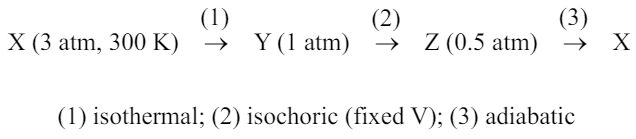 Answer the following questions. (ln 3 = 1.1) (A) Find the temperature (T) at state Z. 2% (B) Find the work done (w) for step (3). 2% (C) Find the change in enthalpy (△H) for step (2). 3% (D) Find the heat (q) involved in a cycle. 3%