所屬科目:研究所、轉學考(插大)、學士後-計算機概論
1. What is the binary representation of the decimal number 69? (A) 1001111 (B) 1001101 (C) 1000101 (D) 1001100
2. In computer science, which of the following best describes an array? (A) A collection of elements where each element points to the next. (B) A data structure that stores elements in a first-in, first-out manner. (C) A collection of elements stored at contiguous memory locations, accessed by an index. (D) A hierarchical data structure with a root and child nodes.
3. What is the primary function of a compiler in the context of programming languages? (A) To execute program instructions line by line during runtime. (B) To translate source code written in a high-level language into machine code or an intermediate language, typically before execution. (C) To manage the allocation and deallocation of memory for program variables. (D) To provide a runtime environment and libraries for program execution.
4. In the Open Systems Interconnection (OSI) model, which layer includes the sublayer where the Media Access Control (MAC) address operates? (A) Network Layer (B) Data Link Layer (C) Transport Layer (D) Physical Layer
5. When using Big-O notation to describe the running time of an algorithm, what is the key idea behind lignoring everything except the element that makes the biggest difference to the running time? (A) It simplifies calculations by removing constants. (B) It focuses on the average-case performance of the algorithm. (C) For very large inputs, the contribution of less significant components becomes negligible. (D) It helps determine the exact running time for small inputs.
6.What is the result of the bitwise AND operation between the decimal numbers 13 and 22? (A) 4 (B) 13 (C) 17 (D)30
7.Which option arranges the following memory types in order of decreasing access speed (fastest to slowest): I. RAMII. CPU Registers III. Cache MemoryIV. Hard Disk Drive (A) II, III, I, IV (B) III, II, I, IV (C) II, I, III, IV (D) IV, I, III, II
8.What is the average-case time complexity of the Bubble Sort algorithm for an input of size n? (A) O(n log n) (B) O(n) (C)O(n2) (D) O(log n)
9.Which of the following statements best describes a key characteristic of a Universal Turing Machine (UTM)? (A) A UTM can solve any mathematical problem, including those proven to be undecidable like the Halting Problem. (B) A UTM is designed with a specific set instructions to solve one particular complex computational problem with maximum efficiency. (C) A UTM can simulate any other Turing machine if provided with a description of that machine and its input. (D) A UTM operates using quantum bits (qubits) to achieve computational power beyond classical Turing machines.
10.In a multi-user database environment, complex interactions between simultaneous transactions can lead to undesirable outcomes such as "lost updates" (where one transaction's changes are overwitten by another), "dirty reads" (where a transaction reads uncommitted data from another transaction), and "inconsistent reads" (where a transaction reads different values for the same data item at different points in time). Which core aspect of database management, typically managed within the database architecture, is primarily responsible for addressing and preventing these types of anomalies? (A) Indexing, which optimizes data retrieval by creating sorted pointers to data records, thereby speeding up query execution and reducing the likelihood of data conflicts. (B) Relational Algebra, which provides a theoretical foundation for querying and manipulating data in relational databases, enabling structured data operations. (C) Concurrency Control, which employs various mechanisms to manage the interleaved execution of transactions, ensuring data integrity and transaction isolation. (D) B-trees, a tree data structure used for efficient storage and retrieval of data on disk, enabling fast lookup, insertion, and deletion operations within a database.
11. What is the output of the following code? int arr[] = {1,2,3,4, 4, 5};int *ptr = arr + 2; printf("%d", *(ptr++)); (A)1 (B) 2 (C)3 (D) 4
12. What will this code output? (A) abcdef (B) ab (C) abcd (D) abc
13. Given the following code, what is printed?(A) 10 (B) 20 (C) 30 (D) 40
14. Which of the following best describes the result of this code?(A) abc (B) bcd (C) acc (D) bcc
15. What does the function compute? (A) Fibonacci of n (B) n squared (C) n factorial (D) Sum from 1 to n
16. What is the output of this recursive function call: foo(3); ? (A) 1233213 (B) 1213121 (C) 3211231 (D) 1122332
17. What is the result of the following pointer expression? int x = 10;int*p=&x; int **pp = &p;printf("%d", **pp + *p); (A)10 (B) 20 (C)0 (D)5
18. What is the output of this code?char *s = "hello"; printf("%c", 3[s]); (A) h (B) e (C)1(D)o
19. What will the code output? char *s = "abcde";printf("%c",*(s+*(s+1) - 'a'); (A) a (B) b (C)c (D) d
20. What does this code output?(A) hallo (B) hello (C) olleh (D) haoll
 阿摩線上測驗
登入
阿摩線上測驗
登入
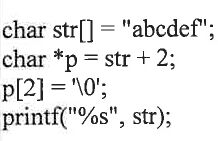 (A) abcdef (B) ab (C) abcd (D) abc
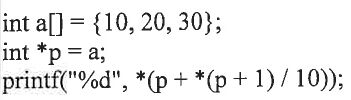 (A) 10 (B) 20 (C) 30 (D) 40
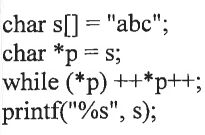 (A) abc (B) bcd (C) acc (D) bcc
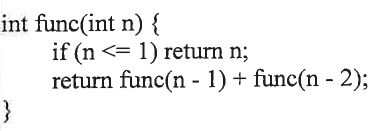 (A) Fibonacci of n (B) n squared (C) n factorial (D) Sum from 1 to n
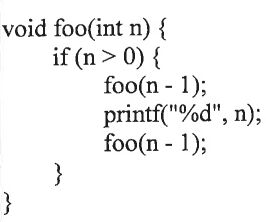 (A) 1233213 (B) 1213121 (C) 3211231 (D) 1122332
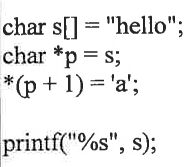 (A) hallo (B) hello (C) olleh (D) haoll