所屬科目:研究所、轉學考(插大)◆心理學概論
1. Most research on psychopathology is correlational because: (A) It would be unethical to manipulate variables to induce psychological disorders (B) The population of potential research participants is too small for correlational studies (C) It is very difficult to develop operational definitions of psychological disorders (D) It would be difficult to randomly assign a group of people with a particular psychological disorder to different groups
2. Which of the following best describes the function of the myelin sheath in the nervous system? (A) It generates electrical impulses (B) It insulates axons and speeds up neural transmission (C) It releases neurotransmitters (D) It connects neurons to muscles
3. According to Piaget, during which stage do children develop object permanence? (A) Sensorimotor (B) Preoperational (C) Concrete operational (D) Formal operational
4. Which part of the brain is primarily responsible for regulating basic drives such as hunger, thirst, and body temperature? (A) Hippocampus (B) Hypothalamus (C) Amygdala (D) Cerebellum
5. Your friend Cal explains to you that when he looks at the names of the days of the week on his calendar, each day looks as if it is written in a different color. For example, Cal always sees Monday as written in a light maroon color, while Tuesday is always in royal blue. Based on Cal's description, it is likely that he is a(n): (A) integrative perceptionist (B) synestheste (C) holistic reader (D) selective reader
6. In studies of monozygotic twins separated at birth and adopted into different environments there are: (A) no similarities (B) only physical similarities (C) only broad personality trait similarities (D) sometimes a surprising number of similarities with regard to idiosyncratic behaviors
7. Which of the following is an example of a fixed-ratio schedule of reinforcement? (A) Getting paid every two weeks (B) Winning on a slot machine (C) Receiving a bonus for every 10th sale (D) Pop quizzes in class
8. Imagine you are at the end part of the chain of activity on a production fine. Your boss, who in his previous career was a neuroscientist, calls you an agonist. What would he be implying? (A) that you completely halt production (B) that you interfere with production (C) that you take stuff out of the process that is defective (D) that you facilitate production
9. What does the term "cognitive dissonance" refer to? (A) The tendency to conform to group norms (B) The discomfort felt when holding conflicting beliefs or behaviors (C) The process of learning through observation (D) The inability to recall past events
10. Which disorder is characterized by alternating periods of depression and mania? (A) Major depressive disorder (B) Generalized anxiety disorder (C) Bipolar disorder (D) Schizophrenia
11. In Milgram's obedience study, what was the main finding? (A) People refuse to obey authority figures when asked to harm others (B) Most participants were willing to administer potentially lethal shocks when instructed by an authority figure (C) Obedience rates were higher among women than men (D) The presence of others decreased obedience
12. If you close one eye, you will still be able to use _______ as a depth cue, but you will not be able to use _______ as a depth cue. (A) linear perspective; occlusion (B) texture gradients; disparity (C) convergence; motion parallax (D) disparity; linear perspective
13. Prolonged exposure to movement in one direction _______ the motion detectors sensitive to that direction. When the movement stops, the baseline firing rate of detectors for the opposite direction of motion will be _______ than the firing rate for the detectors that responded to the prolonged movement, leading to motion aftereffects. (A) activates; higher (B) activates; lower (C) fatigues; higher (D) fatigues; lower
14. If you trained a rat to fear a flashing light by pairing it with a painful electric shock, what would be your conditioned stimulus? (A) flashing light (B) electric shock (C) fear (D) extinction
15. You use eye drops to keep your contacts moist. At first it was just once in the morning, but now it seems you are using eye drops every hour or your eyes just seem to dry out. This increased need for eye drops can be considered an example of _______ and may be due to a mild _______ to eye drops. (A) tolerance; addiction (B) sensitization; habituation (C) withdrawal effects; addiction (D) counter conditioning; habituation
16. In males, at what age does Schizophrenia most often result in hospitalization? (A) Early childhood (0-10yrs) (B) Adolescence (10-20yrs) (C) Midlife (20-40yrs) (D) Later life (40-60yrs)
17. Why is Skinner's dream of solving all social problems through operant conditioning impossible? (A) Biology places constraints on our learning. (B) Operant conditioning isn't effective for learning. (C) Operant conditioning doesn't apply to social learning. (D) Operant conditioning doesn't take into account learning from classical conditioning.
18. Anterograde amnesia is most commonly associated with what part of the brain? (A) Corpus Callosum (B) Hippocampus (C) Primary Visual Cortex (D) Somatosensory Cortex
19. According to the research conducted by Loftus, people will estimate _______ speeds when they are asked how fast a car was going when it smashed into another car relative to when they are asked how fast a car was going when it collided with another car? (A) slower (B) faster (C) similar (D) the same
20. Evolutionary psychologists are more likely to explain the male and female sexual roles of today as (A) products of recent changes in the society. (B) behaviors that developed over extremely long periods of time. (C) identical to those roles as they existed during the Pleistocene era. (D) learned responses to environmental consequences in the individual male's and female's experience.
21. A student is walking through an exhibit at the science museum entitled "The Living Brain." The exhibit takes her from the outer layers of the brain to its deepest recesses. What is the route she will follow? (A) cerebrum, limbic system, brain stem (B) brain stem, limbic system, cerebrum (C) limbic system, cerebrum, brain stem (D) cerebrum, brain stem, limbic system
22. Back in 1920s, Psychologist Lewis Terman explored the popular myth that gifted children have problems with social and emotional adjustment. He found (A) his sample to be better adjusted than their less gifted peers. (B) that gifted children had more problems with social adjustments as compared to their less gifted peers. (C) that gifted children did not participate in athletic activities as compared to their less gifted peers. (D) his sample was poorer on adjustment than their less gifted peers.
23. Charles Spearman's belief that there is a factor of general intelligence underlying all intelligent performance was based on his finding that (A) the performance of individuals on a variety of intelligence tests was highly correlated. (B) each individual domain has associated with it specific skills. (C) a person's performance on tests depended both on general intelligence and domain-specific abilities. (D) fluid intelligence and crystallized intelligence were relatively independent.
24. One of the best ways to remember factual information is to relate it to something personal. In this way, you are taking advantage of your _______ memory to aid retrieval from your _______ memory. (A) implicit; explicit (B) semantic; episodic (C) episodic; semantic (D) explicit; implicit
25. One probable reason that children with more affluent parents tend to have higher IQs is that these children are more likely to: (A) be genetically predisposed to be more intelligent (B) attend better schools and have more enrichment (C) be familiar with the information on IQ tests (D) take classes to prepare them for IQ tests
26. The Stanford Prison Experiment demonstrates the power _______ has in shaping our behaviors. (A) genetics (B) deprivation (C) personality (D) context
27. Alfred Adler's theory of personality revolved around the (A) centrality of Eros and libidinal pleasures. (B) attempts by people to overcome feelings of inferiority. (C) attempts by people to overcome feelings of superiority. (D) ego and its defenses.
28. Although she has never been snowboarding, a girl feels she will not enjoy the sport because she does not like cross-country skiing. She is using the _______ heuristic. (A) availability (B) anchoring (C) representativeness (D) framing
29. Students have been asked to leave the library and wait several blocks away. In which of the following situations would the students be most likely to want to wait together? (A) there is a fire drill (B) there is a bomb threat (C) there has been an assault (D) no explanation has been given
30. Motor-cortex neurons that fire (i.e., become active) in the same manner when you watch someone perform a task as when you perform that task yourself are called _______ neurons. (A) Model (B) Secondary (C) Primary (D) Mirror
31. According to the theory of embodied cognition, which of the following best reflects its core viewpoint? (A) Cognitive processes are completely independent of bodily sensations and motor systems. (B) Bodily states and interactions with the environment directly influence cognition and emotion. (C) Memory storage depends on neural connections in specific brain regions. (D) Language ability is the only determinant of cognitive development.
32. In dual-process theories of social cognition, what are the characteristics of System 1? (A) Relies on logical analysis and step-by-step reasoning. (B) Fast, automatic, and easily influenced by heuristics. (C) Requires high levels of conscious control and attentional resources. (D) Specializes in complex mathematical calculations.
33. In cognitive dissonance theory, how is a person most likely to reduce dissonance if they smoke despite knowing the health risks? (A) Change their behavior (quit smoking) (B) Add new cognitions to justify smoking (e.g., "It helps relieve stress") (C) Downplay the importance of the contradictory cognition (e.g., "The risks are exaggerated") (D) All of the above
34. Which experiment most directly supports the cross-cultural universality of basic emotions? (A) Milgram's obedience experiment (B) Ekman's facial expression recognition research (C) Asch's conformity experiment (D) Harlow's rhesus monkey experiment
35. In attribution theory, the bias of underestimating situational factors and overestimating personal traits is called: (A) Self-serving bias (B) Fundamental attribution error (C) Confirmation bias (D) Anchoring effect
36. According to social impact theory, which of the following is NOT one of the three main factors influencing conformity? (A) Immediacy of the group (B) Size of the group (C) Status of the group (D) Moral controversy of the issue
37. Which of the following best describes the difference between a fixed mindset and a growth mindset, according to Carol Dweck? (A) Fixed mindset believes intelligence is malleable; growth mindset believes it is static. (B) Fixed mindset views abilities as unchangeable; growth mindset believes abilities can be developed through effort. (C) Fixed mindset leads to greater academic achievement; growth mindset leads to less motivation. (D) Fixed mindset is associated with higher self-esteem; growth mindset is associated with lower self-esteem.
38. According to Erikson's psychosocial theory, failure to resolve the "identity vs. role confusion" stage may result in: (A) Guilt and shame (B) A lack of trust in others (C) Difficulty forming close relationships in adulthood (D) A sense of stagnation and unproductiveness
39. In Solomon Asch's classic conformity experiments, which factor was found to most strongly decrease conformity? (A) Increasing the size of the majority (B) The presence of a single ally who disagreed with the majority (C) Making the task more ambiguous (D) Increasing the number of trials
40. Which of the following best illustrates the concept of "reciprocal determinism" as proposed by Albert Bandura? (A) A person's genetic makeup determines their personality regardless of environment. (B) An individual's behavior, personal factors, and environment all influence each other. (C) Behavior is shaped solely by reinforcement and punishment. (D) Cognitive development occurs in fixed stages.
簡答題1. 請解釋「自我效能感」(self-efficacy)的意義,並說明它如何影響個體的行為。
2. 請舉兩例來說明行為主義在教育上的實際應用。
3. 心理學中的「認知」指的是什麼樣的心理過程。
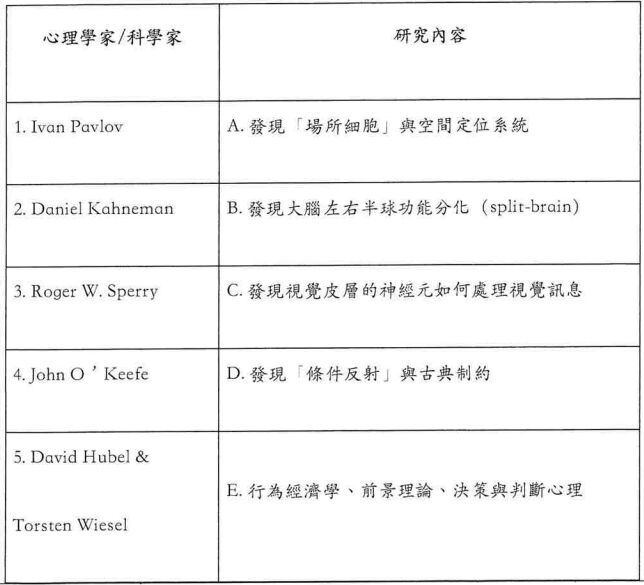
4. Please. Below are 5 Psychologists who have received the prestigious Nobel Awards. Please make the right connections (such as 1-A, etc) between their names and the achievements.
 阿摩線上測驗
登入