所屬科目:研究所、轉學考(插大)◆普通化學
1. You are asked to determine the perimeter of the cover of your textbook. You measure the length as 39.36 cm and the width as 24.83 cm. How many significant figures should you report for the perimeter? (A) 1 (B) 2 (C) 3 (D) 4 (E) 5
2. Many classic experiments have given us indirect evidence of the nature of the atom. Which of the experiments listed below did not give the results described? (A) The Rutherford experiment proved the Thomson "plum-pudding" model of the atom to be essentially correct. (B) The Rutherford experiment was useful in determining the nuclear charge on the atom. (C) Millikan's oil-drop experiment showed that the charge on any particle was a simple multiple of the charge on the electron. (D) The electric discharge tube proved that electrons have a negative charge. (E) All of the above experiments gave the results described.
3. You are given a compound with the formula MCl2, in which M is a metal. You are told that the metal ion has 26 electrons. What is the identity of the metal? (A) Fe (B) Al (C) Zn (D) Co (E) Ni
4. All of the following are in aqueous solution. Which is incorrectly named? (A) HC2H3O2, acetic acid (B) HBr, bromic acid (C) H2SO3, sulfurous acid (D) HNO2, nitrous acid (E) HClO3, chloric acid
5. A substance, A3B, has the composition by mass of 60% A and 40% B. What is the composition of AB3 by mass? (A) 40% A, 60% B (B) 50% A, 50% B (C) 14% A, 86% B (D) 25% A, 75% B (E) none of these
6. A 2.80-g sample of an oxide of bromine is converted to 4.698 g of AgBr. Calculate the empirical formula of the oxide. (molar mass for AgBr = 187.78 g/mol) (A) BrO3 (B) BrO2 (C) BrO (D) Br2O (E) none of these
7.For the reaction \( 4\text{FeCl}_2(aq) + 3\text{O}_2(g) \rightarrow 2\text{Fe}_2\text{O}_3(s) + 4\text{Cl}_2(g) \), what volume of a \( 0.760\ M \) solution of \( \text{FeCl}_2 \) is required to react completely with \( 6.36 \times 10^{21} \) molecules of \( \text{O}_2 \)?
(A) \( 5.26 \times 10^3\text{mL} \) (B) \( 10.7\text{ mL} \) (C) \( 10.4\text{ mL} \) (D) \( 18.5\text{ mL} \) (E) \( 6.02\text{ mL} \)
8. Four identical 1.0-L flasks contain the gases He, Cl2, CH4, and NH3, each at 0°C and 1 atm pressure. Which gas has the highest density? (A) He (B) Cl2 (C) CH4 (D) NH3 (E) all gases the same
9. Order the following in increasing rate of effusion: F₂, Cl₂, NO, NO₂, CH₄ (A) Cl₂ < NO₂ < F₂ < NO < CH₄ (B) Cl₂ < F₂ < NO₂ < CH₄ < NO (C) CH₄ < NO₂ < NO < F₂ < Cl₂ (D) CH₄ < NO < F₂ < NO₂ < Cl₂ (E) F₂ < NO < Cl₂ < NO₂ < CH₄
10. Consider the following specific heats of metals. The Specific Heat (J/(g°C)) for Zinc, Magnesium, Iron, Silver, and Lead are 0.387, 1.02, 0.450, 0.237, 0.127, respectively. If the same amount of heat is added to 25.0 g of each of the metals, which are all at the same initial temperature, which metal will have the highest temperature? (A) Zinc (B) Magnesium (C) Iron (D) Silver (E) Lead
11. Consider the following processes: | Processes | 3B → 2C + D | (1/2)A → B | E + A → D | | --- | --- | --- | --- | | ΔH (kJ/mol) | -125 | 150 | 350 | Calculate ΔH for: B → E + 2C (A) 325 kJ/mol (B) 525 kJ/mol (C) -175 kJ/mol (D) -325 kJ/mol (E) none of these
12. What is the wavelength of light that is emitted when an excited electron in the hydrogen atom falls from n = 5 to n = 1? (h = 6.626×10⁻³⁴ J·s) (A) 1.05 × 10⁷ m (B) 9.50 × 10⁻⁸ m (C) 2.09 × 10⁻¹⁸ m (D) 9.12 × 10⁻⁸ m (E) none of these
13. Consider the following orderings. I. Na⁺ < Mg²⁺ < Al³⁺ < Si⁴⁺ II. Be < Mg < Ca < Sr III. I < Br < Cl < F IV. Al < Si < P < Cl Which of these give(s) a correct trend in ionization energy? (A) III (B) II, IV (C) I, IV (D) I, III, IV (E) none of them
14. Consider the following molecules. Select the molecule(s) that violate the octet rule. (A) I, II, IV (B) I, III, IV, VI (C) III, V, VI (D) I, IV, VI (E) I, II, IV, VI
15. Which of the following statements is true? (A) Tetrahedral molecules (four identical bonds equally spaced) always has a dipole moment. (B) Both HF and CO₂ are linear molecules and therefore polar. (C) The correct order for molecules from most to least polar is CF₂H₂ > CCl₂H₂ > CF₂Cl₂ > CH₄ = CCl₄. (D) The molecular structure of SOCl₂ is trigonal planar. (E) The molecular structure of XeF₅⁺ is trigonal bipyramidal.
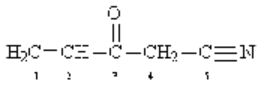
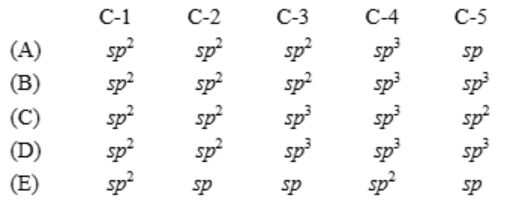
16. Consider the molecule:Specify the hybridization of each carbon atom.
17. Which of the following statements is false?(A) The bond length of $\text{N}2$ is shorter than $\text{N}2^+$.(B) The bond in of $\text{N}2$ is stronger than $\text{N}2^-$.(C) The bond dissociation energy of $\text{N}2$ is higher than $\text{N}2^-$.(D) The bond order of $\text{N}_2$ is 2.5.(E) All of above are true.
18. Which one of the following decreases as the strength of the attractive intermolecular forces increases? (A) the heat of vaporization (B) the normal boiling temperature (C) the extent of deviations from the ideal gas law (D) the sublimation temperature of a solid (E) the vapor pressure of a liquid
19. Determine the osmotic pressure of a solution that contains 0.048 g of a hydrocarbon solute (molar mass = 340 g/mol) dissolved in benzene to make a 350-mL solution. The temperature is 20.0°C. (A) 0.50 torr (B) 2.5 torr (C) 3.3 torr (D) 7.4 torr (E) 6.9 torr
20. For a reaction: aA → Products, $[\text{A}]_0 = 6.0 \text{ M}$, and the first two half-lives are 56 and 28 minutes, respectively. Calculate $[\text{A}]$ at $t = 105.9$ minutes. (A) 5.7 M (B) 12 M (C) 0.68 M (D) 0.33 M (E) none of these
21. Consider the following reaction: $\text{CS}2(g) + 4\text{H}2(g) \rightleftharpoons \text{CH}4(g) + 2\text{H}2\text{S}(g)$. The equilibrium constant $K$ is about 0.31 at 900°C. What is the $K_p$ at this temperature? (A) $2.9 \times 10^3$ (B) $3.2 \times 10^{-3}$ (C) $3.3 \times 10^{-5}$ (D) $3.0 \times 10^1$ (E) $1.1 \times 10^{-3}$
22. The questions below refer to the following system: $$\text{Co}(\text{H}2\text{O}){6}^{2+} + 4 \text{Cl}^- \rightleftharpoons \text{CoCl}4^{2-} + 6\text{H}2\text{O}$$ When cobalt(II) chloride is added to pure water, the $\text{Co}^{2+}$ ions hydrate. The hydrated form then reacts with the $\text{Cl}^-$ ions to set up the equilibrium shown here. Which statement below describes the change that the system will undergo if silver nitrate is added? (A) It should become more blue. (B) It should become more pink. (C) Water will be produced. (D) The silver ion will react with the $\text{CoCl}_4^{2-}$. (E) Nothing will change.
23. Using the following $K_a$ values, indicate the correct order of base strength. $$\text{HNO}_2 \text{ Ka} = 4.0 \times 10^{-4} \quad \text{HF Ka} = 7.2 \times 10^{-4} \quad \text{HCN Ka} = 6.2 \times 10^{-10}$$ (A) $\text{CN}^- > \text{NO}2^- > \text{F}^- > \text{H}2\text{O} > \text{Cl}^-$ (B) $\text{Cl}^- > \text{H}2\text{O} > \text{F}^- > \text{NO}2^- > \text{CN}^-$ (C) $\text{CN}^- > \text{F}^- > \text{NO}2^- > \text{Cl}^- > \text{H}2\text{O}$ (D) $\text{H}2\text{O} > \text{CN}^- > \text{NO}2^- > \text{F}^- > \text{Cl}^-$ (E) none of these
24. The standard molar free energies of formation of $\text{NO}2(g)$ and $\text{N}2\text{O}_4(g)$ at 25°C are 51.840 and 98.035 kJ/mol, respectively. What is the value of $Kp$ (in atm) for the reaction written as follows at 25°C? $2\text{NO}2 \rightleftharpoons \text{N}2\text{O}4$ (A) $6.24 \times 10^{11}$ (B) 1.00 (C) 9.76 (D) $4.38 \times 10^{-36}$ (E) $7.99 \times 10^{-9}$
25. The titration curve for 50.00 mL 1.000M disodium ascorbate, $\text{Na}_2\text{As}$, with standard 1.000M HCl is shown below: The pH at point I and III are 11.79 and 4.10, respectively, which of the following would be the pKa1 of the diprotic acid, $\text{H}_2\text{As}$ (A) 4.10 (B) 7.95 (C) 11.79 (D) 12.39 (E) none of these
 阿摩線上測驗
登入
 | Processes | 3B → 2C + D | (1/2)A → B | E + A → D | | --- | --- | --- | --- | | ΔH (kJ/mol) | -125 | 150 | 350 | Calculate ΔH for: B → E + 2C (A) 325 kJ/mol (B) 525 kJ/mol (C) -175 kJ/mol (D) -325 kJ/mol (E) none of these
 Select the molecule(s) that violate the octet rule. (A) I, II, IV (B) I, III, IV, VI (C) III, V, VI (D) I, IV, VI (E) I, II, IV, VI
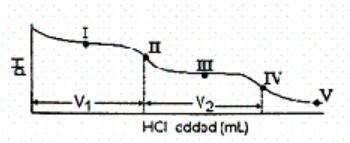 (A) 4.10 (B) 7.95 (C) 11.79 (D) 12.39 (E) none of these