阿摩線上測驗
33. I was used to ______ alone, so travelling with friends has been a big adjustment for me to
make.
(A) travelling
(B) travel
(C) to travel
(D) travelled
統計: A(1859), B(1395), C(94), D(253), E(0) #3090538
詳解 (共 10 筆)

be used to / used to
be used to + Ving / 名詞:習慣於...
這個用法中的 to 是介係詞,因此後面必須加上名詞或是動名詞喔!那如果要表示原本不習慣,後來習慣了的這種「改變的過程」,可以把 be 改成 get 或是 become。
例 1:I’m used to drinking a glass of warm water after I wake up.
(我習慣在起床之後喝一杯溫水。)
例 2:Harry is getting used to his new work environment, so we don’t need to worry about him.
(Harry 漸漸適應了他的新工作環境,所以我們不用為他擔心。)
be used to + V:被用來...
這是被動用法(be 動詞 + 過去分詞 used),因此後面可以加上「原形動詞」,表示某物被用來做什麼事。
例 3:Coffee grounds can be used to get rid of the bad smell in the refrigerator.
(咖啡渣可以用來去除冰箱裡的臭味。)
used to + V:過去經常...
這種用法當中 use 都用過去式 used,而且後面的 to 是不定詞,所以後面直接接上原形動詞,表示「過去經常做某事」。
例 4:My father used to carry me back to my room when I fell asleep on the sofa.
(當我在沙發上睡著的時候,我父親以前常常會把我背到我的房間。)
be used to


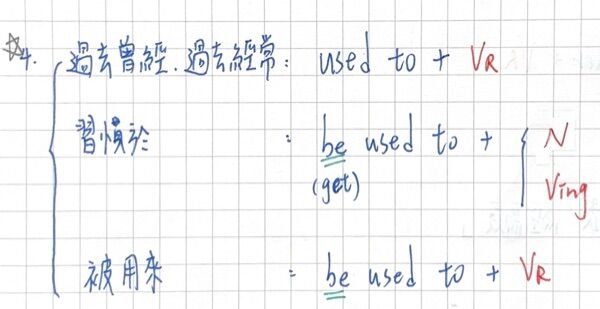




我很習慣獨自旅行,因此和朋友一起旅行對我而言要做出很大的調整。

|
用法名稱 |
文法結構 |
中文意思 |
說明 |
例句 |
|
be used to + N/V-ing |
主詞 + be動詞 + used to + 名詞/動名詞 |
習慣於… |
表示某人現在習慣某事或某種狀況 |
I am used to getting up early. 我習慣早起。 |
|
used to + V |
主詞 + used to + 原形動詞 |
過去經常… |
表示過去經常做某事,但現在不再做了 |
He used to live in Japan. 他以前住在日本。 |
|
be used to + Vpp |
主詞 + be動詞 + used to + 過去分詞 |
被用來…的 |
表示某物被拿來做某事(被動語態) |
This tool is used to cut wood. 這工具是用來切木頭的。 |