 阿摩線上測驗
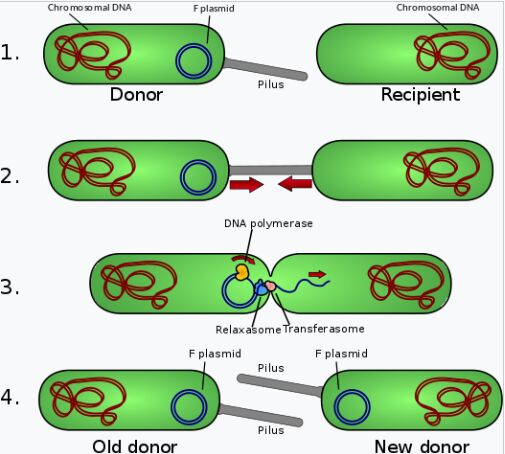
8. What results from conjugation between a bacterium that lacks an F factor (F−) and a bacterium that has an F factor on its
chromosome (F+)?
(A) The F− bacterium ends up carrying one or more plasmids from the F+ bacterium; the F+ bacterium is unchanged.
(B) The F+ bacterium ends up with a recombinant chromosome that carries some genes from the F− bacterium, and the F−
bacterium ends up with an unaltered chromosome.
(C) The F+ bacterium ends up with a recombinant chromosome that carries some genes from the F− bacterium, and the F−
bacterium ends up with a chromosome that lacks those genes.
(D) The F− bacterium ends up with a recombinant chromosome that carries some genes from the F+ bacterium, and the F+
bacterium ends up with an unaltered chromosome.
(E) The F+ bacterium ends up with a recombinant chromosome that carries some genes from the F− bacterium, and the F+
bacterium ends up with an unaltered chromosome.
答案:登入後查看
統計: A(11), B(1), C(5), D(29), E(2) #2973587
統計: A(11), B(1), C(5), D(29), E(2) #2973587
詳解 (共 1 筆)

阿姨我不想努力了
#6148624
請問有人可以解釋一下A為什麼不對嗎QQ
1
0