阿摩線上測驗
登入
首頁
>
研究所、轉學考(插大)◆物理冶金
>
110年 - 110 國立清華大學碩士班考試入學試題_工程與系統科學系/甲組:物理冶金#104981
> 申論題
題組內容
1. Fig. 1 shows a
slip plane of fec crystal containing an edge dislocation.
(b) What is the direction of [u
1
V
1
w
1
]. (3%)
相關申論題
(c) Describe the position of the dislocation including direction of the dislocation line and the Burgers vector in Fig. 1. (5%)
#445287
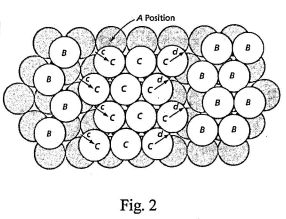
(d) In fec metals, the dislocations are usually dissociated into an extended dislocation, containing two partial dislocations and a stacking fault. Fig. 2 shows an extended dislocation in fcc lattice. Describe the position of the partial dislocation including the direction of dislocation line and Burgers vectors. (5%)
#445288
(e)The strength of an fec metal can be increased by controlling the stacking fault energy. Discuss the strengthening mechanism. (5%)
#445289
(a) Identify whether you think the crystal is FCC or BCC (5%), and
#445290
(b) explain briefly why in each case (15%).
#445291
(a) There is a condition for necking for a true stress-strain curve called Considere's criterion. Derive the Considere's criterion for a true stress-strain curve satisfied a = Kεn, where o is the true stress, s is the true strain, n is the strain hardening exponent, and K is the strength coefficient.(5%)
#445292
(b) Discuss why the strain hardening exponent decreascs with increasing stacking fault energy, as shown in the table below (5%)
#445293
(c)For fcc and bcc metals, there are different temperature dependence on the flow stress components, as shown in Figs. 6 and 7. Use the Considere's criterion to explain the reasons that cause this difference. (10%)
#445294
(a) Refer to Fig. 8 above, and consider the three temperature histories shown. If you are trying to design a steel that best takes advantage of dislocation interactions with a second phase (i.e, strength controlled by bowing), which path is best and why? (10%)
#445295
(b) Refer to Fig.9 above, and consider the three temperature histories shown. If you are trying to produce a microstructure that derives strength through load transfer without being brittle, which path is best and why? (10%)
#445296
相關試卷
110年 - 110 國立臺北科技大學_碩士班招生考試_材料科學與工程研究所:物理冶金#139393
110年 · #139393
110年 - 110 國立清華大學碩士班考試入學試題_工程與系統科學系/甲組:物理冶金#104981
110年 · #104981
 slip plane of fec crystal containing an edge dislocation.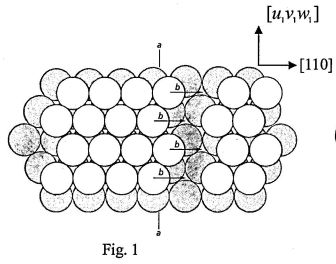
 阿摩線上測驗
登入
slip plane of fec crystal containing an edge dislocation.
阿摩線上測驗
登入
slip plane of fec crystal containing an edge dislocation.