 阿摩線上測驗
四、使用 C 語言或 Java 語言,撰寫一個叫作 linearSearch 的遞迴(recursive)線性搜尋 法函數,此函數有下列幾個參數:key(整數的搜尋鍵)、data(整數的陣列)、 start(搜尋範圍的起始位置)、end(搜尋範圍的結束位置)。如果搜尋鍵在陣列中 出現,則此函數傳回搜尋鍵在陣列中的位置。如果搜尋鍵不在陣列中出現,則此函 數傳回 -1。(30 分)
詳解 (共 4 筆)

Clown(2021上岸
詳解 #3358359
public static in...
(共 403 字,隱藏中)
前往觀看

hchungw
詳解 #6060335
使用 C 語言實現的 linearSearch 遞迴函數。這個函數將遍歷給定陣列的一個範圍(從 start 到 end),尋找匹配的 key 值。如果找到了 key,函數返回 key 在陣列中的位置;如果沒找到,返回 -1。
c
Copy code
#include <stdio.h>
Copy code
#include <stdio.h>
// 函數聲明
int linearSearch(int key, int data[], int start, int end);
int linearSearch(int key, int data[], int start, int end);
int main() {
int data[] = {3, 6, 8, 12, 14, 17, 25, 29, 31, 36, 42, 47, 53, 55, 62};
int n = sizeof(data) / sizeof(data[0]);
int key = 31;
int data[] = {3, 6, 8, 12, 14, 17, 25, 29, 31, 36, 42, 47, 53, 55, 62};
int n = sizeof(data) / sizeof(data[0]);
int key = 31;
// 呼叫 linearSearch 函數
int result = linearSearch(key, data, 0, n-1);
int result = linearSearch(key, data, 0, n-1);
if (result != -1) {
printf("元素 %d 出現在陣列的位置:%d\n", key, result);
} else {
printf("元素 %d 未在陣列中找到。\n", key);
}
printf("元素 %d 出現在陣列的位置:%d\n", key, result);
} else {
printf("元素 %d 未在陣列中找到。\n", key);
}
return 0;
}
}
// 函數定義
int linearSearch(int key, int data[], int start, int end) {
// 如果結束位置小於起始位置,表示範圍無效,返回 -1
if (end < start) {
return -1;
}
// 檢查起始位置的元素是否是搜尋鍵
if (data[start] == key) {
return start;
}
// 否則,遞迴調用函數本身,對範圍中的下一個元素進行檢查
return linearSearch(key, data, start + 1, end);
}
在這個實現中,linearSearch 函數會遞迴地檢查每個元素,直到找到匹配的元素或者檢查完所有元素。這種方法雖然簡單易懂,但在大型數據集上可能不是最高效的搜索策略,特別是對於已排序的數據集,二分搜尋法(Binary Search)會是更好的選擇。然而,對於未排序的數據集或需要執行少量搜尋操作的情況,線性搜尋是一種實用的解決方案。
int linearSearch(int key, int data[], int start, int end) {
// 如果結束位置小於起始位置,表示範圍無效,返回 -1
if (end < start) {
return -1;
}
// 檢查起始位置的元素是否是搜尋鍵
if (data[start] == key) {
return start;
}
// 否則,遞迴調用函數本身,對範圍中的下一個元素進行檢查
return linearSearch(key, data, start + 1, end);
}
在這個實現中,linearSearch 函數會遞迴地檢查每個元素,直到找到匹配的元素或者檢查完所有元素。這種方法雖然簡單易懂,但在大型數據集上可能不是最高效的搜索策略,特別是對於已排序的數據集,二分搜尋法(Binary Search)會是更好的選擇。然而,對於未排序的數據集或需要執行少量搜尋操作的情況,線性搜尋是一種實用的解決方案。
Lin Jai Shing
詳解 #3606160
int linearSearch (in...
(共 183 字,隱藏中)
前往觀看

Triple w.
詳解 #6219311
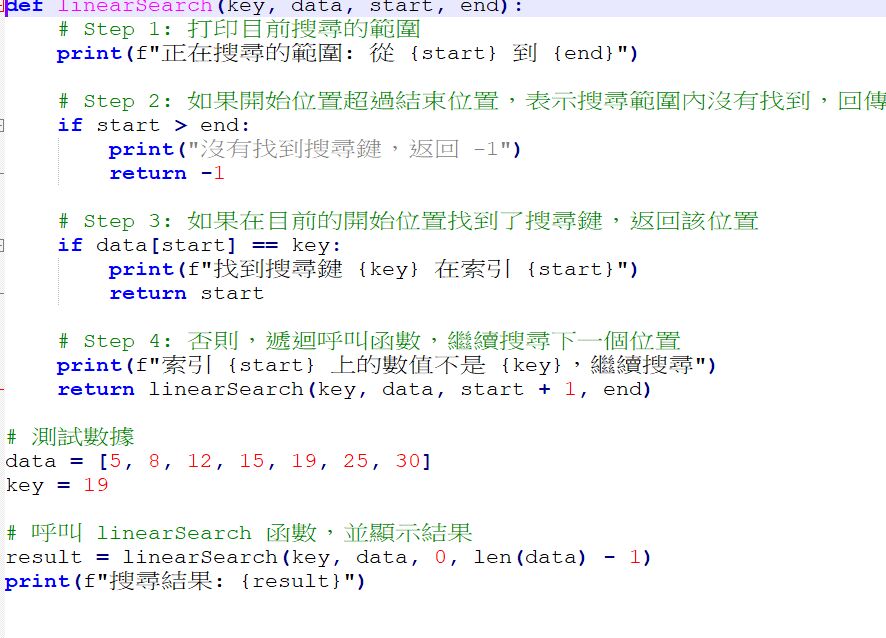
我們今天要學習的是遞迴式的線性搜尋,也就是用程式找到特定值在一個陣列中的位置。這個題目要求我們撰寫一個叫作 linearSearch 的函數,它會有幾個參數:key(我們要找的數值)、data(一個整數陣列)、start 和 end(代表我們要搜尋的範圍)。
遞迴的概念是什麼呢?簡單來說,遞迴是指一個函數自己呼叫自己。我們的 linearSearch 函數會從陣列的 start 位置開始尋找,檢查這個位置上的數字是不是我們要找的 key,如果不是,它會呼叫自己來檢查下一個位置,直到找到符合的數字或者到達 end 結束。如果到最後都找不到,那麼我們就會回傳 -1。
選項的正確與錯誤原因:
- 如果 key 存在於陣列中,函數會找到並回傳它的索引位置。
- 如果 key 不存在,函數會一直搜索到最後一個位置並回傳 -1
ㅤㅤ
ㅤㅤ
正在搜尋的範圍: 從 0 到 6
索引 0 上的數值不是 19,繼續搜尋
正在搜尋的範圍: 從 1 到 6
索引 1 上的數值不是 19,繼續搜尋
正在搜尋的範圍: 從 2 到 6
索引 2 上的數值不是 19,繼續搜尋
正在搜尋的範圍: 從 3 到 6
索引 3 上的數值不是 19,繼續搜尋
正在搜尋的範圍: 從 4 到 6
找到搜尋鍵 19 在索引 4
搜尋結果: 4
索引 0 上的數值不是 19,繼續搜尋
正在搜尋的範圍: 從 1 到 6
索引 1 上的數值不是 19,繼續搜尋
正在搜尋的範圍: 從 2 到 6
索引 2 上的數值不是 19,繼續搜尋
正在搜尋的範圍: 從 3 到 6
索引 3 上的數值不是 19,繼續搜尋
正在搜尋的範圍: 從 4 到 6
找到搜尋鍵 19 在索引 4
搜尋結果: 4