阿摩線上測驗
登入
首頁
>
【段考】高一數學
>
103年 - 台中一中 -103學年度第2學期第3次期末考高1數學#51363
> 申論題
題組內容
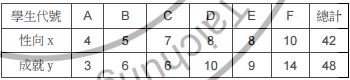
13 研究六位學生的性向測驗與成就測驗的關係,已知六位學生兩種測驗的得分 如下:
沒有 【段考】高一數學 權限,請先開通.
相關申論題
沒有 【段考】高一數學 權限,請先開通.
#184377
沒有 【段考】高一物理 權限,請先開通.
#184378
I. Please draw up a reading comprehension test with 5 questions according to the passage below. There should be four corresponding options in each question (one correct answer and three incorrect ones). Underline the correct answer to your questions. (10%) Nothing affects public health in the world more than food. Gun violence kills tens of thousands of people a year. Heart disease, cancer, stroke and diabetes kill more than a million people a year — nearly half of all deaths — and diet is a root cause of many of those diseases. And the root of that dangerous diet is our system of hyper-industrial agriculture, the kind that uses 10 times as much energy as it produces. We must figure out a way to un-invent this food system. It’s been a major contributor to climate change, spawned the obesity crisis, poisoned countless volumes of land and water, wasted energy, tortured billions of animals… I could go on. The point is that “sustainability” is not only possible but essential: only by saving the earth can we save ourselves, and vice versa. How do we do that? This seems like a good day to step back a bit and suggest something that’s sometimes difficult to accept. Patience. We can only dismantle this system little by little, and slowly. Change takes time.Often — usually — that time exceeds the life span of its pioneers. And when it comes to sustainable food for billions, we’re the pioneers of a food movement that’s just beginning to take shape. The abolition movement began at least a century before the Civil War, 200 years before the civil rights movement. The struggle to gain the right to vote for women in the United States was active for 75 years before an amendment was passed. The gay rights struggle has made tremendous strides over the last 40 years, but equal treatment under the law is hardly established. Yet before we can assess our progress, we must state our goals. There is no consensus behind a program for achieving sustainable production of food that promotes rather than attacks health. We can’t ask for “better food for all”; we must be specific. In the very near term, for example, we must fight to protect and improve programs that make food available to lower-income people. We must also support the increasingly assertive battles of workers in food-related industries; nothing reflects our moral core more accurately than the abuses we overlook in the names of convenience and economy. Beyond that, I believe that the two issues that will have the greatest reverberations in agriculture, health and the environment are reducing the consumption of sugar-laden beverages and improving the living conditions of livestock. About the first, when we begin treating sugar-sweetened beverages as we do tobacco, we will make a huge stride in improving our diet. The second is even more powerful, and progress was made in that arena in 2012 as one food company after another resolved to (eventually) reject pork produced with gestation crates. So over the next few years, some animals will be treated somewhat better. This is absolutely, unquestionably thanks to public pressure, which should now set its sights higher and insist that all animals grown for food production be treated not just better but well. Well-cared- for animals will necessarily be more expensive, which means we’ll eat fewer of them; that’s a win-win. They’ll use fewer antibiotics,they’ll be produced by more farmers in more places, and they’ll eat less commodity grain, which will both reduce environmental damage and allow for more land to be used for high-quality human food like fruits and vegetables. So, in 2015, let’s call for energy, action — and patience.
#184379
II. Essay Writing: 20% Generally speaking, students in a class can be divided into three English proficiency levels: beginning level, intermediate level, and advanced level. Please share the approaches or classroom activities you will adopt to help students of different proficiency levels to learn in your English class.
#184380
V. The following is an article from a textbook. Please make a two-paragraph summary and use your summary to design a cloze test of five multiple-choice questions with four options for each question. The answer for each question should be underlined. (10%) “Tom’s phone is ringing, and Ms. Lewis doesn’t hear a thing,” said Belinda as she laughed to herself. “Yes, she is going on with the lesson,” her friend replied. Their classmates started laughing, and Ms. Lewis had no idea what was going on. “When I heard about it, I couldn’t believe my ears,” said Donna Lewis, a high school teacher in Manhattan. “But one of the kids gave me a copy of the ring tone. My colleague and I played it for some first graders. They could all hear it, but we couldn’t.” The ring tone that she couldn’t hear is called the Teen Buzz. It makes use of an invention called the Mosquito. The Mosquito is an annoying 17 kHz buzzer. It was first designed to keep teenagers from hanging around in front of stores. The high-pitched sound made by the Mosquito is so disturbing that young people cannot stand it and go away. Since it is audible only to kids, adults use the Mosquito to keep them away. The invention is based on a scientific fact related to hearing loss. Humans can generally hear sounds with frequencies between 20 Hz and 20 kHz. However, the range of audible sounds varies with age. When you are younger, you are able to hear high-pitched sounds. When you get older, it is likely that you will no longer hear these sounds. The Mosquito makes a high-frequency noise that usually only people under the age of 20 can hear. The teenagers then turned the tables on the adults. Some clever teenagers reinvented the device as a ring tone, Teen Buzz. The kids adopted this new technology and took advantage of their better hearing. However, not all teenagers have this advantage. Hearing loss affects not only the elderly but the young as well. They can lose their hearing, especially from exposure to noise. If exposure to noise can cause hearing loss, the younger generation may be on the losing side. Many teenagers listen to MP3 players or other portable music players for long periods of time. They also turn up the volume in noisy places, such as on the subway or the street. If the volume is on too high for too long, there is s risk of hearing damage. Unfortunately, however, any hearing loss a person suffers does not show up right away. It may take months or even years for it to surface. The first signs of damage include a feeling of fullness in the ears and the loss of the ability to hear sounds clearly. One warning sign is an inability to hear radio or television at normal volumes. Another is better hearing in one ear than the other when talking on the telephone. It goes without saying that prevention is always better than a cure. Before you come down with any symptoms, give your ears a break. Turn down the volume on your MP3 player and do not listen to it all day long. Take care of your ears and maybe you will be able to enjoy the advantage of Teen Buzz long after your teen years.
#184381
VI. The following is a student’s composition on the college entrance exam. Please correct it, score it, and give some comments. (5%) 題目: 如果你可以不用擔心預算,隨心所欲的度過一天,你會怎麼過?請寫一篇短文,第一段說明你 會邀請誰和你一起度過這一天?為什麼?第二段描述你會去哪裡?為什麼? I finally decide to choose my best friends to come with me and star the crazy day. Because of them, I can feel more freedom, without them, I just like a fish out of water. Therefore, we will try those which we have never experienced and never done. Although shopping is not the tea in my cup, I will can buy any luxury to our contentment. I think the first station will be the Tokyo where is the most prosperous in Japan. We eat the located delicacy and soak in the hot spring which is said that is good for skin. Second station will be Franch where the art and buildings are full of classicism. When it comes to Franch, no one won’t think up the fashionable clothes. We will buy a lot of clothes which are showed by models. Finally station will be home, because it is the warmest place which can’t be replace. And we enjoy sleeping in our own beds.
#184382
VII. Essay Writing (15%) With the implementation of 12-year compulsory education, high school teachers are encouraged and expected to design featured courses for students of our own. As an English teacher, what kind of English featured course will you design for students at Taoyuan Senior High School? Please specify your ideas for the featured course. The title, the objective(s), the content and the activities of the course should be covered and detailed in the essay
#184383
沒有 【段考】高一英文 權限,請先開通.
#184384
沒有 【段考】高一英文 權限,請先開通.
#184385
沒有 【段考】高一英文 權限,請先開通.
#184386
相關試卷
110年 - 110-2-1 新民高中初階英文閱讀與寫作練習#108943
110年 · #108943
106年 - 多項式的問題#77274
106年 · #77274
104年 - 104下1高一數學 - 彰化縣縣立田中高中104 下學期高一數學第一次段考(期中考)#51349
104年 · #51349
104年 - 104下1高一數學 - 彰化縣縣立田中高中104 下學期高一數學第一次段考(期中考)#51305
104年 · #51305
104年 - 104上2高一數學 - 彰化縣縣立田中高中104 上學期高一數學第二次段考(期中考)#51295
104年 · #51295
104年 - 104上1高一數學 - 新北市市立三民高中104 上學期高一數學第一次段考(期中考)#51259
104年 · #51259
104年 - 104上2高一數學 - 新北市私立及人高中104 上學期高一數學第二次段考(期中考)#51122
104年 · #51122
104年 - 104上1高一數學 - 新北市私立及人高中104 上學期高一數學第一次段考(期中考)#51117
104年 · #51117
104年 - 台中一中 -104上期考1高一數學#51059
104年 · #51059
103年 - 北一女中第二學期第一次段考一年級數學科試題#79809
103年 · #79809
 阿摩線上測驗
登入
阿摩線上測驗
登入