 阿摩線上測驗
題組內容
I. The Digital Services Act: ensuring a safe and accountable online environment
European Commission website
https://ec.europa.eu/info/strategy/priorities-2019-2024/europe-fit-digital-age/digital-services-act-ensuring-safe-and-accountable-online-environment_en
European Commission website
https://ec.europa.eu/info/strategy/priorities-2019-2024/europe-fit-digital-age/digital-services-act-ensuring-safe-and-accountable-online-environment_en
What are the key goals of the Digital Services Act?
The new rules are proportionate, foster innovation, growth and competitiveness, and facilitate the scaling up of smaller platforms, SMEs and start-ups. The responsibilities of users, platforms, and public authorities are rebalanced according to European values, placing citizens at the centre. The rules:
• Better protect consumers and their fundamental rights online
• Establish a powerful transparency and a clear accountability framework for online platforms
• Foster innovation, growth and competitiveness within the single market
• For citizens
◦ More choice, lower prices
◦ Less exposure to illegal content
◦ Better protection of fundamental rights
• For providers of digital services
◦ Legal certainty, harmonisation of rules
◦ Easier to start-up and scale-up in Europe
• For business users of digital services
◦ More choice, lower prices
◦ Access to EU-wide markets through platforms
◦ Level-playing field against providers of illegal content
• For society at large
◦ Greater democratic control and oversight over systemic platforms
◦ Mitigation of systemic risks, such as manipulation or disinformation
◦ More choice, lower prices
◦ Less exposure to illegal content
◦ Better protection of fundamental rights
• For providers of digital services
◦ Legal certainty, harmonisation of rules
◦ Easier to start-up and scale-up in Europe
• For business users of digital services
◦ More choice, lower prices
◦ Access to EU-wide markets through platforms
◦ Level-playing field against providers of illegal content
• For society at large
◦ Greater democratic control and oversight over systemic platforms
◦ Mitigation of systemic risks, such as manipulation or disinformation
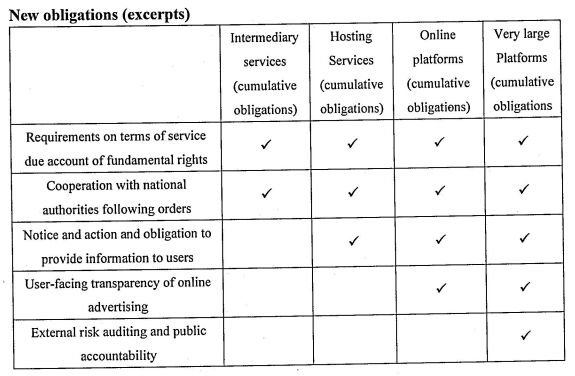
Which providers are covered?
The Digital Services Act includes rules for online intermediary services, which millions of Europeans use every day. The obligations of different online players match their role, size and impact in the online ecosystem.
●Intermediary services offering network infrastructure: Internet access providers, domain name registrars, including also:
● Hosting services such as cloud and webhosting services, including also:
●Online platforms bringing together sellers and consumers such as online marketplaces, app stores, collaborative economy platforms and social media platforms.
●Very large online platforms pose particular risks in the dissemination of illegal content and societal harms. Specific rules are foreseen for platforms reaching more than 10% of 450 million consumers in Europe.
All online intermediaries offering their services in the single market, whether they are established in the EU or outside, will have to comply with the new rules. Micro and small companies will have obligations proportionate to their ability and size while ensuring they remain accountable.
II. The EU is about to announce new rules for Big Tech — and there's not much they can do about it
Published Thu, Nov 5 2020 2:24 AM EST Updated Thu, Nov 5 2020 2:58 AM EST Silvia Amaro
https://www.cnbc.com/2020/11/05/digital-services-act-how-the-eu-is-going-after-big- tech.html
Published Thu, Nov 5 2020 2:24 AM EST Updated Thu, Nov 5 2020 2:58 AM EST Silvia Amaro
https://www.cnbc.com/2020/11/05/digital-services-act-how-the-eu-is-going-after-big- tech.html
LONDON — The European Commission is about to propose a "revolutionary" overhaul of digital regulation that could hurt the business models of Big Tech, industry experts told CNBC.
The Digital Services Act, due to be presented in early December, is expected to overhaul the management of content on platforms like Google and Facebook and is the first of its kind since 2000. Broadly, the EU wants to make tech giants more responsible for the content on their platforms, and to ensure that competitors have a fair chance to succeed against the big firms.
"It's revolutionary," Thomas Vinje, a partner at the law firm Clifford Chance, told CNBC Tuesday.
The upcoming rules are "likely to require dramatic changes in the business practices and even business models" of Big Tech, he said.
Last month, Europe's competition chief Margrethe Vestager outlined some of the changes that could be included in the new regulation.
"The new rules will ... require digital services, especially the biggest platforms, to be open about the way they shape the digital world that we see. They'll have to report on what they've done to take down illegal material," she said.
"They'll have to tell us how they decide what information and products to recommend to us, and which ones to hide, and give us the ability to influence those decisions, instead of simply having them made for us. And they'll have to tell us who's paying for the ads that we see, and why we've been targeted by a certain ad."
This would be massive for tech firms, which have refused to disclose their algorithms for years.
"The strict prohibitions in discussion in the DSA are a tsunami in terms of how platforms do business in Europe," Nicolas Petit, competition law professor at the
European University Institute said.
Long legal battles
In recent years, the European Commission has launched high-profile investigations into companies like Amazon, Facebook, Apple and Google over concerns that their market dominance is hindering competition. These probes have been mostly been led by Margrethe Vestager, who took over the competition portfolio in 2014.
But real change as a result of these investigations is often elusive, with European officials frustrated by lengthy legal action.
For instance, in 2017, the European Commission fined Google 2.4 billion euros ($2.81 billion) for promoting its own shopping comparison service rather than allowing similar access to rival companies. Google made some changes in the wake of that case, but a study by Lademann & Associates showed in September that not much has changed. According to the study, less than 1% of traffic through Google Shopping was transferring users to rival shopping websites.
More recently, the Commission's decision to ask Ireland (a member of the EU) to recoup 13 billion euros in unpaid taxes from Apple has been challenged. The EU's general court decided in July that the Commission had failed to prove that the Irish government had given a tax advantage to Apple. The Commission has appealed that ruling, but it could be difficult for it to meet this burden of proof.
"Perhaps the biggest challenge we face with enforcement is making sure that we have the right legal framework and powers to keep digital markets competitive and fair," Vestager said in late October.
Google's concerns
Speaking to CNBC on Monday, Georgios Petropoulos, research fellow at the Brussels-based think tank Bruegel, said that tech giants were "anxious" about the upcoming rules.
Google has already voiced its concerns.
Karan Bhatia, Google's VP of global government affairs and public policy, issued a statement to CNBC last week that said in part: "As we've made clear in our public and private communications, we have concerns about certain reported proposals that would prevent global technology companies from serving the growing needs of European Page 4 of 12 6 users and businesses."
In a blog post, Bathia explained that Google is worried about how the new rules may, for example, prevent its search platform from showing nearby restaurants and the option to book a table. "While we support the ambition of the DSA (Digital Services Act) to create clear rules for the next 20 years that support economic growth, we worry that the new rules may instead slow economic recovery," he wrote.
The regulation also is expected to hit Facebook, Amazon and Apple, and even some smaller players too.
Petit from the European University Institute said that "many European startups, merchants, or developers are not too hot" on the upcoming rules.
"If, by any chance, one of them was ever to make a killing on the market, the DSA rules would apply to it too," he said.
1. 報導中提到新的歐盟法案是指什麼?該法案的立法目的為何?(10%)