阿摩線上測驗
登入
首頁
>
研究所◆電子電路學
>
103年 - 103 國立臺北大學_學士班曁進修學士班轉學生招生考試試題_通訊工程學系、電機工程學系學士班3年級:電子電路#147372
> 申論題
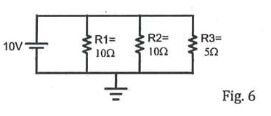
6. (10%) Derive the current on the resistor R3 shown in Fig. 6.
相關申論題
7. (10%) Capacitive reactance \( X{\mathrm{C}} \) and resistor R in parallel that is supplied by a sine wave voltage \( V{\mathrm{A}} \). Draw the signal waveforms of \( V{\mathrm{A}} \), branch currents \( I{\mathrm{R}} \) and \( I_{\mathrm{C}} \) by showing one cycle. (Fig. 7) (Hint: You must identify \( 90^{\circ} \), \( 180^{\circ} \), \( 270^{\circ} \), and \( 360^{\circ} \) in one cycle.)
#606322
8. (10%) Explain (a) channel length modulation of a MOSFET. (b) early effect of a BJT.
#606323
9. (10%) How much current is needed for a 24Ω resistor that dissipates 600 Watt?
#606324
10. (10%) Draw the Bode plot gain response of the transfer function \( A(s) = 10[(1 + (s / 10^3)] / [(1 + (s / 10^6))] \).
#606325
4. (10%) Answer the questions about functions. First, how many functions are there from a set with eight elements to a set with three elements? Second, how many onto functions are there from a set with eight elements to a set with three elements?
#606326
5. (10%) Let \( X = \{1, 2, 3, \ldots, 9\} \). Algorithm A lists all 6-permutations of \( X \) in increasing lexicographic order. Algorithm B prints all 6-combinations of \( X \) in increasing lexicographic order where each combination is printed as an increasing sequence. First, find the next five permutations that will be generated by algorithm A after the permutation 321978. Then, find the next five combinations that will be generated by algorithm B after the combination 123689.
#606327
6. (10%) Solve the recurrence relation \( a_n = (4 / n)(a_0 + a_1 + \dots + a_{n-1}) \) where \( a_0 = 3 \).
#606328
7. (20%) Given the graph shown below, answer the following questions and prove your answers. Does it have a Euler circuit? Does it have a Euler path? Does it have a Hamilton circuit? Does it have a Hamilton path?
#606329
26. (5%) Let \( \mathbf{U} \) be an \( n \times n \) unit upper triangular matrix. It is known that \( \mathbf{U} \) is nonsingular. Now, \( \mathbf{U}^{-1} \) is derived by transforming \( [\mathbf{U} \mathbf{I}] \) into \( [\mathbf{I} \mathbf{U}^{-1}] \) via row operations. Use the above derivation method to prove that \( \mathbf{U}^{-1} \) is also unit upper triangular.
#606330
(27) (10%) Let \( \mathbf{A} \) be a symmetric positive definite matrix with Cholesky decomposition \( \mathbf{A} = \mathbf{R}_{1}^{\text{T}}\mathbf{R}_{1} = \mathbf{R}_{2}^{\text{T}}\mathbf{R}_{2} \). By using the uniqueness of LDU factorization, prove that the upper triangular matrices \( \mathbf{R}_{1} = \mathbf{R}_{2} \).
#606331
相關試卷
109年 - 109 國立臺北大學_日間學士班曁進修學士班轉學生招生考試試題_通訊工程學系日間學士班3年級:電子電路#147355
109年 · #147355
108年 - 108 國立臺北大學_日間學士班轉學生招生考試試題_電機工程學系日間學士班3年級:電子電路#147352
108年 · #147352
107年 - 107 國立臺北大學_日間學士班曁進修學士班轉學生招生考試試題_電機工程學系、通訊工程學系日間學士班3年級:電子電路#147369
107年 · #147369
106年 - 106 國立臺北大學_學士班曁進修學士班轉學生招生考試試題_電機工程學系3年級:電子電路#147353
106年 · #147353
105年 - 105 國立臺北大學_日間學士班轉學生招生考試試題_電機工程學系日間學士班3年級:電子電路#147370
105年 · #147370
104年 - 104 國立臺北大學_學士班曁進修學士班轉學生招生考試試題_電通訊工程學系、電機工程學系學士班3年級:電子電路#147371
104年 · #147371
104年 - 104 國立臺北大學_學士班曁進修學士班轉學生招生考試試題_通訊工程學系、電機工程學系學士班3年級:電子電路#147368
104年 · #147368
104年 - 104 國立臺北大學_學士班曁進修學士班轉學生招生考試試題_通訊工程學系、電機工程學系3年級:電子電路#147350
104年 · #147350
103年 - 103 國立臺北大學_學士班曁進修學士班轉學生招生考試試題_通訊工程學系、電機工程學系學士班3年級:電子電路#147372
103年 · #147372
101年 - 101 國立嘉義大學_碩士班(乙組)招生考試試題_資訊工程工程學系:電子電路學#146247
101年 · #146247
 阿摩線上測驗
登入
阿摩線上測驗
登入