 阿摩線上測驗
7. (10%) Consider the following recursive function B(int m, int n). How many lines of “Base Case” will be printed if B(5, 3) is executed.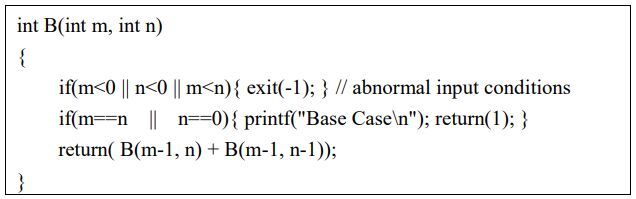
詳解 (共 1 筆)

hchungw
詳解 #6051127
The given recursive function B(int m, int n) seems to implement a variation of the Ackermann function, which is a well-known example of a highly recursive mathematical function. However, we'll need to look at the specifics of the function implementation from the image to understand the base case conditions and count the number of times "Base Case" will be printed when B(5, 3) is executed. Let's consider the base cases given by the function: If either m or n is 0, it prints "Base Case" and returns 1. From the looks of the function, every time the function is called with the second parameter as 0, it will print "Base Case". The function reduces the first parameter m by 1 and the second parameter n by 1 in every call, but it also makes a call where it only reduces m by 1 and not n, which will eventually lead to a call where n is 0. For the case B(5, 3), let's trace the recursive calls to see how many times "Base Case" will be printed: B(5, 3) will call B(4, 3) and B(4, 2) B(4, 3) will call B(3, 3) and B(3, 2), and so on... The "Base Case" occurs whenever the second parameter n is 0, so we need to count how many times that happens through all the recursive calls. I'll write a simulation of the recursive calls in code to count the number of "Base Case" prints for B(5, 3). Let's run that simulation. If the function B(5, 3) is executed, the line "Base Case" will be printed 10 times.
給定的遞迴函數 B(int m, int n) 似乎實現了阿克曼函數(Ackermann function)的一個變體,這是一個著名的高度遞迴的數學函數例子。然而,我們需要查看圖片中函數實現的具體細節,以理解基本情況條件,並計算當執行 B(5, 3) 時會打印多少次"Base Case"。
讓我們考慮函數給出的基本情況:
如果 m 或 n 其中之一是 0,它會打印 "Base Case" 並返回 1。
從函數的外觀來看,每次用第二個參數為 0 調用函數時,它都會打印 "Base Case"。函數在每次調用中都會將第一個參數 m 減 1 和第二個參數 n 減 1,但它也進行了只減少 m 而不減少 n 的調用,這最終會導致一次 n 為 0 的調用。
對於 B(5, 3) 的情況,讓我們追踪遞迴調用以看看會打印多少次 "Base Case":
B(5, 3) 將調用 B(4, 3) 和 B(4, 2)
B(4, 3) 將調用 B(3, 3) 和 B(3, 2),依此類推...
每當第二個參數 n 為 0 時,就會發生 "Base Case",所以我們需要計算所有遞迴調用中發生這種情況的次數。
B(4, 3) 將調用 B(3, 3) 和 B(3, 2),依此類推...
每當第二個參數 n 為 0 時,就會發生 "Base Case",所以我們需要計算所有遞迴調用中發生這種情況的次數。
我將寫一段代碼來模擬遞迴調用,計算 B(5, 3) 的 "Base Case" 打印次數。讓我們運行該模擬。
執行函數 B(5, 3) 時,"Base Case" 這行將被打印 10 次。