所屬科目:研究所、轉學考(插大)◆普通化學
1. Order the four metric prefixes from smallest to largest.(A) milli- < nano- < centi- < kilo-(B) kilo- < centi- < nano- < milli-(C) nano- < milli- < centi- < kilo-(D) kilo- < centi- < milli- < nano-(E) centi- < nano- < kilo- < milli-
2. The pressure of the earth's atmosphere at sea level is 14.7 lb/in2. What is the pressure whenexpressed in g/m2 ? (2.54 cm = 1 in., 2.205 lb = 1 kg)(A) 1.03 × 10⁷(B) 2.62 × 10⁵(C) 5.02 ×10⁴(D) 4.30 × 10²(E) 2.09 × 10⁻³
3. A species with 12 protons and 10 electrons is(A) Ne2+ (B) Mg2+ (C) Ti2+ (D) Ne2– (E) Fe2–
4. How many protons and electrons does the most stable ion for oxygen have? # protons # electrons(A) 8 protons and 6 electrons(B) 6 protons and 8 electrons(C) 8 protons and 8 electrons(D) 10 protons and 8 electrons(E) 8 protons and 10 electrons
5. Iron is biologically important in the transport of oxygen by red blood cells from the lungs to thevarious organs of the body. In the blood of an adult human, there are approximately 2.64 × 10¹³ red blood cells with a total of 2.90 g of iron. On the average, how many iron atoms are present ineach red blood cell? (molar mass Fe = 55.85 g/mol)(A)6. 14 × 1021(B) 3.13 × 10¹⁷(C) 2.64 ×10¹³(D) 1.18 × 10⁹(E) 8.44 × 10⁵
6. A given sample of a xenon fluoride compound contains molecules of a single type XeFn, where n issome whole number. Given that 8.06 × 10²⁰ molecules of XeFn weigh 0.227 g, calculate n.(A) 1(B) 2(C) 3(D) 4(E) 5
7. The interaction between solute particles and water molecules, which tends to cause a salt to fallapart in water, is called(A) coagulation(B) conductivity(C) dispersion(D) hydration(E) polarization
8. 1.00 mL of a 4.05 ×10⁻⁴ M solution of oleic acid is diluted with 9.00 mL of petroleum ether,forming solution A. Then 2.00 mL of solution A is diluted with 8.00 mL of petroleum ether, formingsolution B. How many grams of oleic acid are 5.00 mL of solution B? (Molar mass for oleic acid =282 g/mol)(A) 1.14 × 10⁻⁵ g(B) 1.59 × 10⁻⁵ g(C) 1.59 × 10⁻⁶ g(D) 5.71 × 10⁻⁵ g(E) 5.71 × 10⁻⁶ g
9. You are holding two balloons, an orange balloon and a blue balloon. The orange balloon is filledwith neon (Ne) gas and the blue balloon is filled with argon (Ar) gas. The orange balloon has twicethe volume of the blue balloon. Which of the following best represents the mass ratio of Ne:Ar inthe balloons?(A) 1:2 (B) 2:1 (C) 1:1 (D) 1:3 (E) 3:1
10. How much heat is required to raise the temperature of a 5.75-g sample of iron (specific heat =0.450 J/g°C) from 25.0°C to 79.8°C?(A) 848 J (B) 700 J (C) 315 J (D) 254 J (E) 142 J
11. The wavelength of light associated with the n = 2 to n = 1 electron transition in the hydrogenspectrum is 1.216 × 10⁻⁷ m. By what coefficient should this wavelength be multiplied to obtain thewavelength associated with the same electron transition in the Li2+ ion?(A) 1/9 (B) 1/8 (C) 1/6 (D) 1/4 (E) 1/2
12. Choose the compound with the most ionic bond.(A) LiF (B) KF (C) LiCl (D) NaCl (E) KBr
13. The hybridization of the central atom in ClF2+ is:(A) sp (B) sp2 (C) sp3 (D) dsp3 (E) d2sp3
14. At normal atmospheric pressure and a temperature of 0°C, which phase(s) of H2O can exist?(A) water only (B) ice only (C) water vapor only (D) ice and water (E) ice and water vapor
15. How many milliliters of 15.7 M H2SO4 are needed to prepare 600.0 mL of 0.10 M H2SO4?(A) 0.26 mL (B) 1.9 mL (C) 2.8 mL (D) 3.0 mL (E) 3.8 mL
16. A 20.0-g sample of methyl alcohol (CH3OH, molar mass = 32.04 g/mol) was dissolved in 43.3 gof water. The mole fraction of CH3OH is:(A) 0.206(B) 0.260(C) 0.316(D) 0.624(E) 0.485
17. The following questions refer to the reaction shown below:What is the rate law for this reaction?(A) Rate = k[A] (B) Rate = k[A][B] (C) Rate = k[A]2[B] (D) Rate = k[A][B]2 (E) Rate = k[A]2[B]2
18. At a given temperature, K = 0.017 for the equilibrium: PCl5(g)⇌ PCl3(g) + Cl2(g). What is Kfor: Cl2(g) + PCl3(g) ⇌PCl5(g) ?(A) 0.00029 (B) 0.017 (C) 17 (D) 58.9 (E) 3500
19. Using the following Ka values, indicate the correct order of base strength.HNO2 Ka = 4.0 × 10⁻⁴HF Ka = 7.2 × 10⁻⁴HCN Ka = 6.2 × 10⁻¹⁰(A) CN– > NO2– > F– > H2O > Cl–(B) Cl– > H2O > F– > NO2– > CN–(C) CN– > F– > NO2– > Cl– > H2O(D) H2O > CN– > NO2– > F– > Cl–(E) CN– > H2O > NO2– > F– > Cl–
20. The molar solubility of PbI2 is 1.52 × 10⁻³ M. Calculate the value of Ksp for PbI2.(A) 3.52 × 10⁻⁹(B) 4.61 × 10⁻⁶(C) 1.40 × 10⁻⁸(D) 1.51 × 10⁻³(E) 5.67 × 10⁻⁸
21. How many electrons are transferred in the following reaction when it is balanced in acidic solution?SO32–(aq) + MnO4–(aq)⇌ SO42–(aq) + Mn2+(aq)(A) 2(B) 3(C) 5(D) 6(E) 10
22. Which statements about hydrogen are true?I. H has a lower ionization energy than He.II. H– is smaller than H.III. H bonds with the halogens to form polar covalent compounds.IV. H is always a metal.V. H does not have a second ionization energy.(A) I and V (B) II and IV (C) II, IV and V (D) I, III and V (E) I, III, IV and V
23. The complex FeL62+, where L is a neutral ligand, is known to be diamagnetic. The number of delectrons in this complex ion is:(A) 2 (B) 3 (C) 4 (D) 5 (E) 6
24. Propane undergoes dehydrogenation. The product of this is(A) 1-propene(B) 2-propene(C) cis-1-propene(D) trans-1-propene(E) cis-2-propene
25. What organic compounds often have pleasant fruity odors?(A) ethers(B) alkynes(C) carboxylic acids(D) esters(E) amines
 阿摩線上測驗
登入
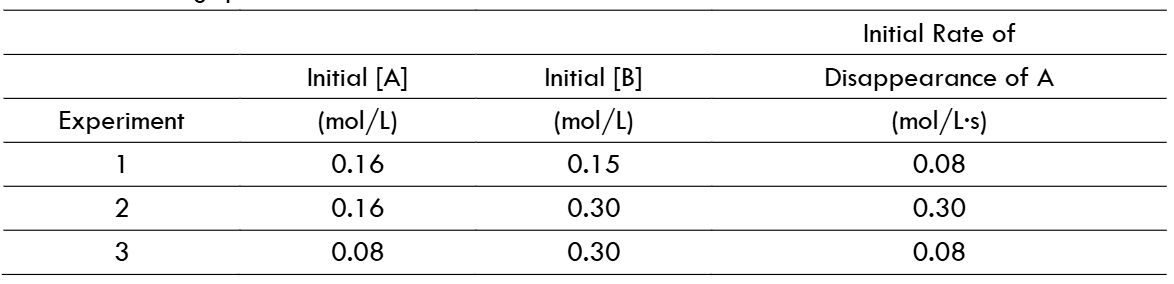 What is the rate law for this reaction?(A) Rate = k[A] (B) Rate = k[A][B] (C) Rate = k[A]2[B] (D) Rate = k[A][B]2 (E) Rate = k[A]2[B]2