所屬科目:研究所、轉學考(插大)◆普通物理學
1. A block of mass m is placed on top of a light vertical spring of force constant k and pushed downward, so that the spring is compressed by x. After the block is released from rest it travels upward and then leaves the spring. To what maximum height above the point of release does it rise? (A)kx²/(mg) (B)2kx²/(mg) (C)kx²/(2mg) (D)kx²/( mg) (E) kx²/(mg)
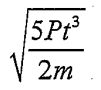
2. An object of mass m is initially at rest on a frictionless horizontal plane. If a constant power P acts on this object for t duration, how far will it travel during this interval? (A)(B) (C) (D)(E)
3. A satellite moves in a circular orbit just above the surface of a planet, assumed to offer no air resistance. If the satellite's orbit speed is v, the escape velocity from the planet is (A)v (B) (C) (D)2v (E)
4. The free-fall acceleration on the surface of the Moon is about one-sixth that on the surface of the Earth. If the radius of the Moon is about 0.250R_E, the ratio of their average densities, ρ_Moon/ρ_Earth is (A)2/3 (B)1/2 (C)1/3 (D)1/6 (E)1/4
5. A solid wheel with mass M, radius R, and rotational inertia MR²/2, rolls without sliding on a horizontal surface. A horizontal force F is applied to the axle and the center of mass has an acceleration a. The magnitudes of the applied force F and the frictional force f of the surface, respectively, are: (A)F = Ma, f = 0 (B)F = Ma, f = Ma/2 (C)F = 2Ma, f = Ma (D)F = 2Ma, f = Ma/2 (E)F = 3Ma/2, f = Ma/2
6. A spherical shell has inner radius R₁, outer radius R₂, and mass M, distributed uniformly throughout the shell. The magnitude of the gravitational force exerted on the shell by a point particle of mass m located a distance d from the center, outside the inner radius and inside the outer radius, is: (A)0 (B)GMm/d² (C)GMm(R₂²-R₁³) (D)GMm(d³-R₁³)/[d²(R₂³-R₁³)] (E)GMm/(d²-R₁³)
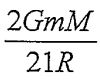
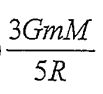
7. A satellite of mass m circles a planet of mass M and radius R in an orbit at a height 2R above the surface. What minimum energy is required to change the orbit to one for which the height of the satellite is 3R above the surface? (A) (B) (C) (D)(E)
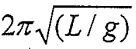
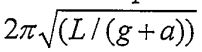
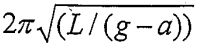
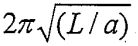
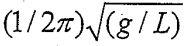
8. A simple pendulum is suspended from the ceiling of an elevator. The elevator is accelerating upwards with acceleration a. The period of this pendulum, in terms of its length L, g, and a is: (A) (B)(C) (D)(E)
9. A point source emits sound waves with a power output of 100 watts. What is the sound level (in dB) at a distance of 10 m? (A)139 (B)119 (C)129 (D)109 (E)10
10. Two harmonic waves traveling in opposite directions interfere to produce a standing wave described by y = 2 sin(πx) cos(3πt) where x is in m and t is in s. What is the distance (in m) between the first two antinodes? (A)8 (B)2 (C)4 (D)1 (E)0.5
11. Work done in an isobaric process by an ideal gas is (A)nRT2ln(V₂/V₁) (B)nRT2(1-V₁/V₂) (C)nRT₂ ln(V₁/V₂) (D)nRT₁(1-V₂/V₁) (E)nRT₁(1-V₂/V₁)
12. An ideal gas is allowed to expand adiabatically. Assume the process is reversible. The change in entropy is: (A)0 (B)nR ln(V₂/V₁) (C)nR ln(T₂/T₁) (D)kn ln(V₂/V₁) (E)kn ln(T₂/T₁)
13. A Carnot refrigerator extracts 35 kJ as heat during each cycle, operating with a coefficient of performance of 4.60. What is the energy per cycle transferred as heat to the room? (A)15.0 kJ (B)21.0 kJ (C)25.9 kJ (D)30.4 kJ (E)42.6 kJ
14. Three particles, each with positive charge Q, form an equilateral triangle, with each side of length d. Then the magnitude of the electric field produced by the particles at the midpoint of any side is: (A)Q/(4πε₀d²) (B)Q/(3πε₀d²) (C)2Q/(3πε₀d²) (D)Q/(πε₀d²) (E)4Q/(3πε₀d²)
15. Two tiny conducting balls of identical mass m and identical charge q hang from nonconducting threads of length L. Assume that θ is small, then the equilibrium separation x is approximately: (A)q²L/(4πε₀mg) (B)[q²L/(4πε₀mg)]1/2 (C)[2q²L/(πε₀mg)]1/2 (D)[q²L/(2πε₀mg)]1/3 (E)[3q²L/(πε₀mg)]1/3
16. Two conducting spheres have radii R₁ and R₂, with R₁ greater than R₂. If they are far apart the capacitance is proportional to: (A)R₁R₂/(R₁-R₂) (B)R₁²-R₂² (C)(R₁-R₂)/(R₁R₂) (D)R₁²+R₂² (E)none of these
17. A conductor of radius r, length and resistivity has resistance R. It is melted down and formed into a new conductor, also cylindrical, with one fourth the length of the original conductor. The resistance of the new conductor is (A)R (B)R (C)R (D)4R (E)16R
18. Faraday's law states that an induced emf is proportional to: (A)the rate of change of the magnetic field (B)the rate of change of the electric field (C)the rate of change of the magnetic flux (D)the rate of change of the electric flux (E)zero
19. If an electron travels with speed v around a circle of radius r, then the magnitude of the orbital magnetic dipole moment is: (A)evr/2 (B)ev/r (C)ev/2πr (D)2πer/v (E)2πev/r
20. An LC circuit consists of a 1-μF capacitor and a 4 mH inductor. Its oscillation frequency is approximately: (A)0.025 Hz (B)25 Hz (C)60 Hz (D)2500 Hz (E)15800 Hz
21. An electric field of approximately 100 V/m is often observed near the surface of the Earth. If this were the field over the entire surface, what would be the electric potential of a point on the surface of Earth? (set V=0 at infinity) (A)0 (B)1.6×10⁸ V (C)3.2×10⁸ V (D)6.4×10⁸ V (E)1.28×10⁹ V
22. A 2 kW heater element from a dryer has a length of 80 cm. If a 10 cm section is removed, what power is used by the now shortened element at 120 V? (A)1.75 kW (B)2.0 kW (C)2.3 kW (D)2.8 kW (E)3.2 kW
23. In the circuit, R₁=5 Ω, R₂=10 Ω, R₃=15 Ω, C₁=5 μF, C₂=10 μF and the ideal battery has emf=20 V. Assuming that the circuit is in the steady state, the total energy stored in the two capacitors is (A)2.78×10⁻⁵ J (B)1.12×10⁻⁴ J (C)2.22×10⁻⁴ J (D)2.50×10⁻⁴ J (E)4.72×10⁻⁴ J
24. An electron has velocity v = (32i+40j) km/s as it enters a uniform magnetic field B = (60i) μT. (A)The radius of the helical path taken by the electron is 0.38 m. (B)The pitch of that path is 1.9 m. (C)The period of the revolution is 60 μs. (D)To an observer looking into the magnetic field region from the entrance point of the electron, the electron spirals counterclockwise as it moves. (E)The magnetic force points in the +k direction.
25. What is the maximum radiation pressure exerted by sunlight in space (S = 1350 W/m²) on a highly polished silver surface? (A)1.4×10⁻² Pa (B)0.12 Pa (C)9.0×10⁻⁶ Pa (D)4.5×10⁻⁵ Pa (E)2.3×10⁻⁶ Pa
26. Consider the problem of elastic collision as shown in Fig.26. The masses of the two pucks are equal. Before colliding, the velocity of puck-1 is v₁b, and puck-2 is at rest initially (v₂b=0). Which answers are correct in the followings? (A)(B)v₂₁sinθ + v₁f/2 = v₁b (C)v₂₁cosθ = v₁f/2 (D)θ = 60° (E)θ = 30°
27. Figure 27 shows a reversible cycle through which 1 mol of a monatomic ideal gas is taken. Assume p=2p₀, V=2V₀, p₀=1.01×10⁵ Pa, and V₀=0.0225 m³. (A)The work done during the cycle is 2.27 kJ. (B)The energy added as heat during stroke abc is 14.8 kJ. (C)The efficiency of the cycle is 0.217. (D)The efficiency of a Carnot engine operating between the highest and lowest temperatures that occur in the cycle is 0.25. (E)The efficiency of Carnot engine is thus greater than the efficiency in the cycle showed in Fig. 27.
28. A solid nonconducting sphere of radius R = 5.6 cm has a nonuniform charge distribution of volume charge density ρ = (14.1 pC/m³)r/R, where r is radial distance from the sphere's center. (A)The shell theorem cannot be applied in this case. (B)The sphere's total charge is 7.78×10⁻¹5 C. (C)The magnitude of the electric field at r = 0 is zero. (D)The magnitude of the electric field at r = R/2 is 5.58×10⁻³ N/C. (E)The magnitude of the electric field at r = R is 1.12×10⁻² N/C.
29. A capacitor of capacitance C₁=6 μF is connected in series with a capacitor of capacitance C₂=4 μF, and a potential difference of 200V is applied across the pair. (A)The equivalent capacitance is 2.4 μF. (B)Charge q₁ on capacitor 1 is 4.8×10⁻⁴ C. (C)The potential difference V₁ on capacitor 1 is 80 V. (D)Charge q₂ on capacitor 2 is 4.8×10⁻⁴ C. (E)The potential difference V₂ on capacitor 2 is 120 V.
30. Figure 30 shows a uniform magnetic field B confined to a cylindrical volume of radius R. The magnitude of B is decreasing at a constant rate of 10 mT/s. In unit-vector notation, (A)the initial acceleration of an electron released at point a (r=5 cm) is (4.4×10⁷ i)m/s². (B)the initial acceleration of an electron released at point b (r=0) is nonzero. (C)the initial acceleration of an electron released at point c (r=5 cm) is (4.4×10⁷ i)m/s². (D)the electric field at point a (r=5 cm) is (+2.5×10⁻⁴ j)V/m. (E)the electric field at point c (r=5 cm) is (-2.5×10⁻⁴ j)V/m.
 阿摩線上測驗
登入
 mg) (E)
 kx²/(mg)
 (B)
 (C)
 (D)
 (E)
 (C)
 (D)2v (E)

 (B)
 (C)
 (D)
 (E)
 (B)
 (C)
 (D)
 (E)
 R (B)
 R (C)R (D)4R (E)16R
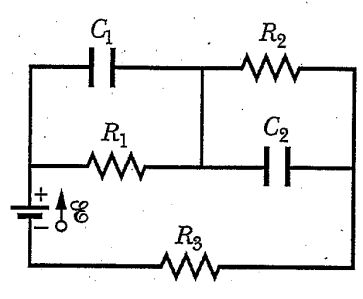 (A)2.78×10⁻⁵ J (B)1.12×10⁻⁴ J (C)2.22×10⁻⁴ J (D)2.50×10⁻⁴ J (E)4.72×10⁻⁴ J
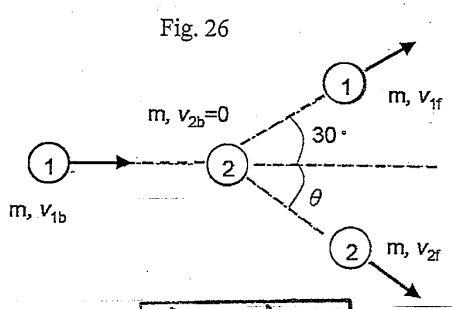 (A)
 (B)v₂₁sinθ + v₁f/2 = v₁b (C)v₂₁cosθ = v₁f/2 (D)θ = 60° (E)θ = 30°
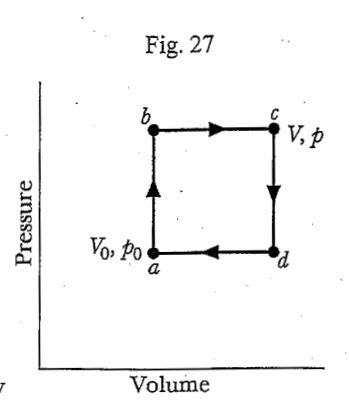 (A)The work done during the cycle is 2.27 kJ. (B)The energy added as heat during stroke abc is 14.8 kJ. (C)The efficiency of the cycle is 0.217. (D)The efficiency of a Carnot engine operating between the highest and lowest temperatures that occur in the cycle is 0.25. (E)The efficiency of Carnot engine is thus greater than the efficiency in the cycle showed in Fig. 27.
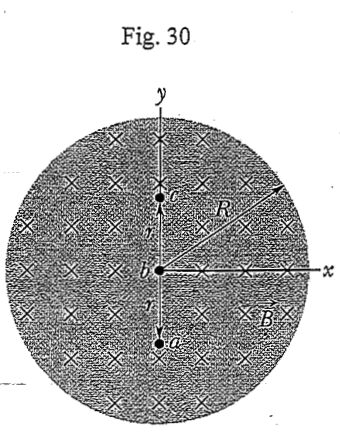 (A)the initial acceleration of an electron released at point a (r=5 cm) is (4.4×10⁷ i)m/s². (B)the initial acceleration of an electron released at point b (r=0) is nonzero. (C)the initial acceleration of an electron released at point c (r=5 cm) is (4.4×10⁷ i)m/s². (D)the electric field at point a (r=5 cm) is (+2.5×10⁻⁴ j)V/m. (E)the electric field at point c (r=5 cm) is (-2.5×10⁻⁴ j)V/m.