所屬科目:研究所、轉學考(插大)◆普通物理學
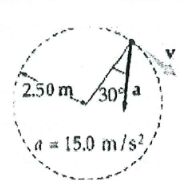
1. The figure represents the total acceleration $a$ of a particle moving clockwise in a circle of radius $2.50 \, \text{m}$ at a certain instant of time. For that instant, what is the speed $v$ of the particle?(A) $5.70 \, \text{m/s}$ (B) $7.50 \, \text{m/s}$ (C) $6.90 \, \text{m/s}$ (D) $8.20 \, \text{m/s}$ (E) $9.30 \, \text{m/s}$
2. Calculate the average power needed to spin a uniform, solid disk of mass $4.40\mathrm{kg}$ and radius $0.70\mathrm{m}$ from rest to 10.0 rad/s in 2.30 s.(A)9.2W(B)23.4 W (C) 14.0 W (D) 12.0 W (E) 16.4 W
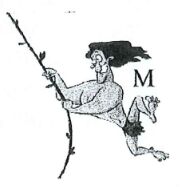
3. Tarzan $(M\mathrm{kg})$ tries to cross a river by swinging from a vine as shown in the figure. The vine is $L$ meter long, and his speed at the bottom of the swing is $V\mathrm{m/s}$. And Tarzan knows that the vine has a breaking strength of $S$ Newton. Find the maximum $V$ that Tarzan would not fall in the river.(A) $[(S - Mg)M / L]^{1 / 2}$ (B) $(SL / M)^{1 / 2}$ (C) $[2(S - Mg)L / M]^{1 / 2}$(D) $(2SL / M)^{1 / 2}$ (E) $[(S - Mg)L / M]^{1 / 2}$
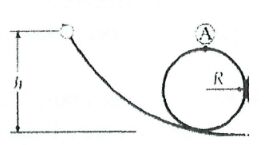
4. A bead slides without friction around a loop-the-loop shown in the figure. The bead is released from a height $h = 3.50R$. How large is the normal force on the bead at the top point A if its mass is $10.0\mathrm{g}$?(A) $0.098\mathrm{N}$ (B) $0.980\mathrm{N}$ (C) $1.960\mathrm{N}$ (D) $0.294\mathrm{N}$ (E) $0.196\mathrm{N}$
5. The sound level at a distance of $2.0\mathrm{m}$ from a source is $120\mathrm{dB}$. At what distance is the sound level $100\mathrm{dB}$? (A) $40\mathrm{m}$ (B) $30\mathrm{m}$ (C) $20\mathrm{m}$ (D) $10\mathrm{m}$ (E) $5\mathrm{m}$.
6. A transverse wave on a string is described by the wave function $y = 0.15 \sin(0.8x - 50t)$, where $x$ and $y$ are in meters and $t$ is in seconds. The mass per unit length of this string is $24.0 \, \text{g/m}$. Determine the power transmitted to the wave.(A) $42.18\mathrm{W}$ (B) $21.09\mathrm{W}$ (C) $63.27\mathrm{W}$ (D) $84.36\mathrm{W}$ (E) $2.11\mathrm{W}$
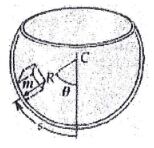
7. The figure illustrates that a particle of mass m slides without friction inside a hemispherical bowl of radius $R$. If the particle starts from rest with a small displacement from equilibrium, it moves in simple harmonic motion with an oscillating angular frequency $\omega$. Find the corresponding period $T$.(A) $\sqrt{g / R}$ (B) $2\pi \sqrt{g / R}$ (C) $2\pi \sqrt{2R / g}$ (D) $2\pi \sqrt{R / g}$ (E) $2\pi \sqrt{R / 2g}$
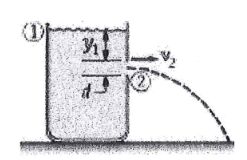
8. A large storage tank shown in the figure, open at the top and filled with water, develops a very small hole in its side at a point $y_{1}$ (m) below the water level. The rate of flow from the leak is found to be $W$ (m³/s). Determine the diameter of the hole.(A) $(4W / \pi)^{1 / 2} \times (2gy_{1})^{1 / 4}$ (B) $(4W / \pi)^{1 / 2} \times (2gy_{1})^{-1 / 4}$(C) $(W / \pi)^{1 / 2} \times (2gy_{1})^{-1 / 4}$ (D) $(4W / \pi) \times (2gy_{1})^{-1 / 4}$(E) $(4W / \pi)^{1 / 2} \times (gy_{1})^{-1 / 4}$
9. A particular heat engine has a mechanical power output of $2.50\mathrm{kW}$ and an efficiency of $25.0\%$. The engine expels $8.00\times 10^{3}\mathrm{J}$ of exhaust energy in each cycle. Find the time interval for each cycle.(A) 0.533 s (B) 5.330 s (C) 0.266 s (D) 2.660 s (E) 1.066 s
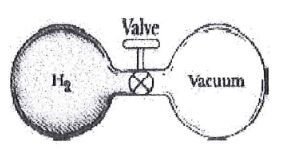
10. As shown in the figure, A 0.10 mole sample of $\mathrm{H}_{2}$ gas is contained in the left side of the container, which has equal volumes left and right. The right side is evacuated. When the valve is opened, the gas streams into the right side. What is the entropy change of the gas? (hint: $\ln(2) = 0.69314$, $R = 8.314 \, \text{J/mole} \cdot \text{K}$)(A) 5.76 J/K (B) 57.6 J/K (C) 2.88 J/K (D) 0.576 J/K (E) 0.288 J/K
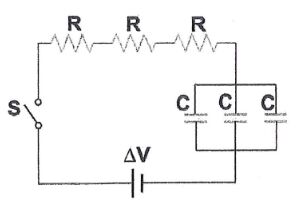
11. When the switch in the circuit is closed at $t = 0$, what is the time constant for the circuit to reach steady state? Each of the three resistors has resistance $R$, and each of the three capacitors has capacitance $C$. The internal resistance of the battery is negligible.(A) RC (B) 9RC (C) RC/9 (D) R/C(E) none of those answers
12. A particle with charge $q1 = -40.0 \, \text{nC}$ is located on the x-axis at $x = 0.0$. A second particle, with charge $q2 = -20.0 \, \text{nC}$, is located on the x axis at $x = 0.5 \, \text{m}$. Is there a point at a finite distance where the electric potential due to these two charges is zero? (A) Yes; it is to the left of $x = 0.0$ along x axis. (B) Yes; it is between $x = 0.0$ and $x = 0.5 \, \text{m}$ along x axis. (C) Yes; it is to the right of $x = 0.5 \, \text{m}$ along x axis. (D) Yes; but not along the x axis (E) No.
13. A parallel-plate capacitor is charged and then disconnected from the battery. The plate separation is then reduced to half its original value. By what factor does the stored energy in the capacitor change? (A) It remains the same. (B) It is doubled. (C) It decreases by a factor of 2. (D) It increases by a factor of 4. (E) It decreases by a factor of 4
14. A charged particle moves through a uniform magnetic field. Which of the following statements about the magnetic force on the particle is true? (A) It exerts a force on the particle parallel to the field. (B) It exerts a force on the particle along the direction of its motion. (C) It increases the kinetic energy of the particle. (D) It changes the momentum of the particle. (E) None of the above.
15. A light ray travels from medium 1 into medium 2, and then into medium 3, as shown in the figure. Which of the following correctly represents the magnitudes of the relative index of refraction, n1, n2, n3? (A) $n3 > n1 > n2$ (B) $n3 > n2 > n1$ (C) $n2 > n3 > n1$ (D) $n1 > n3 > n2$ (E) none of the above.
16. A plane electromagnetic wave in vacuum propagates in the $+\mathbf{x}$ direction with frequency $f = 900\mathrm{Mhz}$. The magnetic field oscillates perpendicular to $\mathbf{x}$ with amplitude $B_0 = 2.0uT$. What is the expression for electrical field $E(x,t)$? (Use $c = 3\times 10^{8}m / s$). (A) $6.67 \times 10^{-14} \cos(18.85x - 5.65 \times 10^{9}t)$ (B) $600 \cos(18.85x - 5.65 \times 10^{9}t)$ (C) $6.67 \times 10^{-1} \cos(0.33x - 5.65 \times 10^{9}t)$ (D) $600 \cos(0.33x - 5.65 \times 10^{9}t)$
17. A bar magnet is held vertically above a circular conducting loop lying in the horizontal plane, as shown in the figure. The south pole of the magnet faces the loop. The magnet is then released and allowed to fall freely toward the loop. As viewed from above, which statement correctly describes the direction of the induced current in the loop? (A) It is always counterclockwise. (B) It is always clockwise. (C) It is counterclockwise as the magnet falls toward the loop, and then clockwise after it has passed through the loop. (D) It is clockwise as the magnet falls toward the loop, and then counterclockwise after it has passed through the loop. (E) There is no induced current.
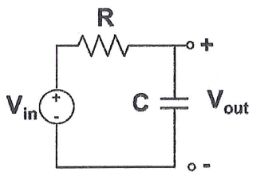
18. The RC circuit shown in the figure $(\mathrm{R} = 100\Omega, \mathrm{C} = 10\mu \mathrm{F})$ is called a low-pass filter because it passes low-frequency AC signals with less attenuation than high-frequency signals. The frequency at which the voltage ratio $\mathrm{A} = \mathrm{v_{out}} / \mathrm{v_{in}}$ drops to $1 / \sqrt{2}$ of its maximum value is known as cutoff frequency. What is the cutoff frequency of this circuit?(A) $159.2\mathrm{Hz}$(B) $1\mathrm{kHz}$(C) $6.28\mathrm{kHz}$(D) $1.59\mathrm{MHz}$(E) $10\mathrm{MHz}$
19. A radio-wave transmitter and a receiver are separated by a horizontal distance $d = 60.0 \, \text{m}$. Both antennas are located at a height $h = 40.0 \, \text{m}$ above the ground, as shown in the figure. The receiver detects two signals: one travels directly from the transmitter, and the other is reflected from the ground. Assume the ground is perfectly level and that a $180^{\circ}$ phase shift occurs upon reflection. What is the longest wavelength that results in destructive interference at the receiver?(A) $20.0\mathrm{m}$ (B) $26.7\mathrm{m}$ (C) $40\mathrm{m}$ (D) $80\mathrm{m}$ (E) $160\mathrm{m}$
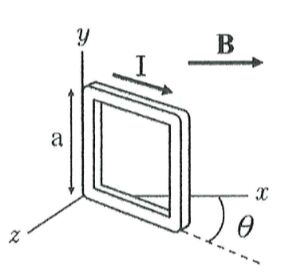
20. A square coil consists of $N = 10$ closely wrapped turns and has side length $a = 0.50 \, \text{m}$. The coil is hinged along the y-axis, and its plane makes an angle $\theta = 60.0^{\circ}$ with the x-axis, as shown in the figure. The current in the coil is $I = 1.50 \, \text{A}$ in the direction indicated, and the coil is placed in a uniform magnetic field $B = 0.40 \, \text{T}$ directed along the positive x-axis. What is the torque exerted on the coil by the magnetic field, and what is its direction when viewed from above (looking down along the +y-axis)?(A) $0.75\mathrm{N}\cdot \mathrm{m}$ clockwise (B) $0.75\mathrm{N}\cdot \mathrm{m}$ counter-clockwise(C) $1.3\mathrm{N}\cdot \mathrm{m}$ clockwise (D) $1.3\mathrm{N}\cdot \mathrm{m}$ counter-clockwise (E) None of the above
 阿摩線上測驗
登入
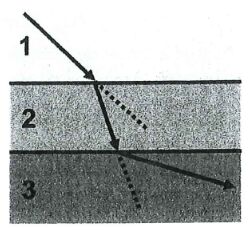 (A) $n3 > n1 > n2$ (B) $n3 > n2 > n1$ (C) $n2 > n3 > n1$ (D) $n1 > n3 > n2$ (E) none of the above.
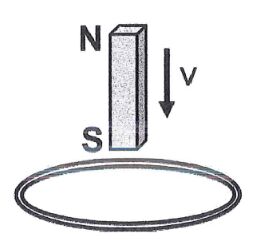 (A) It is always counterclockwise. (B) It is always clockwise. (C) It is counterclockwise as the magnet falls toward the loop, and then clockwise after it has passed through the loop. (D) It is clockwise as the magnet falls toward the loop, and then counterclockwise after it has passed through the loop. (E) There is no induced current.
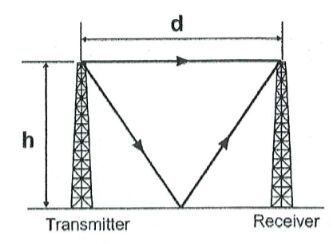 (A) $20.0\mathrm{m}$ (B) $26.7\mathrm{m}$ (C) $40\mathrm{m}$ (D) $80\mathrm{m}$ (E) $160\mathrm{m}$