阿摩線上測驗
登入
首頁
>
高考◆英语◆北京市
> 101年 - 2012年北京高考真题(英语)#13313
101年 - 2012年北京高考真题(英语)#13313
科目:
高考◆英语◆北京市 |
年份:
101年 |
選擇題數:
50 |
申論題數:
0
試卷資訊
所屬科目:
高考◆英语◆北京市
選擇題 (50)
21. —Look at those clouds! —Don’t worry. ______ it rains, we’ll still have a great time. (A) Even if (B)As though (C) In case (D) If only
22. By the time you have finished this book, your meal ______ cold. (A) gets (B) has got (C) will get (D)is getting
23. One learns a language by making mistakes and ______ them. (A) corrects (B) correct (C)to correct (D) correcting
24. Jerry did not regret giving the comment but felt ______ he could have expressed it differently. (A) why (B) how (C) that (D) whether
25. George said that he would come to school to see me the next day, but he ______. (A) wouldn’t (B) didn’t (C) hasn’t (D) hadn’t
26. When deeply absorbed in work, ______ he often was,he would forget all about eating or sleeping. (A) that (B) which (C) where (D) when
27. _______ with care, one tin will last for six weeks. (A) Use (B) Using (C) Used (D) To use
28. Many people have donated that type of blood; however, the blood bank needs _____. (A) some (B) less (C) much (D) more
29. —Have you heard about that fire in the market? — Yes, fortunately no one _____. (A) hurt (B) was hurt (C) has hurt (D) had been hurt
30. Our friendship _____ quickly over the weeks that followed. (A) had developed (B) was developing (C) would develop (D) developed
31. ______ at the door before you enter my room, please. (A) Knock (B) Knocking (C) Knocked (D) To knock
32.It’s so nice to hear from her again ______, we last met more than thirty years ago. (A) What’s more (B) That’s to say (C) In other words (D) Believe it or not
33. We ______ the difficulty together, but why didn’t you tell me? (A) should face (B) might face (C) could have faced (D) must have faced
34. Do you think this shirt is too tight ____ the shoulders? (A) at (B) on (C) to (D) across
35. Don’t handle the vase as if it ____ made of steel. (A) is (B) were (C) has been (D) had been
36.第二节 完形填空(共20小题;每小题1.5分,共30分) 阅读下面短文,掌握其大意,从每题所给的A、B、C、D四个选项中,选出最佳选项,并在答题卡上将该项涂黑。 (A) hobby (B) plan (C) dream (D) word
37. (A) connected (B) expanded (C) exposed (D) extended
38. (A) rarely (B) certainly (C) probably (D) consistently
39. (A) director (B) trainer (C) leader (D) dancer
40. (A) symbol (B) memory (C) truth (D) reality
41. (A) bouncing (B) dating (C) turning (D) tracking
42. (A) lacks (B) adds (C) makes (D) brings
43. (A) while (B) since (C) until (D) when
44. (A) Cared (B) Expected (C) Asked (D) Decided
45. (A) motivated (B) relaxed (C) convinced (D) astonished
46. (A) challenges (B) profits (C) advantages (D) adventures
47. (A) put (B) mix (C) build (D) pick
48. (A) Attention (B) association (C) attraction (D) adaptation
49. (A) apart (B) aside (C) off (D) back
50. (A) over (B) by (C) with (D) beyond
51. (A) function (B) meaning (C) expression (D) usage
52. (A) boundaries (B) problems (C) barriers (D) efforts
53. (A) necessary (B) perfect (C) proper (D) possible
54. (A) talent (B) honor (C) potential (D) responsibility
55. (A) victory (B) trend (C) tradition (D) desire
56. What does the course Basic Math mainly cover? (A) Algebra. (B) College Mathematics. (C) Arithmetic. (D) Mathematics Education.
57. What benefits can students expect from Basic Math? (A) Stronger imaginative ability. (B) Additional presentation skills. (C) More mathematical confidence. (D) Greater chances of becoming teachers.
58. What can we learn about Professor H. Siegel? (A) He is a guest lecturer at Kentucky Educational Television. (B) He is to deliver 30 lectures in Basic Math. (C) He works in Georgia State University. (D) He specializes in training teachers.
59. Where is the passage most likely to have been taken from? (A) A news report. (B) A book review (C) A lesson plan. (D) An advertisement
60. What did the author’s classmates think about his report? (A) Controversial. (B) Ridiculous. (C) Boring. (D) Puzzling.
61. Why was the author confused about the task? (A) He was unfamiliar with American history. (B) He followed the advice and flipped a coin. (C) He forgot his teacher’s instruction. (D) He was new at the school.
62. The underlined word “burning” in Para. 3 probably means _______. (A) annoyed (B) ashamed (C) ready (D) eager
63. In the end, the author turned things around _______. (A) by redoing his task (B) through his own efforts (C) with the help of his grandfather (D) under the guidance of his headmaster
64. We can learn from the passage that people under pressure tend to ______. (A) keep rewards better in their memory (B) recall consequences more effortlessly (C) make risky decisions more frequently (D) learn a subject more effectively
65. According to the research, stress affects people most probably in their ______. (A) ways of making choices (B) preference for pleasure (C) tolerance of punishments (D) responses to suggestions
66. The research has proved that in a stressful situation, ______. (A) women find it easier to fall into certain habits (B) men have a greater tendency to slow down (C) women focus more on outcomes (D) men are more likely to take risks
67. John Sauven holds that_____. (A) many people value nature too much (B) exploitation of wildernesses is harmful (C) wildernesses provide humans with necessities (D) the urge to develop the ecosystem services is strong
68. What is the main idea of Para. 3? (A) The exploitation is necessary for the poor people. (B) Wildernesses cannot guarantee better use of raw materials. (C) Useful services of wildernesses are not the reason for no exploitation. (D) All the characteristics concerning the exploitation should be treated equally.
69. What is the author’s attitude towards this debate? (A) Objective. (B) Disapproving. (C) Sceptical. (D) Optimistic.
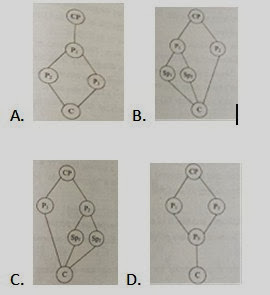
70. Which of the following shows the structure of the passage?
申論題 (0)
相關試卷
102年 - 2013年北京高考真题(英语)#13312
102年 · #13312
100年 - 2011年北京高考真题(英语)#13315
100年 · #13315
99年 - 2010年北京高考真题(英语)#13317
99年 · #13317
98年 - 2009年北京高考真题(英语)#13318
98年 · #13318
97年 - 2008年北京高考真题(英语)#13319
97年 · #13319
96年 - 2007年北京高考真题(英语)#13321
96年 · #13321
95年 - 2006年北京高考真题(英语)#13322
95年 · #13322
94年 - 2005年北京高考真题(英语)#13323
94年 · #13323
93年 - 2004年北京高考真题(英语)#13325
93年 · #13325
 阿摩線上測驗
登入
阿摩線上測驗
登入