所屬科目:研究所、轉學考(插大)◆普通物理學
1. A ball is thrown horizontally from a height of 30 m and hits the ground with a speed that is three times its initial speed. The initial speed of the ball is _(1)_ m/s.
2. A single force acts on a 2.0 kg particle-like object in such a way that the position of the object as a function of time is given by x = 3.0t - 4.0t2 + 1.0t3, with x in meter and t in seconds. The work done on the object by the force from t = 0 to t = 4.0 s is _(2)_ J.
3. Please write down the Bernoulli's equation._(3)_
4. A body of mass 2.0 kg makes an elastic collision with another body at rest and continues to move in the original direction but with one-fourth of its original speed. What is the mass of the other body? _(4)_ kg.
5. A parallel-plate capacitor has area L ✕ L and separation D << L. One-half the space between the plates is filled with a dielectric for which k = k0, the other half with a dielectric for which k = k1. The capacitance of this capacitor is _(5)_.
6. N electrons move at speed v in a circular orbit of radius R. What is the magnetic dipole moment associated with the current loop?_(6)_
7. The magnetic field for a given electromagnetic wave has an rms value of 7✕10-9T. How much energy is transported per minute through a 0.1-m2 area?_(7)_
8. Yellow light at 587.6 nm, characteristic of helium, is found to be redshifted as it is observed in a certain star; the wavelength is measured to be 611.7 nm. How fast is the star receding from Earth?_(8)_
9. 2.00 kg of water is warmed from 20.0 °C up to 80 °C. What is the change in entropy \( \Delta S \) of the water? (The specific heat of water is c = 4.19 kJ/kg·K)
10. Several objects (a hoop, a solid cylinder, a solid sphere, and a thin spherical shell) roll, without slipping down an incline of vertical height H, all starting from rest at the same moment. In addition a box slides down without friction. In what order do they reach the bottom of the incline?
11. What are the Kepler's laws of planetary motion? Please derive the Kepler's third law.
12. List the features of the photoelectric effect that cannot be explained by the wave nature of light? What is Einstein's postulate to explain the photoelectric effect?
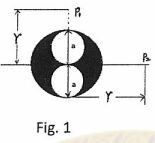
13. A long cylindrical conductor, of radius a, has two cylindrical cavities of diameter a through its center, as shown in Fig. 1. A current I is directed out of the page and is uniform through a cross section of the conductor. Find the magnetic field in terms of \( \mu_0 \), I, r and a at (a) point \( P_1 \) and (b) point \( P_2 \).
14. A series RLC circuit consists of a 1200.0-Hz AC emf with \( V_0 = 80 \) V; \( R = 500 \) Ω, \( L = 92 \) mH, and \( C = 2 \) mF. Find the reactance \( X_C \), \( X_L \), impedance Z, and \( I_{max} \), phase angle \( \phi \) between voltage and current.
 阿摩線上測驗
登入