所屬科目:研究所、轉學考(插大)◆普通化學
1. Which of the following are incorrectly named? (A) SO42-, sulfate ion (B) Cr2O72- , dichromate ion (C) CO32- bicarbonate ion (D)CN-, cyanide ion (E) ClO- , chlorite ion
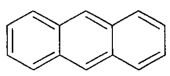
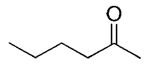
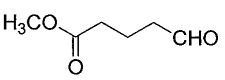
2. Which of the following organic compounds has (or have) the ketone functional group(s)? (A)(B)(C)(D) (E)
3. Which of the following statements are true of uranium-238? (A)Its ionization energy is similar to of an atom of uranium-235. (B)Its mass will be slightly different from that of an atom of uranium-235. (C)It will contain a different number of protons than an atom of uranium-235. (D)Its chemical properties will be exactly like those of uranium-235. (E)All of the above are wrong
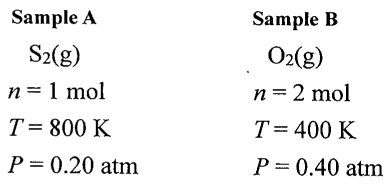
4. Consider the following gas samples:
(A)The volume of sample A is twice the volume of sample B. (B)The mean square velocity of molecules in sample A is twice as large as the mean square velocity of molecules in sample B. (C)The fraction of molecules in sample A, having a kinetic energy greater than some high fixed value, is larger than the fraction of molecules in sample B, having kinetic energies greater than that same high fixed value. (D)Assuming identical intermolecular forces in the two samples, sample A should be more nearly ideal than sample B. (E)The average kinetic energy of the molecules in sample A is twice the average kinetic energy of the molecules in sample B.
5. The reaction of fats with sodium hydroxide is called: (A)solvolysis (B)saponification (C)alcoholysis (D)hydrolysis (E)aminolysis
6. Which of the followings would absorb microwave? (A)vibrational transitions (B)rotational transitions (C)electronic transitions (D)covalent-bond cleavage (E)nuclear transitions from α to β spin state
7. Please select the central metals that exist in hemoglobin and chlorophyll. (A)iron (B)rhodium (C)zinc (D)cobalt (E)magnesium
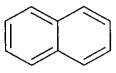
8. Which of the followings is (are) not aromatic compound(s)? (A)allene (B)naphthalene (C)pyridine (D)acetylene (E)ethylene
9. Which of the following statements is (are) correct? (A)Electrons are never found in an antibonding molecular orbital. (B)All antibonding molecular orbitals are higher in energy than the atomic orbitals of which they are composed. (C)Antibonding molecular orbitals have electron density mainly outside the space between the two nuclei. (D)The fact that O2 is paramagnetic can be explained by the molecular orbital diagram for O2 . (E)None of the above is true.
10. Which of the following statement(s) is/are true? (A)When two opposing processes are proceeding at identical rates, the system is at equilibrium. (B)Catalysts are an effective means of changing the position of an equilibrium. (C)An endothermic reaction shifts toward products when heat is added to the reaction. (D)For an endothermic reaction, increasing temperature not only increases the forward reaction rate but also decreases the reverse reaction rate. (E)None of the above statements is true.
1. Consider a reaction of A → Products in which the rate law is found to be rate = k[A]4 . If the first half-life of the reaction is found to be 10 seconds when [A]=1M, what is the time for the half-life for [A]=0.1M?
2. Order the following species with respect to carbon-oxygen bond length (longest to shortest)
CH3OH, CO, CO2, CO32-
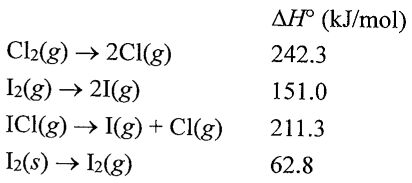
3. Using the following data, calculate the standard heat of formation of the compound ICl in kJ/mol:
4. A solution is prepared from 40.0 g of a nonvolatile, nondissociating solute and 80.0 g of water. The vapor pressure of the solution at 60°C is 132 torr. The vapor pressure of water at 60°C is 150. torr. What is the molar mass of the solute?
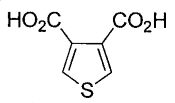
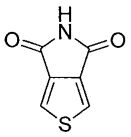
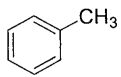
5. Give the English names of the following aromatic compounds.
(A)(B)(C)(D)
6. The Nobel Prize in chemistry 2010 was awarded to "Palladium-catalyzed cross-coupling reactions in organic synthesis". Please give the oxidation state of palladium in each of the following transition-metal catalysts. (A)PdCl2 (B)Pd(OCOCH3)2 (C) Pd(OCOCF3)2 (D) Pd(PPh3)4
7. Please describe the Gibbs free energy.
8. What is Arrhenius acid?
9. Please give an example of first-order transition.
10. What is valence-shell electron-pair repulsion (VSEPR) model?
11. What is second-order transition?
12. Please draw a temperature-dependent molar Gibbs free energy of a solid and its liquid phase to show freezing point .
13. What is the first law of Thermodynamics?
 阿摩線上測驗
登入
 (B)
 (C)
 (D)
 (E)
 (B)
 (C)
 (D)