所屬科目:中山◆電機◆工程數學甲
1. (15%) Evaluate the following integral
(2) (7%6) Compute the quantity A given below where the Fourier transform of f1(t) is given in the following figure (a).
(b) (8%) Compute the quantity B given belowwhere the Fourier transform of f2(t) is given in the following figure (b).
(a) (6%) Please continue the argument to derive the result rank(A) = rank(R). (接下來前段是背景知識介紹,之後才是提問)Insthq given, instead of using the elementary row operations (i.e. the Gauss eliminations) to manipulate the equation, we may also apply the QR factorization to the equation to get QRx = b, which implies further QT QRx = QTb. Since QTQ = In, it gives Rx = QTb. Thus, according to the result of (a), when all columns of A are linearly independent, the square matrix R is nonsingular and so the solution x =b is obtained. It seems that we may summarize the above argument as the following statement:
Given, where all columns of A are assumed linearly independent, then solution to the equation Ax = 6 can always be computed from x =, where Q and R are matrices obtained from the QR factorization of A.
However, the simple example shows that the summary is incorrect because, according to the summary, the solution is x ==0 and obviously it does not satisfy the original equation.
(a) (10%) Let . Suppose 4 0 and u ≡ 0. Find the solution of x1 and x2 for the initial conditions x1(0) = .
(b) (4%)Suppose Find the range of k: such that the solution of x1 and x2 converges to zero for any initial condition.
(c) (5%) SupposeFind the range of k such that the solution of at and ta exhibits oscillatory behavior for any nonzero initial condition.
(d) (6%) For the values , calculate the steady-state response of.
(c) (2%) Find, where C is the straight line going from the points (2,2,1) to the point (1,-1,2).
7. (5%) Evaluate the following integral
 阿摩線上測驗
登入
阿摩線上測驗
登入

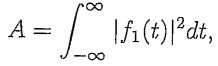 where the Fourier transform of f1(t) is given in the following figure (a).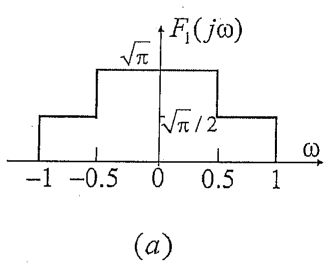
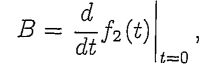 where the Fourier transform of f2(t) is given in the following figure (b).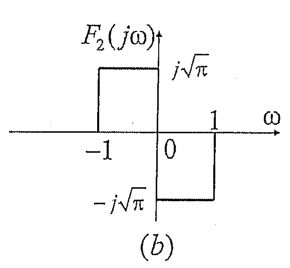
 , instead of using the elementary row operations (i.e. the Gauss eliminations) to
manipulate the equation, we may also apply the QR factorization to the equation to get QRx = b,
which implies further QT QRx = QTb. Since QTQ = In, it gives Rx = QTb. Thus, according to the
result of (a), when all columns of A are linearly independent, the square matrix R is nonsingular and
so the solution x =
, instead of using the elementary row operations (i.e. the Gauss eliminations) to
manipulate the equation, we may also apply the QR factorization to the equation to get QRx = b,
which implies further QT QRx = QTb. Since QTQ = In, it gives Rx = QTb. Thus, according to the
result of (a), when all columns of A are linearly independent, the square matrix R is nonsingular and
so the solution x = b is obtained.
It seems that we may summarize the above argument as the following statement:
b is obtained.
It seems that we may summarize the above argument as the following statement:  , where all columns of A are assumed linearly independent, then
solution to the equation Ax = 6 can always be computed from x =
, where all columns of A are assumed linearly independent, then
solution to the equation Ax = 6 can always be computed from x = , where Q and R are
matrices obtained from the QR factorization of A.
, where Q and R are
matrices obtained from the QR factorization of A. shows that the summary is incorrect because, according
to the summary, the solution is x =
shows that the summary is incorrect because, according
to the summary, the solution is x =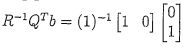 =0 and obviously it does not
satisfy the original equation.
=0 and obviously it does not
satisfy the original equation. . Suppose
 4 0 and u ≡ 0. Find the
solution of x1 and x2 for the initial conditions x1(0) =
4 0 and u ≡ 0. Find the
solution of x1 and x2 for the initial conditions x1(0) =  .
. Find the
range of k: such that the solution of x1 and x2 converges to zero for any initial condition.
Find the
range of k: such that the solution of x1 and x2 converges to zero for any initial condition. Find the
range of k such that the solution of at and ta exhibits oscillatory behavior for any nonzero
initial condition.
Find the
range of k such that the solution of at and ta exhibits oscillatory behavior for any nonzero
initial condition. ,
calculate the steady-state response of
,
calculate the steady-state response of .
. , where C is the straight line going from the points (2,2,1) to the point (1,-1,2).