2. The linear combination of a set of vectors is an essential element in linear algebra. We say a set V is invariant under linear combination if the implication "∀n ∈  and any set of vectors {v₁, ...,
  } ⊂ V ⇒ the set of all linear combinations {c₁v₁ + ... +
 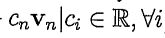 } ⊂ V" holds. And we say a mapping L defined on a set X is invariant under linear combination if the form of linear combination is unchanged under L, or more precisely the statement "
 , and any set of vectors {x₁, ...,
  } ⊂ X, the identity L(c₁x₁ + ... +
  ) = c₁L(x₁) + ... +
  holds" is true. Which one of the following statements related to linear combination is false
(A)Let S be a subset of a vector space V. Then S is a subspace of V if S is invariant under linear combination.
(B) Let {V₁, ...,  } be a set of k subspaces of a vector space W and denote span{V₁, ...,
  } as the set of all linear combinations of the form c₁v₁ + ... +
  with each vᵢ chosen freely from
  . Then span{V₁, ...,
  } is also a subspace of W with dim(span{V₁, ...,
  }) = dim(V₁) + ... + dim(
 )
)
(C) Let A and B be two matrices and denote C := AB. Then each column of C is a linear combination of all columns of A, and so rank ≤ rank
 is implied.
(D) A mapping L between two vector spaces is a linear transformation if and only if it is invariant under linear combination. (E) Let (V, (. ,. )ᵥ) be an inner product space. Then (. , .)ᵥ is invariant under linear combination at either one of its two arguments.
 阿摩線上測驗
登入
阿摩線上測驗
登入
 . Which of the following is true? (A) for a fixed b, the amplitude of
  is maximized when k = ω² (B) for a fixed b, the maximal amplitude of
  is 1/b (C) for fixed b and k, the amplitude of
  always grows as ω increases (D) the period of
  is 2πω (E) the period of
  depends on b and k.
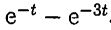 . Which of the following is true? (A) the system is
  order (B) the characteristic equation of the system has a pair of complex roots (C) the unit step response has oscillatory behavior (D) the unit step response does NOT converge to a constant value (E) the unit step response is equal to
  /3
/3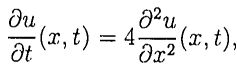 , ∀0 < x < 1, t > 0
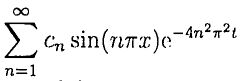 (C) suppose f(x) = 7 sin(3x), then the solution is u(x,t) =
  (D) all of the above are true (E) none of the above is true
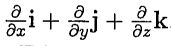 (A) ∇(∇ × F) = 0, where F is a vector field with continuous first and second derivatives. (B) ∇(F × G) = G ⋅ (∇ × F) – F ⋅ (∇ × G), where F and G are two smooth vector fields (C) ∇ ⋅ (φF) = ∇φ ⋅ F + (∇ ⋅ F), where φ is a smooth scalar field and F a smooth vector field. (D) all of the above are true (E) none of the above is true
 u(t-2) is F(jω) = e<sup>aω (b+jc), where u(t) is an unit-step function. Then which of the following statements is correct? (A) a=-2, b=1, c=0. (B) a = 2, b =1, c=0. (C) a>0, b>1, c=0. (D) a<2, b≠1, c≠0. (E) None of the above statements are correct.
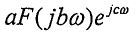 . Then which of the following statements is correct? (A) a=3, b=3, c=2. (B) 0<a<1, -1<b<0, 0<c≤2. (C) a = -3, b=1/3, c=3. (D) a>0, b>0, c<0. (E) None of the above statements are correct.
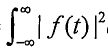 dt is equal to α. Which of the following statements is correct?
 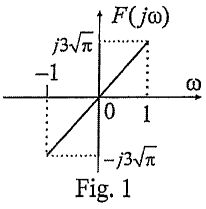 (A) α = 0 (B) α = 6√π (C) α = 3π (D) α = 3 (E) None of the above statements are correct.
  (B) f(z) = z Im z, Im z stands for the imaginary part of z (C) f(z) = x² + jy² (D)
 (E) None of the above statements are correct.
 f(z)dz is c + jd. Then which of the following statements is correct? (A) c < 0, d ≤ 0 (B) c > 0, d > 0 (C) c = 0, 15 < d < 20 (D) c = 0, 1 < d < 10 (E) None of the above statements are correct.
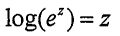 (E) None of the above statements are correct.
 f(z)dz = a + jb. Then which of the following statements is correct? (A) a < 0, b ≤ 0 (B) a + b = -2/3 (C) a + b = 2/3 (D) a > 0, b < 0 (E) None of the above statements are correct.
 } is linearly independent if there exist coefficients c1, ...,
  , all of them are zero, such that c1v1 + ... +
  = 0. (C) The linear independence of a set of vectors is a necessary but not sufficient condition for them to be a basis of a vector space. (D) A square matrix is diagonalizable if and only if all its eigenvectors are linearly independent. (E) Let (λ1, x1) be the i th eigenvalue-eigenvector-pair of a square matrix. Then all λ's are distinct if and only if the set {x1, ...,
  } of eigenvectors is linearly independent.
 and
and  denote, respectively, the set of all even and all odd functions in V. Moreover, define an inner product (f, g) :=
  f(x)g(x)dx for any f(﹒), g(﹒) \in V. Which of the following statements are true?
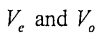 are subspaces of V.

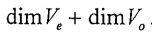
 ) as the distance induced from the defined inner product between any f(﹒) ∈ V and
  . Then dist((x + 1)2,
  ) = √8/3.
 f(x)g(x)dx. Then the set {u₁, u₂} with u₁ = 1/√2 and u₂ = (√6/2)x forms an orthonormal set in C[-1,1]. Moreover, the best least squares approximation to h(x) = x² by a linear function is
  = (√2/3)+(√6/4)x.
 (‧) denote the Laplace transform. Which of the followings are true? (A)
  (a₁f₁+a₂f₂) = a₁
  (f₁) + a₂
  (f₂), for all a₁, a₂ ∈
  and for all functions f₁, f₂ (B) if
  (f) = F(s), then
  = sF(s) (C) if
  (f) = F(s), then
 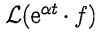 = F(s)/(s+a) (D) if
  (f) = F(s), then
  (t² f) =
 (E) if
  (f) = F(s) and
  (g) = G(s), then
  (f ‧g) = (F*G)(s), where * denotes convolution operation
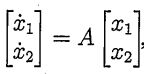 =where
 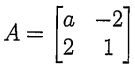 ; (A) the system is linear (B) the system is time invariant (C) the system has more than one equilibrium (D) when a < -4, any initial condition results in a solution which diverges to infinity (E) when -4 < a < -1, any initial condition results in a solution which converges to the origin
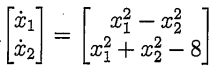 (A) the system is linear (B) the system has two equilibria (C) (x₁, x₂) = (2,-2), (-2, -2) are equiliria of the system (D) (x₁, x₂) = (-2, -2) is the only stable equilibrium of the system (E) (x₁, x₂) = (2, -2) is a saddle equilibrium of the system.