所屬科目:研究所、轉學考(插大)◆普通化學
1. The statement “The total mass of materials is not affected by a chemical change in those materials” is called a(n) (A) observation (B) measurement (C) theory (D) natural law
2. As part of the calibration of a new laboratory balance, a 1.000-g mass is weighed with the following results:The balance is: (A) Both accurate and precise. (B) Accurate but imprecise. (C) Precise but inaccurate. (D) Both inaccurate and imprecise.
3. Consider the numbers 1.305 and 4.10. The sum of these numbers has ____ significant figures, and the product of these numbers has ____ significant figures.(A) 2, 3 (B) 4, 2 (C) 3, 2 (D) 3, 3
4. Consider an atom traveling at 2% of the speed of light. The de Broglie wavelength is found to be 3.50 × 10⁻⁶ nm. Which element is this? (Planck’s constant, h = 6.626 × 10⁻³⁴ J⋅s) (A) O (16.00) (B) F (19.00) (C) S (32.06) (D) Ar (39.95)
5. How many electrons in an atom can have the quantum numbers n = 4, l = 3?(A) 6 (B) 10 (C) 14 (D) 16
6. How many of the following is/are correct?i. The importance of the equation E = mc2 is that energy has mass. ii. Energy can only occur in discrete units called quanta. iii. The energy and position of an electron cannot be determined simultaneously.iv. No two electrons can have the same four quantum numbers. (A) 1 (B) 2 (C) 3 (D) 4
7. Which of the following names is not correct? (A) MgCO3, magnesium carbonate (B) CuBr2, copper bromide (C) HClO, hypochlorous acid (D) PCl3, phosphorus trichloride
8. Order the elements S, Cl, P, and As in terms of increasing first ionization energy. (A) As, S, P, Cl (B) As, P, S, Cl (C) P, S, Cl, As (D) Cl, As, S, P
9. Choose the compound with the most ionic bond. (A) KF (B) LiF (C) NaCl (D) LiCl
10. Which of the following ionic compounds has the largest lattice energy (i.e., the lattice energy most favorable to a stable lattice)? (A) BeO (B) BaO (C) CsI (D) NaBr
11. How many of the following ions or molecules have no dipole moment? i. BH3, ii. NO2-, iii. SF6, iv. O3, v. PCl5 (A) 1 (B) 2 (C) 3 (D) 4
12. The hybridization of the central atom in O3 is (A) sp (B) sp2 (C) sp3 (D) dsp3
13. Which of the following has the shortest bond length? (A) O22- (B) O2- (C) O2 (D) O2+
14. In the cyanide ion (CN– ), the formal charge and oxidation state for nitrogen atom are and , respectively. (A) 0, 0 (B) -1, +3 (C) 0, -3 (D) -3, -3
15. A 4.2-g oil sample is burned in a bomb calorimeter, which causes the temperature of the calorimeter to increase by 5.0°C. The calorimeter contains 1.00 kg of water (heat capacity of H2O = 4.184 J/g°C) and the heat capacity of the empty calorimeter is 0.10 kJ/°C. How much heat is released per gram of the oil when it is burned? (A) 5.1 kJ/g (B) 10.2 kJ/g (C) 21.4 kJ/g (D) 42.0 kJ/g
16. A sample of helium gas occupies 15.0 L at 23°C and 0.956 atm. What volume will it occupy at 40°C and 1.20 atm? (A) 20.8 L (B) 15.2 L (C) 12.6 L (D) 11.3 L
17. At 200 K, the molecules of an unknown gas, X, have an average velocity equal to that of Ar gas at 400 K. What is X? (Assume ideal behavior.) Atomic mass: H 1.01, C 12.01, O 16.00, F 19.00, Ar 39.95, Br 79.90 (A) HF (B) CO (C) F2 (D) HBr
18. You are given the following boiling point data. Which one of the liquids would you expect to have the highest vapor pressure at room temperature? (A) water, 100°C (B) ethanol, 78.5°C (C) ethylene glycol, 198°C (D) diethyl ether, 34.5°C
19. Which of the following is the correct order of boiling points? (A) SiO2 > C2H5OH > C3H8 > CH3OCH3 (B) C2H5OH > SiO2 > CH3OCH3 > C3H8 (C) SiO2 > C2H5OH > CH3OCH3 > C3H8 (D) C2H5OH > CH3OCH3 > C3H8 > SiO2
20. Acetone (\((\text{CH}_3)_2\text{C}=\text{O}\)) and water (\(\text{H}_2\text{O}\)) form a solution. (A) It is ideal. (B) It exhibits a negative deviation from Raoult's law. (C) It exhibits a positive deviation from Raoult's law. (D) More information is needed.
21. A 7.05-g sample of potassium chlorate was decomposed according to the following equation:
How many moles of oxygen are formed? (KClO3 122.55 g/mol) (A) 0.0863 mol (B) 0.0575 mol (C) 0.0384 mol (D) 0.0288 mol
22. The limiting reactant in a reaction (A) has the lowest coefficient in a balanced equation. (B) is the reactant for which you have the fewest number of moles. (C) has the lowest ratio of coefficient in the balanced equation/moles available. (D)has the lowest ratio of moles available/coefficient in the balanced equation.
23. Consider the following reaction: 2A + B 3C + D. 3.0 mol A and 2.0 mol B react to form 3.8 mol C. What is the percent yield of this reaction? (A) 63% (B) 75% (C) 84% (D) 89%
24. Determine the mass of a nonvolatile, nonionizing compound that must be added to 3.90 kg of water to lower the freezing point to -1.30°C. The molar mass of the compound is 50.0 g/mol and the Kf for water is 1.86°C kg/mol. (A) 8.96 g (B) 18.3 g (C) 68.0 g (D) 136 g
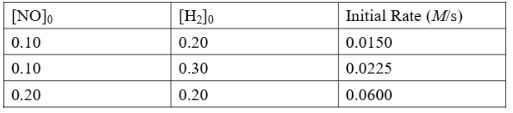
25. Initial rate data have been determined at a certain temperature for the gaseous reaction 2NO + 2H2 <=> N2 + 2H2O
What is the rate law? (A) Rate = k[NO][H2] (B) Rate = k[NO][H2]2 (C) Rate = k[NO]2[H2] (D) Rate = k[NO]2[H2]2
26. Chemists commonly use a rule of thumb that an increase of 10 K in temperature doubles the rate of a reaction. What must the activation energy be for this statement to be true for a temperature increase from 20°C to 30°C? (A) 51.2 (B) 49.5 (C) 46.1 (D) 56.7 kJ/mol
27. The value of the equilibrium constant, K, is dependent on: I. the nature of the reactants and products II., the concentration of the reactants and products, III. the temperature of the system, IV. the pressure of the system. (A) I, II (B) I, III (C) I, II, III (D) I, II, IV
28. The autoionization of water, \( \text{H}_2\text{O}(l) + \text{H}_2\text{O}(l) \rightleftharpoons \text{H}_3\text{O}^+(aq) + \text{OH}^-(aq) \), is known to be endothermic. Which of the following correctly states what occurs as the temperature of water is raised? (A) The pH of the water does not change, and the water remains neutral. (B) The pH of the water decreases, and the water becomes more acidic. (C) The pH of the water increases, and the water remains neutral. (D) The pH of the water decreases, and the water remains neutral.
29. Which of the following is the strongest reducing agent? \( \text{Zn}^{2+} + 2\text{e}^- \rightleftharpoons \text{Zn} \quad E^\circ = -0.76 \text{ V}; \text{MnO}_4^- + 4\text{H}^+ + 3\text{e}^- \rightleftharpoons \text{MnO}_2 + 2\text{H}_2\text{O} \quad E^\circ = 1.68 \text{ V}; 2\text{H}^+ + 2\text{e}^- \rightleftharpoons \text{H}_2 \quad E^\circ = \) 0.00 V; \( \text{Cl}_2 + 2\text{e}^- \rightleftharpoons 2\text{Cl}^- \quad E^\circ = 1.36 \text{ V}. \) (A) Zn (B) MnO2 (C) H2 (D) Cl2
30. What is the potential at 25°C for the cell: Cr|Cr3+(0.030 M)||Ag+(0.00030 M)|Ag? Cr3+ + 3e- <=> Cr Eo = -0.73 V; Ag+ + e- <=> Ag Eo = 0.80 V (A) 0.95 V (B) 1.35 V (C) 1.49 V (D) 1.71 V
31. Which of the following solutions will be the best buffer at a pH of 4.74? (Ka for acetic acid, HC2H3O2, is 1.8 × 10⁻⁵, Ka for benzoic acid, HC7H5O2, is 6.4×10⁻⁵) (A) 0.10 M HC2H3O2 + 0.10 M NaC2H3O2 (B) 5.0 M HC2H3O2 + 5.0 M Na C2H3O2 (C) 0.50 M HC7H5O2 + 0.14 M KC7H5O2 (D) 5.0 M HC7H5O2 + 1.4 M KC7H5O2
32. The pH of a 0.100 M benzoic acid (6.4×10⁻⁵) aqueous solution is (A) 2.60 (B) 4.19 (C) 3.26 (D) 2.53
33. The solubility of solid silver chromate, Ag2CrO4 (Ksp =9.0 × 10⁻¹²) in 0.500 M solution of K2CrO4 at 25oC is (A) 1.8×10⁻¹¹ (B) 4.2×10⁻⁶ (C) 2.1×10⁻⁶ (D) 1.3×10⁻⁴
34. The solubility of which of the following compounds in water can not be increased by adding HNO3? (A) Fe(OH)3 (B) CuS (C) AlPO4 (D) HgCl2
35. Which of the following result(s) in an increase in the entropy of the system? I. Br2(g) → Br2(l), II. NaBr(s) → Na+(aq) + Br-(aq), III. O2(298 K) → O2(373 K), IV. NH3(1 atm, 298 K) → NH3(3 atm, 298 K) (A) I, III (B) II, III (C) I, II, III (D) II, III, IV
36. For the reaction A + B $\rightleftharpoons$ C + D, $\Delta H^\circ = +40$ kJ and $\Delta S^\circ = +50$ J/K. Therefore, the reaction under standard conditions is (A) spontaneous at temperatures less than 10 K (B) spontaneous at temperatures greater than 800 K (C) spontaneous only at temperatures between 10 K and 800 K (D) spontaneous at all temperatures
37. Which of these Group 2A elements reacts least vigorously with water? (A) Mg (B) Ca (C) Sr (D) Ba
38. Which of the following complexes will absorb visible radiation of the shortest wavelength? (A) [Fe(H2O)6]3+ (B) [FeCl6]3- (C) [Fe(CN)6]3- (D) [Fe(NH3)6]3+
39. The number of unpaired electrons in CoF63-(weak field) (A) 0 (B) 1 (C) 2 (D) 4
40. What is the most likely decay for the nucleus? (hint:nucleus is stable) (A) $\alpha$-decay (B) $\beta$-decay (C) positron emission (D) $\gamma$-ray emission
 阿摩線上測驗
登入
阿摩線上測驗
登入

 nucleus? (hint:
 nucleus is stable) (A) $\alpha$-decay (B) $\beta$-decay (C) positron emission (D) $\gamma$-ray emission