所屬科目:研究所、轉學考(插大)◆普通物理學
1. The position of a simple harmonic oscillator (SHO) as a function of time is given by x = 20 cos( + ), where t is in seconds and x in meters. Find the maximum speed in unit of m/s: (A) 12.57 (B) 15.71 (C) 18.85 (D) 20.
2. A rocket whose initial mass is 800 kg consumes fuel at the rate R = 2.8 kg/s. The speed of the exhaust gases relative to the rocket engine is 2400 m/s. The initial acceleration of the rocket is (in unit of m/s²): (A) 0.9 (B) 1.1 (C) 3.0 (D) 8.4.
3. A rectangular block of mass 1 kg rests on a 30°-wedge-shaped block of mass 3 kg, as shown in the figure. Neglecting all the frictions between the contact surfaces, find the magnitude of the horizontal force F that must be applied to the wedge in order that the rectangular block does not slide along the wedge:
(A) 19.60 N (B) 22.63 N (C) 27.72 N (D) 33.95 N.
4. What will be the speed of a solid ring of mass M and radius R when it reaches the bottom of an incline if it starts from rest at a vertical height h and rolls without slipping? Ignore losses due to dissipative forces. (g: gravitational acceleration) (A)(B) (C) (D)
5. A vertical force applied tangentially to a uniform cylinder of weight 100 N as shown in the figure. The coefficient of static friction between the cylinder and all surfaces is 0.4. Find the magnitude of the maximum force F that can be applied without causing the cylinder to rotate:
(A) 12.29 N (B) 24.57 N (C) 32.57 N (D) 48.86 N.
6. As a longitudinal wave, sound induces compressions and expansion in air. In terms of displacement, which of the illustrations is correct?
(A) A (B) B (C) C (D) D
7. When we blow across the mouth of a bottle, we can cause a standing wave in the air inside the bottle, which makes a musical sound. Blowing harder can give a higher musical pitch, but that takes practice. Assume that, for any liquid height in the bottle, we can reliably obtain only the fundamental (first harmonic) and the next higher harmonic frequency by blowing. Consider a beverage bottle 25 cm in length, with an original liquid height of 20 cm inside (before we drink any of the beverage). Given that the speed of sound in air is 343 m/s, what range of frequencies can you obtain as you slowly sip the liquid in the bottle? (Choose the closest match.) (A) 20 – 20000 Hz. (B) 80 – 13500 Hz. (C) 350 – 5000 Hz. (D) 1200 – 3600 Hz.
8. Consider four paths on a P-V diagram, through which a gas can be taken from state i to state f. States i and f are at the same temperature. Rank the paths according to the magnitude of the energy transferred as heat ΔQ between the gas and its environment (high to low).
(A) 1234. (B) 4321. (C) 1324. (D) 2413.
9. In a model gasoline engine, the air-gasoline mixture can be treated approximately with a thermodynamic cycle known as the Otto cycle. In the first process (1→2), the gas undergoes an isentropic compression (the engine's compression stroke), during which the temperature rises from 300 K to 600 K. The next process (2→3) is an isochoric pressure increase, and the gas temperature reaches 1500 K as the gasoline burns. Next (3→4), the gas undergoes isentropic expansion (the engine's power stroke) during which its temperature drops to 800 K. Finally (4→1), the gas experiences an isochoric pressure decrease during which its temperature drops back to 300 K. Please estimate the efficiency of this model engine.
(A) 10%~20% (B) 20%~30% (C) 30%~40% (D) 40%~50%.
10. A sample of a monatomic ideal gas containing 6.00 × 10²³ atoms in a volume of 8.00 × 10⁻³ m³ is initially in thermal equilibrium with its surroundings at 300 K. The gas is made to expand until the final volume is 6.40 × 10⁻² m³, and the final temperature is 50 K. The change in entropy of the gas should be (A) positive (B) negative (C) zero (D) undetermined.
11. A point charge Q is surrounded by a spherical conducting shell of inner radius a and outer radius b. The conducting shell is grounded. Which of the following statement is correct ?
(A) The total charge on the outer surface of the conducting shell is zero. (B) The electric potential V is proportional to 1/r for 0 < r < a. (C) The total charge on the conducting shell is zero. (D) The magnitude of the electric field is nonzero and inversely proportional to r² for r > b.
12. Consider the following statements: (1) Magnetic field lines are always closed in the absence of magnetic monopoles. (2) The index of refraction n of a given material is defined as n = v/c, where v is the velocity of light in the material and c is that in vacuum. (3) Brewster's angle is the angle of incidence at which total reflection happens for a certain polarization. (4) It is possible that the phase velocity of electromagnetic waves in a material is larger than the velocity of light in vacuum. Which of the statements above are correct ? (A) (1), (2) and (3) are correct. (B) (1), (3) and (4) are correct. (C) Only (2) and (4) are correct. (D) Only (1) and (4) are correct.
13. A long solenoid of radius a has n loops of wire per unit length. For a time-dependent current I(t) = I₀ sin(ωt) through the solenoid, what is roughly the current on a circular conductor of radius b (b > a) and resistance R outside the solenoid, assuming that the frequency is sufficiently low? Up to an overall constant factor, the current is
(A) a² n I₀ ω cos(ωt)/R. (B) R n² I₀ cos(ωt). (C) a² n I₀ sin(ωt)/R. (D) R n² I₀ ω sin(ωt).
14. The Cartesian coordinates of a charged particle are given by x(t) = 0, y(t) = 0 and z(t) = A cos(ωt). Regarding the electromagnetic (EM) waves it generates, which of the following statement is wrong? (A) At a point on the x-y plane far from the origin, the electric field is polarized in the z direction. (B) At a large distance r, the outgoing EM wave measured at (x, y, z) = (0, 0, r) are stronger than the outgoing EM wave measured at (x, y, z) = (r, 0, 0). (C) The frequency of the EM wave at a generic fixed point in space is ω/(2π). (D) The magnitude of the electric field is approximately proportional to 1/r at large r.
15. An inductor of inductance L is connected to a battery of voltage V through a resistor of resistance R. The circuit is open for t < 0, and it becomes closed at t = 0. Which of the following is wrong ?
(A) The current is 0 for t < 0. (B) The voltage across the resistor is V immediately after it is closed at t = 0. (C) The current approaches to V/R at large t. (D) The voltage across the inductor approaches to 0 at large t.
16. Consider an electron of mass mₑ confined in a one-dimensional box of size L. Supposing that it is in the ground state, what is its energy E and what is the probability p of finding it located within the region of size L/2 in the center of the box? (A) E = , p = (B) E = , p = 1 − (C) E = , p = (D) E = , p = 1 −
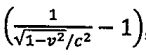
17. Which of the following statement is not true about the theory of relativity? (A) Two events A and B occur at different locations. In some frame, event A occurs before B. There must exist another frame where event B occurs before A. (B) Photons do not have rest mass but their trajectories can be bended by gravity. (C) A clock in an accelerated frame ticks slower than one in an inertial frame supposing that the two clocks are identical in the same frame. (D) The kinetic energy of a particle of rest mass m₀ and velocity v is m₀c², where c is the speed of light in vacuum.
18. A Rydberg atom is an atom with one of its electrons being excited to a state of a very large principle quantum number n, called a Rydberg state. During the transition from Rydberg state n+1 to state n of a hydrogen-like atom, the wavelength of the emitted photon is proportional to (A) n (B) n² (C) n³ (D) n⁴.
19. Which of following statements is not true for conductors, insulators, and semiconductors? (A) For conductors, the highest occupied band is only partly filled with electrons. (B) For insulators, the Fermi energy is lower than the top the valence band. (C) For semiconductors, electrons can be excited to the conduction band by thermal and/or electrical excitation. (D) For p-type semiconductors, the majority charge carriers are holes.
20. The lifetime of a muon is 2.2 μs. Suppose that a muon is generated at a height of 15 km above Earth's surface. In order to be detected on the ground, the velocity of the muon must be at least (c = 3 × 10⁸ m/s²) (A) 0.9 c (B) 0.99 c (C) 0.999 c (D) 0.9999 c.
 阿摩線上測驗
登入
 +
 ), where t is in seconds and x in meters. Find the maximum speed in unit of m/s: (A) 12.57 (B) 15.71 (C) 18.85 (D) 20.
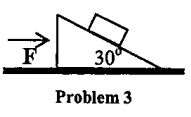 (A) 19.60 N (B) 22.63 N (C) 27.72 N (D) 33.95 N.
 (B)
 (C)
 (D)

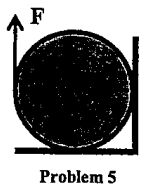 (A) 12.29 N (B) 24.57 N (C) 32.57 N (D) 48.86 N.
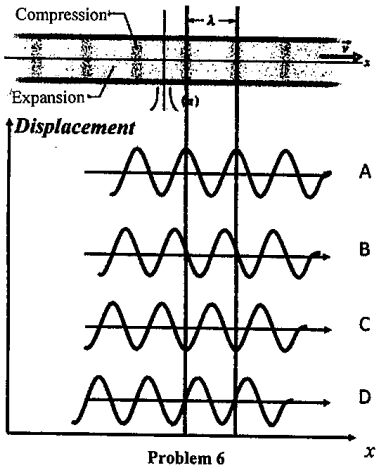 (A) A (B) B (C) C (D) D
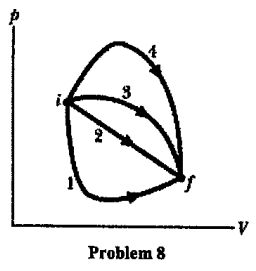 (A) 1234. (B) 4321. (C) 1324. (D) 2413.
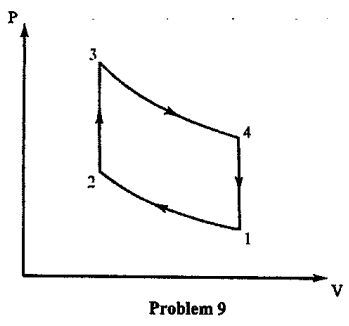 (A) 10%~20% (B) 20%~30% (C) 30%~40% (D) 40%~50%.
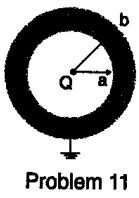 (A) The total charge on the outer surface of the conducting shell is zero. (B) The electric potential V is proportional to 1/r for 0 < r < a. (C) The total charge on the conducting shell is zero. (D) The magnitude of the electric field is nonzero and inversely proportional to r² for r > b.
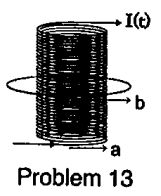 (A) a² n I₀ ω cos(ωt)/R. (B) R n² I₀ cos(ωt). (C) a² n I₀ sin(ωt)/R. (D) R n² I₀ ω sin(ωt).
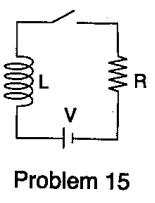 (A) The current is 0 for t < 0. (B) The voltage across the resistor is V immediately after it is closed at t = 0. (C) The current approaches to V/R at large t. (D) The voltage across the inductor approaches to 0 at large t.
 , p = (B) E =
 , p = 1 −
 (C) E =
 , p =
 (D) E =
 , p = 1 −

 , where c is the speed of light in vacuum.