所屬科目:教甄◆英文-國小
1. Both elevators are _______, so I had to use the stairs. (A) neither serving (B) no serving (C) no services (D) out of service
2. Jack caused _______ to raise when he married a poor girl from Russia. (A) tongues (B) ears (C) eyebrows (D) lips
3. Nancy needs to really _______ what’s important instead of going off on a lot of tangents. (A) zone out on (B) zero in on (C) zoom out in (D) zoom out on
4. I knew my company was polluting the water, but I was afraid I would lose my job if I blew _______ on it. (A) my nose (B) a kiss (C) the whistle (D) out
5. He worked hard to get to where he is today. He paid his _______ and did what he was told. (A)loyalty (B) studies (C) dues (D) diligence
6. Teachers need to be thinking beyond content, and _______ the development of particular ways of thinking and inquiring in all aspects of teaching and assessment. (A) incorporate (B) innovate (C) indulge (D) insert
7. We are all _______ familiar with at least one language, our own. Yet few of us ever stop to consider what we know when we know a language. (A) promptly (B) abruptly (C) intimately (D) legitimately
8. The delicate and _______ sculpture in the National Palace Museum has soon become the most popular tourist attraction in a short time. (A) generous (B) impoverished (C) ample (D) exquisite
9. In its original sense, ‘nanotechnology’ refers to the projected ability to construct items from the bottom up, using _______ and tools being developed to make complete, high performance products. (A) traits (B) components (C) techniques (D) schemes
10. Larry broke his _______ when falling from the ladder. The accident left him paralyzed from the waist down. (A) ribs (B) liver (C) spine (D) commitment
11. The platypus grows _______ on the Australia continent. Nowhere else was it originally found. (A) exclusively (B) genuinely (C) ferociously (D) virtually
12. Babies are born with the ability to _______ virtually all sounds of all human languages; that is, they can differentiate between phonemes in their own language. (A) articulate (B) discriminate (C) manifest (D) demonstrate
13. Dr. Vygotsky claimed that timely and sensitive intervention by adults when a child is _______ learning a new task could help children learn new tasks. (A) on account of (B) led astray to (C) on the edge of (D) encouraged to
14. (A) aimed (B) targeted (C) directed (D) pointed
15. (A) during (B) throughout (C) since (D) in
16. (A) copyrighted (B) registered (C) trademarking (D) illegal
17. (A) benefit (B) charge (C) fortune (D) cost
18. (A) deceit (B) illegality (C) unbalanced (D) implausible
19. (A) can be (B) being (C) are (D) have
20. (A) retrospect (B) circumspect (C) deflation (D) inflation
21. (A) in spite of (B) unlike (C) similar to (D) in contrast to
22. (A) manually (B) erratically (C) rationally (D) periodically
23(A) although they are pronounced identically(B) despite their spelling differences(C) whether words arethe same or different(D) only pronunciation
24(A) although they are pronounced identically(B) despite their spelling differences(C) whether words arethe same or different(D) only pronunciation
25(A) although they are pronounced identically(B) despite their spelling differences(C) whether words arethe same or different(D) only pronunciation
26(A) although they are pronounced identically(B) despite their spelling differences(C) whether words arethe same or different(D) only pronunciation
27.(A) to describe experiences and talk about thoughts and feelings(B) success in school or games might develop a feeling of competence(C) grow even less dependent on their families and they are challenged academically(D) can undermine a child's development by failing to recognize accomplishments
28.(A) to describe experiences and talk about thoughts and feelings(B) success in school or games might develop a feeling of competence(C) grow even less dependent on their families and they are challenged academically(D) can undermine a child's development by failing to recognize accomplishments
29.(A) to describe experiences and talk about thoughts and feelings(B) success in school or games might develop a feeling of competence(C) grow even less dependent on their families and they are challenged academically(D) can undermine a child's development by failing to recognize accomplishments
30.(A) to describe experiences and talk about thoughts and feelings(B) success in school or games might develop a feeling of competence(C) grow even less dependent on their families and they are challenged academically(D) can undermine a child's development by failing to recognize accomplishments
31. Which of the following statements about findings in reading is correct? (A) Affective factors such as self-esteem and empathy do not influence ultimate reading success. (B) Vocabulary knowledge supports the acquisition of reading skills. (C) Culture plays a passive role in motivating and rewarding people for literacy. (D) Silent reading is a key to student gains in reading ability, linguistic competence and writing.
32. Which of the following statements about lesson planning is correct? (A) Variety in techniques will distract students rather than can keep the lesson lively and interesting. (B) Timing is the least important aspect in planning a lesson and can be taken into consideration at the end of planning. (C) Difficult aspects of a lesson will usually be placed at the beginning of a lesson to challenge students. (D) Good pacing is a factor of how well you provide a transition from one activity to the next and activities are not too long nor too short.
33. What does inductive grammar teaching mean? (A) Students are given with rules first in order to practice the language. (B) Students are asked to quickly complete a lot of questions in a short period of time. (C) Students are given examples first to identify the rules by themselves. (D) Students are given a rule and compare it with the ones they have already known of.
34. ‘The use of commands is the major teaching technique and the commands are given to get students to perform an action. The action makes the meaning of the command clear.’ Which teaching method does the description refer to? (A) The Natural Approach (B) Task-based Learning (TBL) (C) Total Physical Response (TPR) (D) Communicative Language Teaching (CLT)
35. Which of the following principles about teaching listening is correct? (A) Listening once is authentic and sufficient. (B) Students should work to respond to the content, not just to the language of a listening. (C) Students should be able to listen at any time without engaging with the topic and the tasks. (D) For a first listening, students may focus on detailed information, and then later listenings can be language use and pronunciation.
36. ________ is “a type of alternative assessment which is used to identify the skills that an individual child possesses as well as the child’s learning potential”. Its procedure is interactive and emphasizes the learning process and accounts for the amount and nature of examiner investment. (A) Performance Assessment (B) Behavioral Assessment (C) Portfolio Assessment (D) Dynamic Assessment
37. Which of the following methods is the BEST to increase the validity of assessment tool? (A) To increase the test time that is administered (B) To decrease the difficulty of test items (C) To increase number of test items of alternate forms (D) To find test takers of similar abilities
38. If a test designer attempts to select a test technique that can identify whether the students can decode the th digraph and pronounce the phoneme [θ] correctly, which of the following techniques has moderate practicality, good reliability, good validity, low authenticity, and positive washback? (A) A dictation to have students listen to the teacher pronounce “The thin guy is with three roses” and write out what they have heard onto the paper. (B) A one-on-one interview to converse with the test taker addressing daily living topics while analyzing test taker’s pronunciation of [θ] sound. (C) A listening discrimination exercise that asks students to select from a set of minimal pair options such as “sing” versus “thing”. (D) An oral test that has students read-aloud a list of words in which words like “theme, moth, thus, mose, ect.” are presented.
39. ________ is a form of computer-based test that tailors and adapts to the examinee’s ability level. It is a form of computer-administered test in which the next item or set of items selected to be administered depends on the correctness of the test taker’s responses to the most recent items administered. While TOEFL-iBT goes into this category, TOEIC and GEPT do not. (A) Computer-Based Instruction (B) Affective Testing (C) Computerized Adaptive Testing (D) Compute-Aided Design
40. Figure [A] demonstrates a normal distribution of English midterm performance of Eagle class students. The statistical data shows that students’ mean score is 70 points, with a standard deviation of 10 points. There are 30 students in Eagle class. Based on the data and the graph, which of the following statement is TRUE ? (A) w= 55, x=60, y=80, z=90 (B) Twenty-five students in Eagle Class scored above 60 and passed the English midterm exam. (C) Students who scored within the 90-100 range were as many as students who scored within the 50-60 range. (D) According to the graph, we are 95 percent certain that individual student’s actual score will be within one standard error of 70 points. W X M Y Z
41. Comprehensive Assessment Program for Junior High School Students (國中教育會考) is a ________ test. The Basic Competence Test for Junior High School Students (國中基測) is a ________ test. The Recruitment Test of Primary Teachers (國小教師甄試) is a ________ test. (A) criterion-referenced; norm-referenced; criterion-referenced (B) criterion-referenced; norm-referenced; norm-referenced (C) norm-referenced; norm-referenced; criterion-referenced (D) criterion-referenced; criterion-referenced; norm-referenced V. Reading Comprehension (18%)
42. The following is mentioned as a way of conveying differences in meaning EXCEPT (A) changing word order. (B) adding auxiliary verbs. (C) using different tenses. (D) using complex words.
43. Why does the writer include information about the Cherokee language in paragraph 1? (A) To show how even primitive cultures have complex grammar structures. (B) To show how English grammar differs from Cherokee grammar. (C) To prove that complex grammar structures were invented by the Cherokees. (D) To demonstrate how difficult it is to learn the Cherokee language.
44. Which word could best replace the word ‘emergence’ in paragraph 2? (A) experience (B) beginning (C) possibility (D) observation
45. ‘From scratch’ in paragraph 2 is closest in meaning to (A) from the very beginning. (B) in simple cultures. (C) by copying something else. (D) by using written information.
46. Which of the following is true about the pidgin? (A) It contained complex grammar. (B) It was based on many different languages. (C) It was difficult to understand, even among slaves. (D) It was created by the landowners.
47. What does the passage mainly discuss? (A) The history of genetically modified foods. (B) The reason why genetically modified food was invented. (C) The advantages and disadvantages of genetically modified foods. (D) How genetically modified foods came to exist and the controversies about it.
48. What might NOT be the purpose of creating genetically modified crops? (A) to increase the yield of the crops. (B) to better the health condition of human beings. (C) to upgrade the quality of the crops. (D) to add more varieties to crops via DNA transfers.
49. Which statement about GM food in the following is NOT true? (A) GM crops involve DNA transfers, which were from the advance of biotechnology. (B) The first GM crop was an antibiotic-resistant tobacco plant. (C) The first farmed GM crop was the herbicide-resistant tobacco plant in 1986. (D) Scientifically speaking, food produced from GM crops is as harmless as traditional food.
50. Which of the following is NOT an opposition from the advocacy groups? (A) The United States Food and Drug Administration does not require labeling of GM food. (B) Regulatory authorities and scientific bodies are not objective enough about GM industry. (C) The examination of GM food should be conducted on a case-by-case basis. (D) There is still the possibility of danger from the GM crops to human health.
 阿摩線上測驗
登入
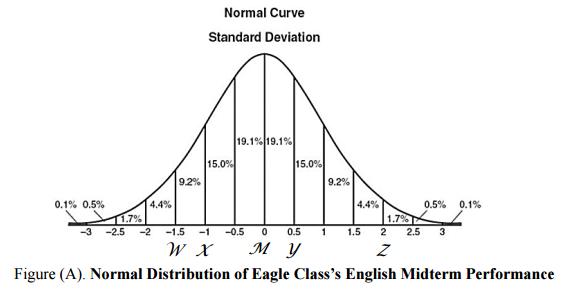 (A) w= 55, x=60, y=80, z=90 (B) Twenty-five students in Eagle Class scored above 60 and passed the English midterm exam. (C) Students who scored within the 90-100 range were as many as students who scored within the 50-60 range. (D) According to the graph, we are 95 percent certain that individual student’s actual score will be within one standard error of 70 points. W X M Y Z