所屬科目:研究所、轉學考(插大)◆普通化學
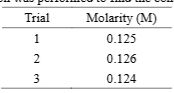
1. A titration was performed to find the concentration of hydrochloric acid with the following results:
Trial Molarity (M) 1 0.125 2 0.126 3 0.124 The actual concentration of HCl was determined to be 0.100 M; the results of the titration are: (A) both accurate and precise. (B) accurate but imprecise. (C) precise but inaccurate. (D) both inaccurate and imprecise. (E) none of these
2. What mass of calcium chloride, CaCl2, is needed to prepare 500 mL of a 1.56 M solution? (Ca: 40.08, Cl: 35.45) (A) 86.6 g (B) 60.8 g (C) 111 g (D) 25.6 g (E) 70.6 g
3. One mole of an ideal gas is expanded from a volume of 1.00 liter to a volume of 10.00 liters against a constant external pressure of 1.00 atm. How much work (in joules) is performed on the surroundings? (T = 300 K; 1 L atm = 101.3 J) (A) 456 J (B) 912 J (C) 2740 J (D) 1824 J (E) none of these
4. Which of the following is not determined by the principal quantum number, n, of the electron in a hydrogen atom? (A) the energy of the electron (B) the minimum wavelength of the light needed to remove the electron from the atom. (C) the size of the corresponding atomic orbital(s) (D) the shape of the corresponding atomic orbital(s) (E) none of these
5. The hybridization of the central atom in SeF4 is: (A) sp (B) sp3 (C) d2 sp3 (D) d2 sp2 (E) dsp3
6. Which of the following has the largest bond order? (A) N2 (B) N2 - (C) N22+ (D) N2 + (E) N22-
7. What statement about equilibrium is true? (A) When two opposing processes proceed at identical rates, the system is at equilibrium. (B) The equilibrium constant is independent of temperature. (C) An endothermic reaction shifts toward reactants when heat is applied. (D) Catalysts shifts the position of an equilibrium. (E) none of these
8. How many moles of solid NaF would have to be added to 2.0 L of 1.90 M HF solution to achieve a buffer of pH 3.0? Assume there is no volume change. (Ka for HF = 1.0 ×10⁻³ ) (A) 3.1 (B) 2.3 (C) 1.6 (D) 1.0 (E) 3.8
9. Find the solubility (in mol/L) of lead chloride (PbCl2) at 25℃. (Ksp = 1.6×10⁻⁵ ) (A) 1.6×10⁻⁵ (B) 1.6×10⁻² (C) 0.025 (D) 0.21 (E) 0.16
10. As water is heated, its pH decreases. This means that (A) the water is no longer neutral. (B) the Kw value is decreasing. (C) the water has a lower [OH- ] than cooler water. (D) the dissociation of water is an endothermic process. (E) none of these
11. The average mass of a boron atom is 10.81. If you were able to isolate a single boron atom, what is the chance that you would randomly get an atom with mass 10.81? (A) 0% (B) 0.81% (C) about 11% (D) 10.81% (E) 1.08%
12. For the hypothetical reactions 1 and 2, K1 = 102 and K2 = 10-4 .
1. A2(g) + B2(g)⇌ 2AB(g)
2. 2A2(g) + C2(g)⇌ 2A2C (g)
3. A2C (g) + B2(g)⇌ 2AB(g) + (1/2)C2(g)
What is the value for K for the reaction 3? (A) 10-2 (B) 104 (C) 106 (D) 102 (E) 10-4
13. The value of the equilibrium constant K depends on
I. the initial concentrations of the reactants.
II. the initial concentrations of the products.
III. the final concentrations of the reactants.
IV. the final concentrations of the products. (A) I, II (B) II, III (C) III, IV (D) I (E) none of these
14. Calculate the [H+] in a 0.010 M solution of HCN, Ka = 6.2 x 10⁻¹⁰. (A) 1.0 x 10⁻⁷ M (B) 2.5 x 10⁻⁶ M (C) 3.6 x 10⁻³ M (D) 6.2 x 10⁻¹⁰ M (E) 2.5 x 10⁻⁵ M
15. The following reaction occurs in basic solution:
Ag(s) + CN- (aq) +O2(g) → Ag(CN)2 - (aq)
When the equation is balanced by using the half-reaction method, the sum of the coefficients is: (A) 10 (B) 20 (C) 18 (D) 16 (E) 23
16. The following reaction occurs in acidic solution:
MnO4 - (aq) + Fe2+(aq) → Fe3+(aq) + Mn2+(aq)
When the equation is balanced by using the half-reaction method, the sum of the coefficients is: (A) 10 (B) 16 (C) 20 (D) 22 (E) 24
17. The rate constant k is dependent on
I. the concentration of the reactant.
II. the nature of the reaction.
III. the temperature.
IV. the order of the reaction. (A) none of these (B) one of these (C) two of these (D) three of these (E) all of these
18. For a reaction at 1 atm
Br2(l) → Br2(g)
Where \(\Delta H^\circ = 31.0\) kJ/mol and \(\Delta S^\circ = 93.0\) J K-1mol-1.
What is the normal boiling point of liquid Br2 ? (A) 25 ℃ (B) 35 ℃ (C) 55 ℃ (D) 10 ℃ (E) 60 ℃
19. A solution of hydrogen peroxide is 30.0% H2O2 by mass and has a density of 1.11 g/cm3. The molarity of the solution is: (A) 7.94 M (B) 8.82 M (C) 9.79 M (D) 10.5 M (E) 0.980 M
20. Which of the metal ions in the following complex ions has a d5 electron configuration? (A).[FeCl6]4– (B).[Cr(CN)6]3– (C).[Ti(H2O)6]2+ (D).[Mo(NH3)6]3+ (E).[Fe(CN)6]3–
21. A metal ion in a weak-field octahedral complex has two more unpaired electrons than the same ion does in a strong-field octahedral complex. Which of the following could the metal ion be? (A) Cr3+ (B)Mn2+ (C)Co2+ (D)Ti2+ (E)Cu2+
22. Which of the following complexes will absorb visible radiation of the highest energy (shortest wavelength)? (A) [Co(Br)6]3– (B) [Co(NH3)6]3+ (C) [Co(I)6]3– (D) [Co(H2O)6]3+ (E) [Co(CN)3]3-
23. Which of the following statements is true about the octahedral complexes of Ni2+? (A) Both strong- and weak-field complexes are paramagnetic. (B) The strong-field complex is paramagnetic and the weak-field complex is diamagnetic. (C) Both strong- and weak-field complexes are diamagnetic. (D) The strong-field complex is diamagnetic and the weak-field complex is paramagnetic. (E) none of these
24. Silver crystallizes in a cubic closet packed structure. The radius of a silver atom is 144pm. Calculate the density of solid silver. (The atomic mass of silver is 107.9 g/mol) (A)10.6 g/cm3 (B)12.5 g/cm3 (C) 6.05 g/cm3 (D) 14.6 g/cm3 (E)16.5 g/cm3
25. Calculate activation energy, Ea (kcal/mol) for a reaction whose rate at room temperature (298 K) is doubled by a 20℃ increase in T. (ln 2 =0.693, R = 8.314 J mol-1 K-1 ) (A)12.3KJ/mol (B) 16.3KJ/mol (C) 20.5KJ/mol (D) 14.2KJ/mol (E) 27.3KJ/mol
 阿摩線上測驗
登入