所屬科目:研究所、轉學考(插大)◆生物化學
1. Glutamic acid has three pKa at 2.10, 4.07, and 9.47. The isoelectric point of this amino acid is(A) 3.09(B) 6.77(C) 5.79(D) 5.20
2. Which is the most basic amino acid?(A) Asp(B) Asn(C) Gln(D) Arg
3. The coding region of a mature mRNA is 900 nucleotides. How big is the protein made from this mRNA? (A) Approximate 9 KDa (D) Approximate 2700 KDa (B) Approximate 33 KDa (C) Approximate 610 KDa
4. Proteins absorb ultra-violate light at about 280 nm because they contain certain amino acids, which are (A) Asp and Asn (B) Tyr and Trp (C) Lys and Arg (D) Pro and Phe
5. Mercaptoethanol can be used to(A) break disulfide bond. (B)interrupt hydrophobic interaction. (C) neutralize charge.(D) chelate metal ions.
6. Glycogen phosphorylase can be converted from inactive form to active form by(A) methylation (B) glycosylation (C) phosphorylation (D) enzymatic hydrolysis
7. A circular plasmid DNA has two Xhol sites and three BamHI sites. How many fragments would the plasmid generate after treatment with the two restriction enzymes? (A) 3 (B) 4 (C) 5 (D) 6
8. The "dideoxynucleotides" for Sanger sequencing has deoxy sites at(A) 1, 2(B) 2, 4(C) 2, 3(D) 3', 5'
9. In a nucleotide, the ribose links to the base through a(A) glycosidic bond (B) phosphodiester bond (C) disulfide bond (D) ionic bond
10. In an enzyme, which amino acid is frequently involved in acid-base catalysis?(A) Tyr(B) His(C) Cys(D) Pro
11. According to current hypothesis, an enzyme reduces active energy and enhances reaction rate by association with (A) substrate. (B) transition state. (C) product. (D) cofactor.
12. Deficiency of hypoxanthine-guanine phosphoribosyl transferase results in increase of purine de novo synthesis because the deficiency (A) impairs purine salvage mechanism. (B) inhibits phosphorylation of dGDP. (C) blocks the conversion from GDP to dGDP. (D) reduces generation of uric acid.
13. The net reaction for one turn of the urea cycle is as follows:CO2 + NH4+ + 3ATP + X + 2H2O→ urea + 2ADP + AMP + fumarate;What is the molecule X?(A) glutamate(B) arginine(C) aspartate(D) phenylalanine
14. A ketogenic amino acid can(A) generate pyruvate.(B) generate glucose through gluconeogenesis.(C) increase the supply of oxaloacetate. (D) generate acetyl-CoA.
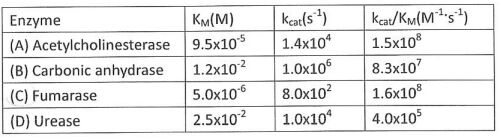
15. Which of the enzyme listed in the table has the highest affinity to substrate?
16. A competitive inhibitor __ of the enzyme.(A) does not affect Km(B) reduces Km(C) reduces the affinity with substrates(D) does not affect Vmax
17. What biomolecules on the surface of erythrocytes determine ABO blood group?(A) Polysaccharides(B) lipids(C) peptides(D) nucleic acids
18. Proteins to be degraded by proteasome need the label of a stretch of(A) glucose(B) ubiquitins(C) biotin(D) glycosylation
19. Which description about type I topoisomerase is correct?(A) It changes one linking number at a reaction. (B) It cuts two strands of DNA at a reaction.(C) It needs NADPH as a cofactor. (D) It changes twist but not writhe on the target DNA.
20. If a pyruvate obtains an a-amino group through transamination, it would change into(A) an aspartate.(B) a glycine.(C) a serine.(D) an alanine.
21. Life forms that obtain carbon by intake of complex organic molecules are(A) herbivorous(B) heterotrophic(C) benthic(D)heterogeneous
22. Which of the following ion does ATP normally complex with in biochemical reaction?(A) Mg2+(B)Fe2+(C)Fe3+(D)Co2+
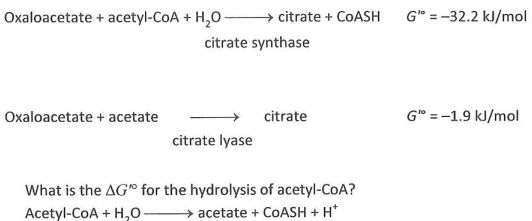
23. The AG values for the two reactions shown below are given.(A) -34.1 kJ/mol (B) -32.2 kJ/mol (C) -30.3 kJ/mol (D) +61.9 kJ/mol
24. How many heme groups does cytochrome aa3 contain? (A) 3 (B) 2 (C) 1 (D) 4
25. Consider the section of the TCA cycle in which isocitrate is converted to fumarate. This segment of the TCA cycle can be best described by which one of the following statements? (A) These reactions yield 5 moles of high energy phosphate bonds per mole of isocitrate. (B) These reactions require a coenzyme synthesized in the human from niacin (nicotinamide) (C) These reactions are catalyzed by enzymes located solely in the mitochondrial membrane. (D) These reactions require GTP to drive one of the reactions.
26. In the TCA cycle, a role for thiamine pyrophosphate is which one of the following?(A) To accept electrons from the oxidation of pyruvate and a-ketoglutarate(B) To accept electrons from the oxidation of isocitrate(C) To form a covalent intermediate with the a-carbon of a-ketoglutarate(D) To form a thioester with the sulfhydryl group of CoASH
27. Which one of the following cofactors or enzyme complexes would be most affected by this condition? (A) The concentration of NAD* (B)The concentration of FAD (C) The concentration of coenzyme Q (D)The functioning of the cytochrome-containing components of complex III
28. To reverse the symptoms described, a diet rich in which one of the following food should be recommended? (A) Green, leafy vegetables (B) Whole grains and meat (C) Citrus fruits (D) Chocolate cake
29. A firefighter is brought to the emergency room (ER) from the scene of a fire, and he complains of headaches, weakness, confusion, and difficulty in breathing. His skin and mucous membranes appear very pink/red. The causative agent of these symptoms inhibits electron transport and oxidative phosphorylation by which one of the following mechanisms? (A) Uncoupling of electron transport and phosphorylation (B) Combining with NADH dehydrogenase (C) Combining with cytochrome oxidase (D) Combining with coenzyme Q
30. Which one of the following metabolites does the pentose phosphate pathway generate? (A) NADH, which may be used for fatty acid synthesis. (B)Pyruvate and fructose 1,6-bisphosphate by the direct action of transaldolase and transketolase. (C) Ribose-5-phosphate, which may be used for the biosynthesis of ATP. (D) Glucose from ribose-5-phosphate and CO2.
31. Which one of the following occurs during the conversion of pyruvate to glucose during gluconeogenesis? (A) Biotin is required as a cofactor. (B) The carbon of CO2, added in one reaction, appears in the final product. (C) Energy is utilized only in the form of GTP. (D) All of the reactions occur in the cytosol.
32. An individual in the basal metabolic state ingests a large amount of glucose. If he/she displays a normal response, this ingestion results in which one of the following? (A) Enhanced glycogen synthase activity in liver (B) An increased ratio of phosphorylase a to phosphorylase b in the liver (C) Inhibition of PP-1 activity in the liver (D) Increased activity of CREB
33. Which of the following clinical condition can the deficiency of glucose-6-phosphate dehydrogenase cause? (A) Pernicious anemia (B) Hemolytic anemia (C) Hemorrhages (D) Blindness
34. The steroid receptors are normally:(A) Gated ion channels (B) Serpentine receptors (C) Nuclear receptors (D) Intrinsic receptors
35. Assume there is a microRNA that regulates the expression of a particular cyclin kinase inhibitor. How might an alteration in this microRNA lead to uncontrolled cell proliferation? (A) Overexpression of the microRNA, so it acts as an oncogene. (B) Reduced expression of the microRNA, so it acts as a tumor suppressor. (C) A total loss of activity of the microRNA, so it cannot bind to its target mRNA. (D) A loss of specificity of the microRNA for its target, so different mRNAs are not targeted.
36. Which of the following factors does the formation of initiation complex during protein translation in bacterium require? (A) IF-3 (B) EF-Tu (C) EF-Ts (D) CTP
37. Which of the following cofactors is involved in various steps of protein translation?(A) AMP(B) ATP(C) GTP(D) UTP
38. Prokaryotic DNA dependent RNA polymerase is inhibited by the antibiotic:(A) Puromycin(B) Rifamycin (C) Terramycin(D) Streptomycin
39. Modification of a primary mRNA transcript in human cell does not normally involve:(A) synthesis of a long poly( A )sequence at the 3' end.(B) conversion of normal bases to modified bases, such as inosine and pseudouridine.(C) intron removal.(D) splicing.
40. Which of the following molecular technique is used for studying transcription factor-DNA interaction? (A) Electrophoretic mobility shift assay (B) Immunoblotting (C) Fluorescence in situ hybridization (D) Southern blotting
41. Which one of the followings is the major storage form of fat in the body?(A) Triglycerides(B) Phospholipids(C) Ceramides(D) Starch
42. Which one of the followings is an essential fatty acid?(A) Palmitic acid(B) linoleic acid(C) Lauric acid(D) Stearic acid
43. How many Ca2+ ion binding sites could be found in calmodulin?(A) 1(B) 2(C) 3(D) 4
44. Which one of the followings could be synthesized by the skin after exposure to sunlight?(A) Vit D2(B) Vit D3(C) Vit C(D)1a, 25-dihydroxycholecalciferol
45. Which one of following ions could be transported by valinomycin?(A) Na+(B) K+(C) Ca++(D)Mg++
二、簡答題(10分)1. With the help of a diagram, please describe how mitogen-activated protein kinase is activated.
 阿摩線上測驗
登入