所屬科目:研究所、轉學考(插大)-分析化學
2. Which of the following statements about the Interational System of Units (St) is (are) correct? (AB) The SI is based on seven fundamental base units. (AC) The angstrom unitis a SI unit of length. (AD) The mole is a SI unit for the amount of a chemical substance. (AE) Not all non-SI units can be derived from the base units of SI. (BC) The SI base unit of temperature is Celsius. (BD) The SI base unit of mass is gram.
3. Which of the following statements about analytical calculations is (are) correct? (AB) Mass is a variant measure of the quantity of matter in an object, while weight is the force of attraction between an object and its sur undings, principally the carth. (AC) The molar mass of a substance is the mass in amu of I mole of that substance. (AD) The molar analytical concentration of a solution gives the total number of millimoles in 1 mL of the solution. (AE) The prefix giga- for units is abbreviated as G and represents the multiplier of . (BC) The pH is a p-function and is the negative logarithm of [H+]. (BD) The specific gravity is the ratio of the mass of a substance to the mass of an equal volume of water at 0℃.
expected to lie within a certain probability.
on the mass obtained from a_______. specifically when the error has its origin in the difference in___________force exerted by the medium (air) on the object and on the masses.
(d)_______ -balance equations relate the_________concentrations of various species in a solution to one another and to the analytical concentrations of the various____________.
Ill. Full names of abbreviations
13. Write down the full names in English of the following abbreviations used in analytical chemistry:
(a) ppt. (b) CL, (c) RSD, (d) LOL, (e) EDTA, (I SCE, (8) NHE, (h) RDE, (i) DME, 6) UV, (k) FTIR, (I) PMT. (m) CCD
(13%)
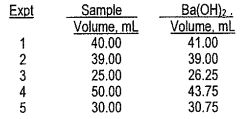
14. The HE solution is titrated with a 0.2000 M Ba(OH)2 solution. The results of the titration experiments are shown below.
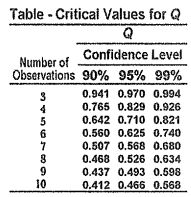
(a) Calculate the mean w/v percentage of the monoprotic acid in the dilute solution. (b) Use Q test to decide if any anomalous result exists
that should be rejected at the 95% confidence level. (Heavy penalty will be applied if this test is not performed.) (c) Calculate the standard
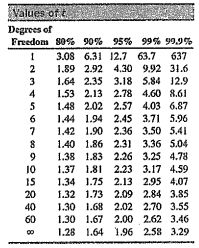
deviation for the results. (d) Calculate the 95% confidence interval for the mean. (e) Assume that the buret used to measure out the acid
solution has a systematic error of -0.05 mL at all volumes delivered and no other sources of errors exist in the experiments. Calculate the
systematic error in the mean result. (See the related tables in the next page.) (13%)
15. Assume that the conjugate base, E', of the monoprotic acid can be used as complexing agent for determination of using a direct titration method. An experiment is planned in which standard aqucous solutions ofare prepared and Eriochrome Black T (EBT) is employed as the indicator. In general, there are two types of direct titration
(non-potentiometric) methods for quantifying metal ions using a complexing agent, depending on the availability of suitable indicators. (a) Using the titration of as an cxample, describe the chemistry and the conditions of use for the two different direct titration methods when a complexing agent E" is used. (b) Sketch and properly label a titration apparatus that can be used in a direct potentiometric titration of with E-. (c) Why should an auxiliary complexing agent be used in this titration?
(d) What is the condition of use for the auxiliary complexing agent? (e) The electrode potential of the apparatus you sketched in
(b) is expected to change during the titration. (i) Based on the Nernst expression of the electrode potential, which often involves both the reduced and the oxidized states, is formality, species molarity, or activity obtained from the titration? Define these three terms before explanation. (ii) Will a color change be observed if a general redox indicator is also present in the solution of your apparatus? Explain. (f [Cu(NH3)4H2O]SO4 (FM 245.75) can be prepared by adding concentrated solution of ammonia to a saturated aqueous solution of copper sulfate followed by precipitation of the product with ethanol. What is the number of reacting units (eq/mol) for NH3 in the reaction of the preparation? (g) 0.983 g [Cu(NH3)4H2O]SO4 is dissolved in 100.0 mL aqueous solution that contains 0.200 M in NH3. Calculate the potential of a copper electrode immersed in the solution. (β4 for 0.337 V)(h) Assume that both and Et solutions are 0.100 M in NH3 and 0.175 M in NH4CI to provide a constant pH of 9.0. Without actually going through the calculation, show the calculation procedure for determining pCu at the equivalent point when the complexing agent E- is employed to titrate . In the procedure, use your defined symbols to show variables whose values are not provided in the question. (27%)
 阿摩線上測驗
登入
 is a SI unit of length.
(AD) The mole is a SI unit for the amount of a chemical substance.
(AE) Not all non-SI units can be derived from the base units of SI.
(BC) The SI base unit of temperature is Celsius.
(BD) The SI base unit of mass is gram.
 .
(BC) The pH is a p-function and is the negative logarithm of [H+].
(BD) The specific gravity is the ratio of the mass of a substance to the mass of an equal volume of water at 0℃.

 using a direct titration method. An experiment is planned in which standard aqucous solutions of
 are prepared and Eriochrome Black T (EBT) is employed as the indicator. In general, there are two types of direct titration
 0.337 V)(h) Assume that both