所屬科目:研究所、轉學考(插大)-分析化學
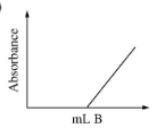
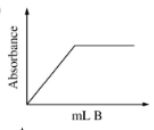
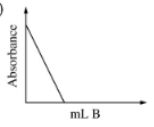
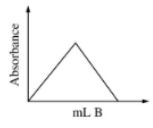
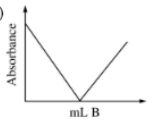
1. To determine the concentration of analyte A, the sample is titrated with the titrant B. Since both A and B can absorb electromagnetic radiation of 550 nm, the end point is to be detected spectrophotometrically at 550 nm. The shape of the titration curve at 550 nm would most closely resemble which of the following?(A) (B)(C)(D)(E)
2. Which of the following types of spectroscopy is a light-scattering technique? (A) Nuclear magnetic resonance (B) Infrared spectroscopy (C) Raman spectroscopy (D) Electron paramagnetic resonance (E) UV-Vis spectroscopy
3. The vitamin C content in a bottle of juice is determined by a titration method with potassium iodate based on the following equations. The total volume of juice is 500 mL and a portion of 100 mL is titrated with 0.01 M KIO3(aq) in the acidic condition. The volume of titrant required to reach the end point is 20.00 mL. Calculate the mass of vitamin C in the bottle of juice. (The molecular weight of vitamin C is 176 g/mol.)
\( \mathrm{KIO_3} + 5\mathrm{KI} + 6\mathrm{H^+} \longrightarrow 3\mathrm{I_2} + 6\mathrm{K^+} + 3\mathrm{H_2O} \)
\( \mathrm{C_6H_8O_6} + \mathrm{I_2} \longrightarrow \mathrm{C_6H_6O_6} + 2\mathrm{I^-} + 2\mathrm{H^+} \)
(A) 0.1056 g (B) 0.528 g (C) 0.176 g (D) 0.0352 g (E) None of the above
4. Which of the following combination gives the greatest buffer capacity? (A) 0.05 M CH3COOH (B) 0.05 M CH3COONa (C) 0.01 M CH3COOH/CH3COONa (The mole ratio of CH3COOH/CH3COONa is 1.) (D) 0.05 M CH3COOH/CH3COONa (The mole ratio of CH3COOH/CH3COONa is 1.) (E) 0.05 M CH3COOH/CH3COONa (The mole ratio of CH3COOH/CH3COONa is 5.)
5. For EDTA titrations, the analyte solution and the titrant solution are bother buffered at the same pH for which of the following reasons? I. The conditional formation constant is affected by pH. II. The fraction of EDTA in the fully deprotonated Y4- form varied with pH. III. When EDTA reacts to form a metal complex, H+ is a product in most cases. (A)I only (B) I and II only (C) I and III only (D) II and III only (E) I, II, and III
6. The following reactions are spontaneous and thus proceed to the right, as written:
\( 2\text{H}^+ + \text{Cd}_{\text{(s)}} \rightleftharpoons \text{H}_2 + \text{Cd}^{2+} \)
\( 2\text{Ag}^+ + \text{H}_{2\text{(g)}} \rightleftharpoons 2\text{Ag}_{\text{(s)}} + 2\text{H}^+ \)
\( \text{Cd}^{2+} + \text{Zn}_{\text{(s)}} \rightleftharpoons \text{Cd}_{\text{(s)}} + \text{Zn}^{2+} \)
What can we deduce regarding the strengths of H+ , Ag+ , Cd2+, and Zn2+ as oxidizing agents? (A)Ag+ > H+ > Cd2+ > Zn2+ (B) Cd2+ > Zn2+ > Ag+ > H+ (C) Zn2+ > Cd2+ > H+ > Ag+ (D) Zn2+ > Cd2+ > Ag+ > H+ (E) None of the above
7. Plants selectively synthesize alkanes with an odd number of carbon atoms. The concentration of C29H60 in summer rainwater collected in Hannover, Germany is 23 μM. How many ppm of C29H60 are in 23 μM C29H60? (The molecular mass of C29H60 is 408.8 g/mol.) (A) 0.023 ppm (B) 23 ppm (C) 9.4 ppm (D) 0.0094 ppm (E) None of the above
(二) Short answer question1. State and explain the influence of temperature and solvent viscosity on the quantum efficiency of fluorescence. (4%)
 阿摩線上測驗
登入
 (B)
 (C)
 (D)
 (E)