所屬科目:台大◆化工◆輸送現象及單元操作
3. Which of the followings is NOT an assumption of the McCabe-Thicle method? (A) Components have similar values (B) Molar flowrates of vapor and liquid are constant in the rectifying section. (C) Distillation column is well-insulated. (D) There is a significant pressure drop in the column.
4. Which of the followings is the volume-surface means diameter of a mixture of particles?(A) (B)(C)(D) xi: mass fraction in a given increment; N: number of particles in a fraction; NT: total particle number; : average particle diameter in an increment
7.Aconical tank with a bottom opening of cross-sectional area A is filled with water and is mounted on supports as shown in the figure. What is the force F with which plate X must be pushed up to prevent water from leaking? Assume that the density of air is negligible as compared to the density of water pL. Support (A) PL• Vg (B) PL• Vg/2 (C) PL• A·Hg (D) pL• AHg/2
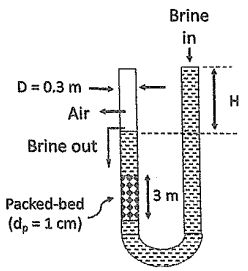
(a) What is the void fraction (ε) of the packed bed? (3 pts)
(c) What is the water level of the brine inlet above the top of the brine outilet (H)? (6 pts)
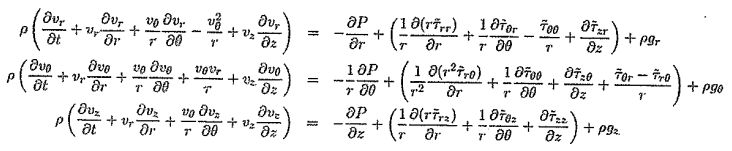
(2) Write down the boundary conditions. (5 points) Equation of continuity: Equation of motion:
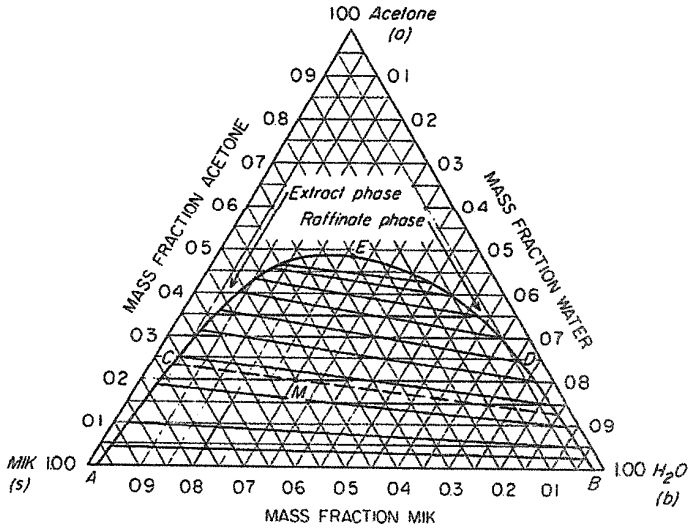
Problem8 Fill-in-the-Blank (10 points) A countercurrent extraction plant is used to extract acetone from its mixture with water by means of methyl isobutyl ketone (MIK) at a temperature of 25℃. The feed consists of 40 percent acetone and 60 percent water. Pure solvent equal in mass to the feed is used as the extracting liquid. In such an extraction process, you need (a) 5pt ideal stages to extract 99 percent of the acetone fed, and the extract composition is (b) 5pt... after removal of the solvent. (Hint. The following phase diagran can be used)
Problem 9 Fill-in-the-Blank (5 points) Tests are made on the absorption of carbon dioxide from a carbon dioxide-air mixture in a solution containing 100 kg/m3 of caustic soda, using a 250 mm diameter tower packed to a height of 3 m with 19 mm Raschig rings. The results obtained at atmospheric pressure were: Gas rate, G' - 0.34 kg/m2•s. Liquid rate, L' = 3.94 kg/m2•s. The carbon dioxide in the inlet gas was 315 parts per million and the carbon dioxide in the exit gas was 31 parts per million. Therefore the valve of the overall gas transfer coefficient KGa is(a) 5pt
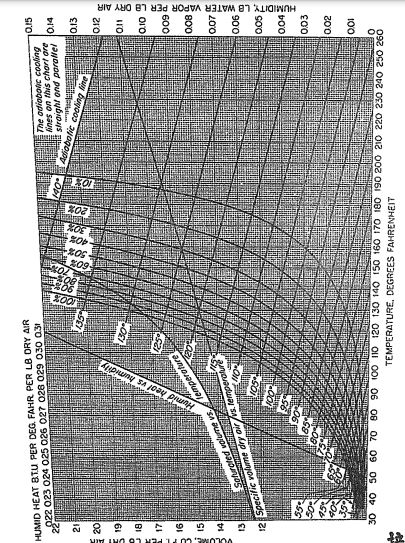
Problem 10 Fill-in-the-Blank (10 points) 0.126 kg/s of a solid product containing 4 per cent water is produced in a dryer from a wet feed containing 42 per cent water on a wet basis. Ambient air at 294 K and of40 per cent relative humidity is heated to 366 K in a preheater before entering the dryer from which it leaves at 60 per cent relative humidity. Assuming that the dryer operates adiabatically, what must be the flowrate of air to the preheater (a) 2pt ? and how much heat must be added to the preheater (b) 3pt ? Conditions change if the air enters the dryer at 340 K and sufficient heat is supplied within the dryer so that the air again leaves at 340 K with a relative humidity of 60 per cent, what must be the flowrate of air to the preheater (c) 2pt ? and how much heat must be added to the preheater (d) 3pt ? (Hint. The following humidity chart can be used)
Problem 11 Fill-in-the-Blank (10 points) A continuous rectifying column handles a mixture consisting of 40 per cent of benzene by mass and 60 per cent of toluene at the rate of 4 kg/s, and separates it into a product containing 97 per cent of benzene and a liquid containing 98 percent toluene. The feed is liquid at its boiling-point. In such an operation the mass flow of distillate is (a) 2ptand the mass flow of waste liquor is(b) 2pt . If a reflux ratio of 3.5 is employed, (c) 3pt plates are required in the rectifying part of the column. Ifthe plate-efficiency is now requires 60 percent, then (d) 3pt actual number of plates are needed.
 阿摩線上測驗
登入
 values
(B) Molar flowrates of vapor and liquid are constant in the rectifying section.
(C) Distillation column is well-insulated.
(D) There is a significant pressure drop in the column.
 (B)
 (C)
 (D)

 : average particle diameter in an increment
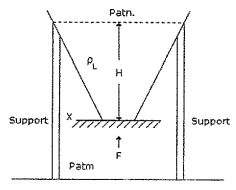 (A) PL• Vg
(B) PL• Vg/2
(C) PL• A·Hg
(D) pL• AHg/2