阿摩線上測驗
登入
首頁
>
教甄◆英文科
> 111年 - 國立清華大學附設實驗國民小學 111 學年度教師甄選英語教育專業科目試題#107944
111年 - 國立清華大學附設實驗國民小學 111 學年度教師甄選英語教育專業科目試題#107944
科目:
教甄◆英文科 |
年份:
111年 |
選擇題數:
20 |
申論題數:
4
試卷資訊
所屬科目:
教甄◆英文科
選擇題 (20)
1. The symbols [p] and [pʰ] in English are in ________. (A) contrastive distribution (B) overlapping distribution (C) contemporary distribution (D) complementary distribution
2. It’s best to ____ your own tea than to buy bottled teas, which are full of sugar. (A) brew (B) leach (C) marinade (D) saute
3. Going vegan may not be as hard as you first thought as many of your favorite snacks could already be _____. (A) unintentional vegan-friendly (B) unintentional friendly-vegan (C) unintentionally vegan-friendly (D) vegan-friendly unintentional
4. In this activity, a team member tries to communicate to the others a particular word or phrase by expressing the word or phrase using silent actions. (A) charade (B) information gap activities (C) jigsaw activities (D) minimal pairs
5.Today L2 teachers use pictures and props to help students understand. This was originally from ____. (A) The Audiolingual Method (B) Communicative Language Teaching (C) The Direct Method (D) Grammar Translation Method
6. What is this method? Memorized dialogues and pattern drills help reinforce structural patterns. The teacher would present the correct model of a sentence and the students would have to repeat it. The teacher would then continue by presenting new words for the students to practice in the same structure. (A) Audiolingualism (B) The Direct Method (C) Communicative Language Teaching (D) Total Physical Response
7. _____ are words that sound the same when spoken, but have different meanings and are spelled differently. (A) Homophones (B) Homographs (C) Homonyms (D) Synonyms
8. In Content and Language Integrated Learning, the 4Cs principles are proposed to guide teachers to design lessons. Which of the following is not among the four Cs? (A) content (B) cognition (C) context (D) culture
9. Phonological awareness is: (A) a person’s ability to manipulate sound structures of speech (B) a person’s ability to hear sound structures of speech (C) a print-free skillset (D) all of the above
10. Which is NOT part of the writing process? (A) brainstorming (B) re-reading (C) revising (D) making inferences
11. Cooperative learning involves students working together: (A) as partners (B) in small groups (C) on defined tasks (D) all of the above
12. When students “understand that people around the world are different and shaped by different circumstances and cultural influences”, what aspect of global competence do the students demonstrate? (A) Respect for difference (B) Intercultural knowledge (C) Empathy (D) Self-awareness
13. The teacher introduces new vocabulary and a grammar structure. Students complete exercises in their books. Then the teacher checks their answers. The teacher asks students to compare their answers with other classmates. What language teaching method is this? (A) Presentation Practice Production (B) Grammar Translation (C) Direct Method (D) Task-Based Language Teaching
14. A teacher writes an instructional objective as: By the end of this lesson, the students will be able to use verbs in the sentences. The subdomains or level of learning in which the objective will fall is: (A) knowledge (B) comprehension (C) application (D) analysis
15. There are lots of ways we can look after our planet. Three great ways are 'the three Rs': Reduce! Reuse! Recycle! We throw away too many things and make too much rubbish. Lots of the things we throw in the bin ______thousands of years to go away. (A) for (B) spend (C) take (D) needs
16. The process of going from one language to the other in mid-speech when both speakers know the same two languages is called __________. (A) aphasia (B) codeswitching (C) scaffolding (D) convergence
17. We really enjoyed the new movie, especially the performances. The lead actor’s __________ of a famous painter was exquisite. (A) manner (B) procedure (C) portrayal (D) substance
18. Which of the following may NOT be a strategy for enhancing and maintaining students’ motivation? (A) Make learning stimulating and enjoyable for the learner by increasing the attractiveness of the tasks. (B) Create specific roles and personalized assignments for every student. (C) Use contracting methods with the learners to formalize their commitment. (D) Increase students’ social comparison, even in its subtle forms, and put students in the spotlight unexpectedly and allow them to receive criticism.
19. In the following linguistic explanations which is NOT true? (A) The prefixes un- and dis- can form the opposites of verbs, e.g., tie/untie, appear/disappear, agree/disagree, fold/unfold. (B) The prefixes in- (and its variations) always have a negative meaning, e.g., impatient, illegal, internal, import, insert, income. (C) Many words in English are formed from Latin roots, e.g., respect, suspect (spect-see); transport, support (port-carry). (D) Drinkable and edible are adjectives because of their suffixes, and modernize and industrialize are verbs because of their suffixes.
20.Which of the following statements concerning CLIL (Content and Language Integrated Learning) is NOT true? (A) CLIL is an approach with many methodologies. (B) Communication in CLIL aims to develop skills to express ideas in curricular subjects. (C) In the CLIL classroom, BICS (Basic Interpersonal Communicative Skills) is not required, and often keeps learners from reaching their academic L2 goals. (D) Studying curricular subjects in CLIL helps learners understand new subject knowledge in addition to language.
申論題 (4)
貳、申論題:
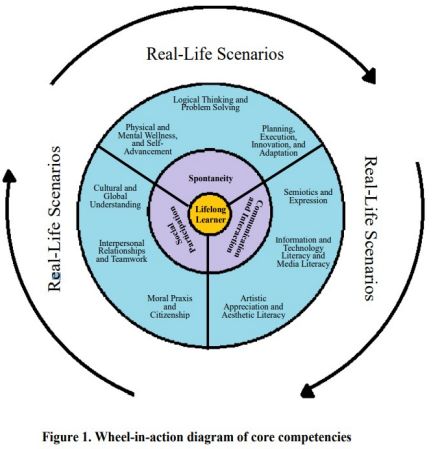
1. In Taiwan, the concept of core competencies in Curriculum Guidelines of 12-Year
Basic Education emphasizes lifelong learning. These competences are divided into
three broad dimensions, namely, spontaneity, communication and interaction, and
social participation.
(The above sentences and the figure are from Curriculum Guidelines of 12-Year Basic
Education at https://cirn.moe.edu.tw/Upload/file/32077/83646.pdf.)
Design an English lesson (40 minutes to 80 minutes) aligning with the core competences.
Plan teaching procedures and design activities to teach students the theme of Earth Day.
(1) Why do we need to establish classroom routines?
(2) What are your classroom routines, and
(3) how do you develop or teach them to your students?
相關試卷
115年 - 115-1國立東華大學附設實驗國民小學_教師甄選試題:英文#143447
115年 · #143447
115年 - 115-2 國立基隆高級中學_正式教師甄選試題:英文科#142615
115年 · #142615
115年 - 115 國立嘉科實驗高級中等學校_教師甄選試題:高中英文科#141942
115年 · #141942
115年 - 115 金門縣國民中學正式教師聯合甄選:英語文#141578
115年 · #141578
115年 - 115 高雄市市立國民中學教師聯合甄選試題:英語#141556
115年 · #141556
115年 - 115 臺南市市立國民中學正式教師聯合甄選試題:英語文#141326
115年 · #141326
115年 - 115 桃園市國民中學新進教師甄選試題:英文科#140721
115年 · #140721
115年 - 115 臺北市立華江高級中學 _正式教師甄選﹕英文科#140673
115年 · #140673
115年 - 115 臺北市市立國民中學_正式教師聯合甄選: 英文#140599
115年 · #140599
115年 - 115 中區縣市政府教師甄選策略聯盟_國中:英語科#140388
115年 · #140388
 阿摩線上測驗
登入