所屬科目:研究所、轉學考(插大)◆工程數學
(a)Cramer’s Rule (10%)
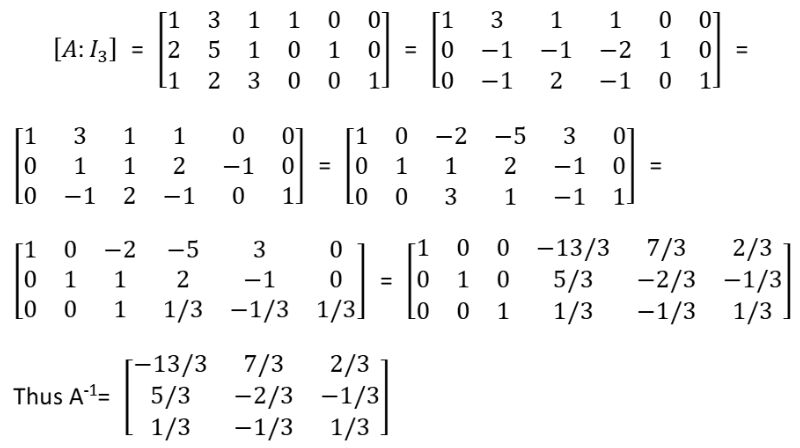
(b)Gauss-Jordan Elimination (5%)
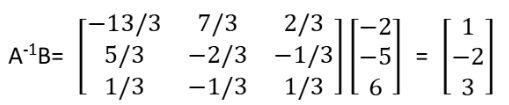
(c)the inverse of the matrix (10%)
2. Solve the following system of linear differential equations (25%).
3. Solve the ODE:\( 2x^2y'' + 4xy' + 2y = 0 \)(25%)
4. Solve the ODE:: \(y' + \frac{\sin x}{\cos x} y\)= 2 sin x cos x (25%)
(a) The matrix of coefficients A and column matrix of constants B are
$A = \begin{bmatrix} 1 & 3 & 1 \\ 2 & 5 & 1 \\ 1 & 2 & 3 \end{bmatrix}$ and $B = \begin{bmatrix} -2 \\ -5 \\ 6 \end{bmatrix}$
It is found that |A| = –3 ≠ 0. Thus Cramer’s rule can be applied. We get
\(A_1 = \begin{bmatrix} -2 & 3 & 1 \\ -5 & 5 & 1 \\ 6 & 2 & 3 \end{bmatrix}\) \(A_2 = \begin{bmatrix} 1 & -2 & 1 \\ 2 & -5 & 1 \\ 1 & 6 & 3 \end{bmatrix}\) \(A_3 = \begin{bmatrix} 1 & 3 & -2 \\ 2 & 5 & -5 \\ 1 & 2 & 6 \end{bmatrix}\)
giving \(|A_1| = -3, |A_2| = 6, |A_3| = -9\) 。Cramer’s rule now gives
\(x_1 = \frac{|A_1|}{|A|} = \frac{-3}{-3} = 1, x_2 = \frac{|A_2|}{|A|} = \frac{6}{-3} = -2, x_3 = \frac{|A_3|}{|A|} = \frac{-9}{-3} = 3\)
(b)
(c)
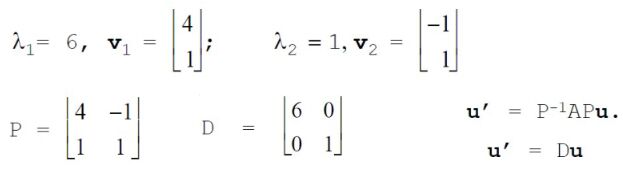
2. Solution initial condition;
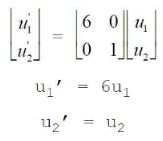
We have transformed the original system into a diagonal system.
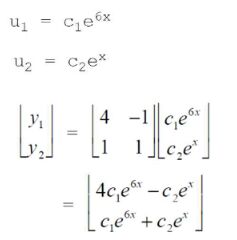
The solution to this diagonal system of linear differential equations
(as in example 1) is
The general solution to the system of linear differential equations is
\(y_1 = 4c_1e^{6x} - c_2e^x\)
\(y_2 = c_1e^{6x} + c_2e^x\)
3. Solution
4. Solution
Integrate factor \( I(x) = e^{\int \tan x dx} = e^{-\ln \cos x} = \cos^{-1} x \)
 阿摩線上測驗
登入